$F$-manifolds with eventual identities, bidifferential calculus and twisted Lenard-Magri chains
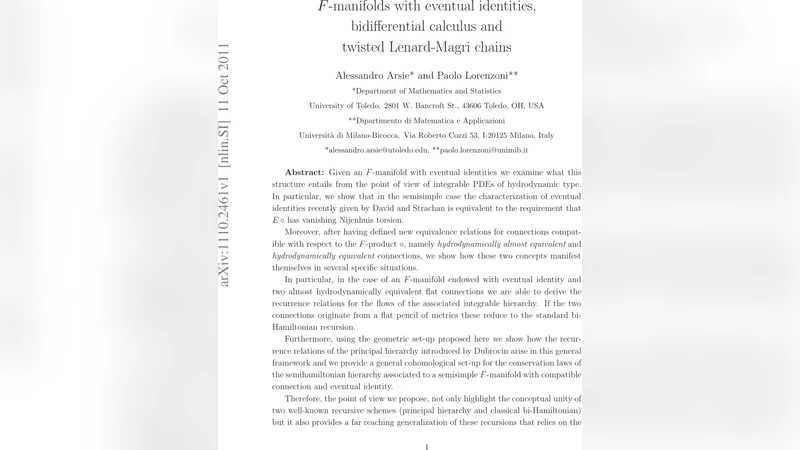
Given an $F$-manifold with eventual identities we examine what this structure entails from the point of view of integrable PDEs of hydrodynamic type. In particular, we show that in the semisimple case the characterization of eventual identities recently given by David and Strachan is equivalent to the requirement that $E\circ$ has vanishing Nijenhuis torsion. Moreover, after having defined new equivalence relations for connections compatible with respect to the $F$-product $\circ$, namely hydrodynamically almost equivalent and hydrodynamically equivalent connections, we show how these two concepts manifest themselves in several specific situations. In particular, in the case of an $F$-manifold endowed with eventual identity and two almost hydrodynamically equivalent flat connections we are able to derive the recurrence relations for the flows of the associated integrable hierarchy. If the two connections originate from a flat pencil of metrics these reduce to the standard bi-Hamiltonian recursion. Furthermore, using the geometric set-up proposed here we show how the recurrence relations of the principal hierarchy introduced by Dubrovin arise in this general framework and we provide a general cohomological set-up for the conservation laws of the semihamiltonian hierarchy associated to a semisimple $F$-manifold with compatible connection and eventual identity. Therefore, the point of view we propose, not only highlight the conceptual unity of two well-known recursive schemes (principal hierarchy and classical bi-Hamiltonian) but it also provides a far reaching generalization of these recursions that relies on the presence of an eventual identity.
💡 Research Summary
The paper investigates the interplay between F‑manifolds equipped with eventual identities and integrable systems of hydrodynamic type. An eventual identity is a vector field E on an F‑manifold (M, ∘) such that the endomorphism V := E∘ is invertible and satisfies certain compatibility conditions. The authors first recall the definition of an F‑manifold and the notion of a compatible (generally non‑metric) connection ∇. They then extend the classical Frölicher–Nijenhuis bicomplex to differential forms with values in the tangent bundle, introducing two exterior covariant derivatives d∇ and dL∇, where L is a (1,1)‑tensor. When ∇ is flat and L has vanishing Nijenhuis torsion, the pair (d∇, dL∇) forms a bidifferential complex: d∇² = 0, dL∇² = 0 and d∇ dL∇ + dL∇ d∇ = 0.
In the semisimple case, the recent characterization of eventual identities by David and Strachan (which requires that the eigenvalues of V are distinct and that V satisfies a specific algebraic condition) is shown to be equivalent to the requirement that V has zero Nijenhuis torsion. Consequently, V defines a Nijenhuis operator and the associated bidifferential complex can be built from ∇ and V.
The authors introduce two new equivalence relations for connections on a semisimple F‑manifold with an eventual identity: “hydrodynamically almost equivalent” and “hydrodynamically equivalent”. The former means that two connections give rise to the same semi‑Hamiltonian hierarchy (in the sense of Tsarev), while the latter imposes a stronger condition that leads to identical principal hierarchies. In the presence of two flat, almost‑equivalent connections ∇(1) and ∇(2) together with the eventual identity E, they derive recursion relations for the flows of the associated integrable hierarchy. If the two connections come from a flat pencil of metrics, these recursion relations reduce to the classical bi‑Hamiltonian Lenard‑Magri scheme.
A cohomological framework is developed for the conservation laws of the semi‑Hamiltonian hierarchy. Densities ρ satisfy d∇ ρ = 0, and when a second compatible flat connection exists, an extra recursion dV∇ ρ_{k+1} = d∇ ρ_k appears, where V = E∘. This structure mirrors the recursion of the principal hierarchy introduced by Dubrovin. The paper shows that the principal hierarchy’s recursion can be interpreted as a special case of the more general “twisted” Lenard‑Magri chain built from V and the two almost‑equivalent connections.
Finally, the authors construct the twisted Lenard‑Magri chain explicitly. Starting from a seed vector field X₀, they generate a sequence {X_k} by alternating the operators d∇ and dV∇: dV∇ X_{k+1} = d∇ X_k. When ∇(1) and ∇(2) belong to a flat pencil of metrics, the chain collapses to the standard bi‑Hamiltonian recursion. Otherwise, it provides a genuine generalization that works without any metric, relying solely on the existence of the eventual identity. The paper thus unifies the principal hierarchy and the classical bi‑Hamiltonian recursion under a single geometric umbrella and extends them to a broader class of F‑manifolds, highlighting the central role of eventual identities in the theory of integrable hydrodynamic‑type systems.
Comments & Academic Discussion
Loading comments...
Leave a Comment