Elementary chains and compact spaces with a small diagonal
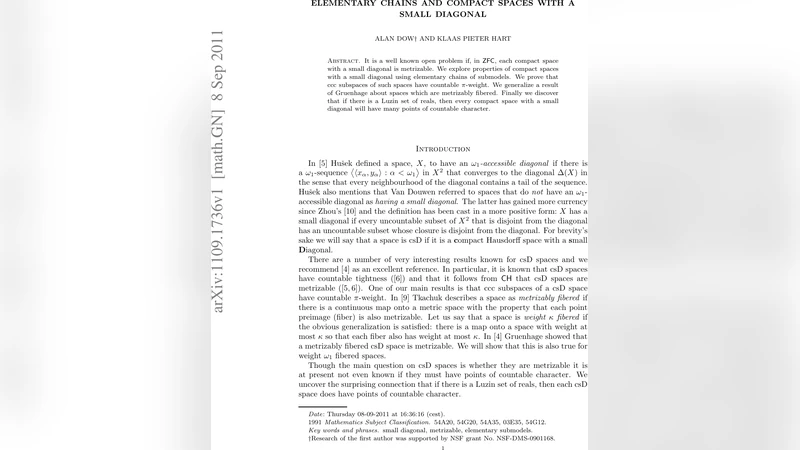
It is a well known open problem if, in ZFC, each compact space with a small diagonal is metrizable. We explore properties of compact spaces with a small diagonal using elementary chains of submodels. We prove that ccc subspaces of such spaces have countable \pi-weight. We generalize a result of Gruenhage about spaces which are metrizably fibered. Finally we discover that if there is a Luzin set of reals, then every compact space with a small diagonal will have many points of countable character.
💡 Research Summary
The paper investigates compact Hausdorff spaces that possess a “small diagonal” (csD) – a property introduced by Hušek and later popularized by Zhou. A space X is csD if every uncountable subset of X² disjoint from the diagonal contains an uncountable sub‑set whose closure remains disjoint from the diagonal. The authors employ elementary chains of countable elementary submodels of H(θ) (for a sufficiently large regular cardinal θ) as a central technical tool.
First, they formalize the notion of an elementary ω₁‑sequence of pairs: a sequence ⟨(xα, yα): α<ω₁⟩ such that for each α the pair belongs to Mα+1, xα≠yα, and the projections of xα and yα onto the coordinates in Mα coincide. Using this device they prove two foundational propositions: (1) a compact space is metrizable iff it lacks any elementary ω₁‑sequence of pairs; equivalently, a compact space has uncountable weight iff it contains such a sequence. (2) a compact space fails to be csD iff it contains an elementary ω₁‑sequence of pairs that is not ω₁‑separated (i.e., there is no uncountable A⊂ω₁ for which the two coordinate families are separated by disjoint open sets). These results recast earlier characterizations of csD spaces (Gruenhage’s ω₁‑separation criterion) in model‑theoretic language.
The first major theorem (Theorem 2.2) shows that any ccc subspace of a csD compact space must have countable π‑weight. The proof proceeds by assuming a counterexample with π‑weight ω₁, constructing an elementary ω₁‑sequence of pairs using basic open sets that avoid earlier members of the chain, and then demonstrating that this sequence cannot be ω₁‑separated, contradicting the csD hypothesis. Consequently, csD spaces cannot map onto the Tychonoff cube
Comments & Academic Discussion
Loading comments...
Leave a Comment