Edge-Colored Graphs with Applications To Homogeneous Faults
In this paper, we use the concept of colored edge graphs to model homogeneous faults in networks. We then use this model to study the minimum connectivity (and design) requirements of networks for bei
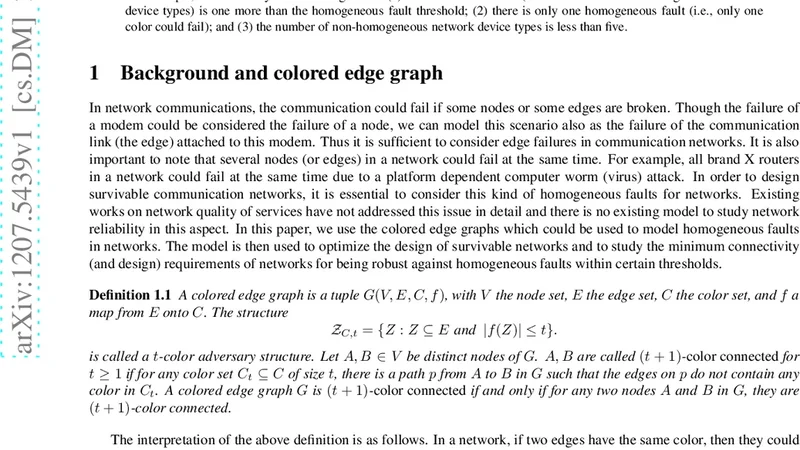
In this paper, we use the concept of colored edge graphs to model homogeneous faults in networks. We then use this model to study the minimum connectivity (and design) requirements of networks for being robust against homogeneous faults within certain thresholds. In particular, necessary and sufficient conditions for most interesting cases are obtained. For example, we will study the following cases: (1) the number of colors (or the number of non-homogeneous network device types) is one more than the homogeneous fault threshold; (2) there is only one homogeneous fault (i.e., only one color could fail); and (3) the number of non-homogeneous network device types is less than five.
💡 Research Summary
The paper introduces a novel way to model homogeneous faults in communication networks by using colored edge graphs, a mathematical construct in which each edge of a graph is assigned a color representing a class of identical network devices or a shared vulnerability. In this model, a homogeneous fault corresponds to the simultaneous failure of all edges of a particular color, reflecting real‑world scenarios where devices from the same vendor, running the same firmware, or sharing a common design flaw fail together. By treating colors as fault domains, the authors are able to translate fault‑tolerance requirements into combinatorial connectivity conditions on the underlying graph.
The authors first formalize the notion of t‑color‑connectivity: a graph is said to be t‑color‑connected if, after the removal of any set of t colors (i.e., the simultaneous loss of all edges of those colors), the remaining subgraph stays connected. This definition generalizes the classic k‑connectivity concept, which assumes independent edge failures, and provides a more realistic robustness metric for networks that must survive correlated failures.
Three principal regimes are examined in depth:
-
Number of colors equals the fault threshold plus one (k = t + 1).
In this setting the paper proves that color separation is both necessary and sufficient for t‑color‑connectivity. Specifically, each color class must induce a subgraph whose minimum degree is at least t, and the overall graph must have a minimum degree of at least t·(k − 1). Under these conditions any t colors can be removed without disconnecting the network. The authors also discuss design heuristics that minimize edge overlap between color classes, thereby simplifying the verification of the separation condition in practical topologies. -
Single homogeneous fault (t = 1).
Here the analysis reduces to a combination of classic 2‑connectivity and a new single‑color resilience property. The latter requires that for every color class there exist at least two internally disjoint paths between any pair of vertices that avoid that color. Mathematically this translates to a minimum degree of at least two within each color subgraph and overall 2‑connectivity of the whole graph. The result guarantees that the failure of any one device type does not partition the network. -
Few colors (k < 5).
When the palette of colors is small, the interaction between color classes becomes critical. The paper introduces the concept of color‑degree balance, a quantitative relationship between the minimum degrees of individual color subgraphs (δ₁, δ₂, …, δ_k) and the global minimum degree δ. For k = 2, 3, 4 the authors derive explicit inequalities (e.g., for k = 3, δ ≥ max{δ₁ + δ₂, δ₁ + δ₃, δ₂ + δ₃}) that are both necessary and sufficient for the graph to remain connected after any set of up to t = k − 1 colors fails. These bounds reveal that an uneven distribution of edges among colors can create hidden vulnerabilities, and they motivate design strategies that equalize the degree contributions of each color class.
Beyond the theoretical contributions, the paper outlines practical implications for network engineering. First, diversifying device types (i.e., increasing the number of colors) and ensuring each type has redundant paths dramatically improves resilience to correlated failures. Second, the color separation principle suggests that logical routing and physical layout should be coordinated so that edges of the same color do not share critical bottlenecks. Third, the color‑degree balance metric can be incorporated into automated topology synthesis tools, allowing designers to verify t‑color‑connectivity during the planning phase rather than after deployment.
The authors conclude by proposing several avenues for future work. One direction is to extend the static colored‑edge model to dynamic scenarios where devices can change color over time (e.g., after a firmware upgrade) and to study how such transitions affect fault tolerance. Another is to integrate probabilistic failure models, assigning failure probabilities to colors and developing stochastic versions of t‑color‑connectivity. Finally, they suggest building simulation frameworks that combine the combinatorial guarantees presented here with realistic traffic and latency constraints, thereby bridging the gap between abstract graph theory and operational network design.
In summary, the paper demonstrates that colored edge graphs provide a powerful and mathematically rigorous framework for analyzing and designing networks that must withstand homogeneous, correlated failures. By establishing clear necessary and sufficient conditions for several practically important cases, it equips researchers and practitioners with concrete design criteria that can be directly applied to improve the robustness of modern heterogeneous communication infrastructures.
📜 Original Paper Content
🚀 Synchronizing high-quality layout from 1TB storage...