Coupling of Active Motion and Advection Shapes Intracellular Cargo Transport
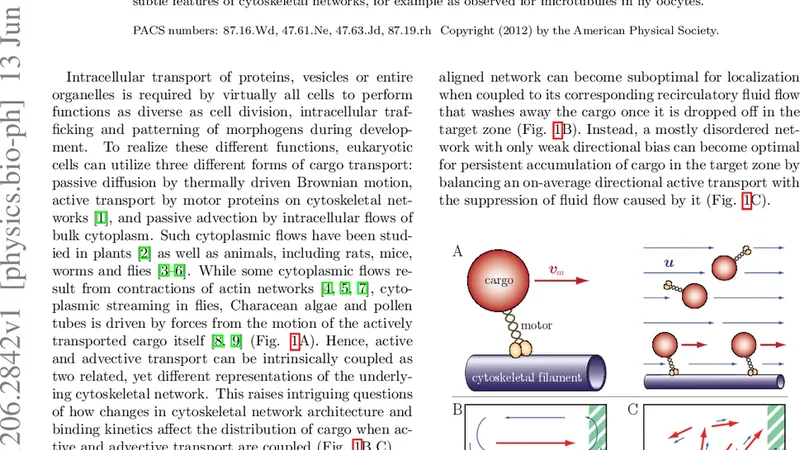
Intracellular cargo transport can arise from passive diffusion, active motor-driven transport along cytoskeletal filament networks, and passive advection by fluid flows entrained by such motor/cargo motion. Active and advective transport are thus intrinsically coupled as related, yet different representations of the same underlying network structure. A reaction-advection-diffusion system is used here to show that this coupling affects the transport and localization of a passive tracer in a confined geometry. For sufficiently low diffusion, cargo localization to a target zone is optimized either by low reaction kinetics and decoupling of bound and unbound states, or by a mostly disordered cytoskeletal network with only weak directional bias. These generic results may help to rationalize subtle features of cytoskeletal networks, for example as observed for microtubules in fly oocytes.
💡 Research Summary
The paper investigates how intracellular cargo transport emerges from the interplay of three fundamental mechanisms: passive diffusion, motor‑driven active transport along cytoskeletal filaments, and passive advection caused by fluid flows that are themselves generated by the motion of motor‑bound cargo. Recognizing that active transport and advection are two manifestations of the same underlying filament network, the authors construct a reaction‑advection‑diffusion model that explicitly couples the bound (motor‑attached) and unbound (free) states of a tracer particle.
In the model, cargo switches between bound and unbound states with forward and reverse reaction rates k_on and k_off. Bound cargo moves with a prescribed velocity field v(x) that reflects the geometry and polarity of the cytoskeletal network, while unbound cargo experiences diffusion (coefficient D) and a fluid velocity field u(x). Crucially, u(x) is not imposed externally; it is generated by the collective motion of bound cargo through a low‑Reynolds‑number Stokes flow equation, where the divergence of v(x) acts as a source term. This creates a feedback loop: motor‑driven transport drives fluid flow, and the resulting flow redistributes free cargo.
Numerical simulations are performed in a confined cylindrical domain mimicking a Drosophila oocyte. The authors explore a wide parameter space, varying diffusion strength, reaction kinetics, and the degree of directional bias (β) in the filament orientation. When diffusion is sufficiently low (D ≪ 10⁻³ µm² s⁻¹), the system’s behavior is dominated by the coupling between reaction and advection. Two distinct regimes emerge as optimal for concentrating cargo in a predefined target zone:
-
Slow reaction kinetics (k_on·k_off ≪ 1) – The bound and free states are effectively decoupled. Bound cargo follows the filament‑aligned velocity field directly to the target, while free cargo remains largely stationary because diffusion is negligible and advection is weak (the bound population is too sparse to generate significant flow). This regime yields high localization without the disruptive influence of flow.
-
Weakly biased, almost disordered filament network (β ≈ 0) – The velocity field v(x) has little net polarity, producing only modest fluid flows. If the reaction rates are moderate to high, cargo frequently exchanges between bound and free states. The weak flow gently mixes the free population, allowing a fraction of cargo to be repeatedly captured by filaments that happen to point toward the target. The net effect is an enhanced accumulation compared with a strongly aligned network, where vigorous flows can sweep free cargo away from the target region.
Conversely, a highly ordered network with strong polarity (large β) generates strong, coherent flows that, while efficiently transporting bound cargo, also create a “wash‑out” effect for the free component, reducing overall target enrichment. The authors therefore argue that cells may deliberately maintain a degree of cytoskeletal disorder or regulate motor‑binding kinetics to balance the benefits of directed transport against the detrimental mixing caused by flow.
The study’s implications are illustrated with the example of microtubule organization in the Drosophila oocyte, where a partially random microtubule array coexists with localized mRNA accumulation. The model suggests that such a configuration could be an evolutionary compromise that maximizes cargo delivery while minimizing flow‑induced dispersion.
In summary, the paper provides a mechanistic framework that unifies active transport and advection as coupled processes, demonstrates how their interaction shapes cargo distribution in confined geometries, and identifies parameter regimes—slow binding kinetics or weakly biased filament networks—that optimize cargo localization when diffusion is limited. These insights offer a quantitative basis for interpreting observed cytoskeletal architectures and may guide the design of synthetic intracellular transport systems or targeted drug‑delivery strategies.