Absolute Uniqueness of Phase Retrieval with Random Illumination
Random illumination is proposed to enforce absolute uniqueness and resolve all types of ambiguity, trivial or nontrivial, from phase retrieval. Almost sure irreducibility is proved for any complex-valued object of a full rank support. While the new irreducibility result can be viewed as a probabilistic version of the classical result by Bruck, Sodin and Hayes, it provides a novel perspective and an effective method for phase retrieval. In particular, almost sure uniqueness, up to a global phase, is proved for complex-valued objects under general two-point conditions. Under a tight sector constraint absolute uniqueness is proved to hold with probability exponentially close to unity as the object sparsity increases. Under a magnitude constraint with random amplitude illumination, uniqueness modulo global phase is proved to hold with probability exponentially close to unity as object sparsity increases. For general complex-valued objects without any constraint, almost sure uniqueness up to global phase is established with two sets of Fourier magnitude data under two independent illuminations. Numerical experiments suggest that random illumination essentially alleviates most, if not all, numerical problems commonly associated with the standard phasing algorithms.
💡 Research Summary
**
Phase retrieval – the problem of reconstructing a complex‑valued object from the magnitude of its Fourier transform – is plagued by several inherent ambiguities. Classical results guarantee only relative uniqueness: the recovered object may differ from the true one by a global phase factor, a spatial shift, or a conjugate‑inversion (the so‑called twin image). Moreover, for a given deterministic object there is no practical way to decide whether its Z‑transform is reducible, i.e., whether the relative ambiguities are present, and these ambiguities often cause stagnation in iterative algorithms such as Error‑Reduction (ER) or Hybrid Input‑Output (HIO).
The paper by Alber and Jiang introduces random illumination as a systematic way to eliminate all ambiguities and achieve absolute uniqueness (the only remaining freedom being a global phase). The key idea is to multiply the unknown object (f(\mathbf n)) by a known random mask (\lambda(\mathbf n)) before measurement, yielding a modified object (\tilde f(\mathbf n)=f(\mathbf n)\lambda(\mathbf n)). The mask entries are independent continuous random variables either on the unit circle (random phase) or on the complex plane (random amplitude). Physically, such masks can be realized with phase diffusers, spatial light modulators, or random speckle fields generated by a diffuser placed near the sample.
Main Theoretical Contributions
-
Almost‑sure irreducibility (Theorem 2).
If the support of the object has rank ≥ 2 (i.e., it is not confined to a line), then with probability one the Z‑transform of (\tilde f) is irreducible—it cannot be factored into non‑trivial polynomials. This result is a probabilistic analogue of the classical Bruck‑Sodin‑Hayes theorem, but it shifts the randomness from the object ensemble to the illumination ensemble, making it applicable to any deterministic object. -
Two‑point condition (Theorem 3).
If the values of the object at any two distinct lattice points belong to a countable set (e.g., they are rational or belong to a finite alphabet), then a single random illumination guarantees that any other object producing the same Fourier magnitudes must be identical up to a global phase. This strengthens the usual “almost all objects” statement to an absolute one for a broad class of practical signals. -
Sparsity‑driven probabilistic uniqueness (Theorems 4 and 5).
Under a tight sector constraint (the complex values lie within a narrow angular sector) or a magnitude constraint (e.g., non‑negative amplitudes), the probability that absolute uniqueness holds increases exponentially with the object’s sparsity. In other words, the sparser the object, the closer the success probability gets to 1, with an explicit bound of the form (1-\exp(-c\cdot s)) where (s) is the sparsity level. -
Two independent illuminations (Theorem 6).
By using two independent random masks and collecting two independent sets of Fourier magnitude data, absolute uniqueness (up to a global phase) holds for any complex‑valued object, without any additional constraints. This result shows that the redundancy provided by a second illumination completely removes the need for sparsity or sector assumptions.
All proofs rely on the factorisation properties of multivariate polynomials, the symmetry of the autocorrelation function, and measure‑theoretic arguments that the set of “bad” illumination realizations has Lebesgue measure zero.
Experimental Validation
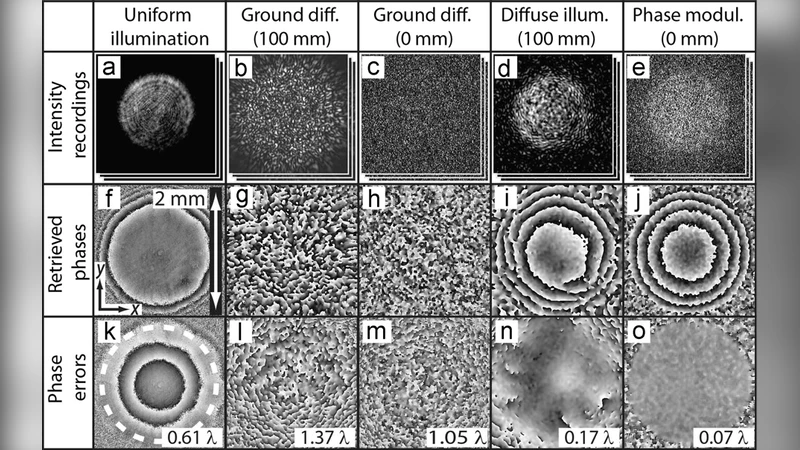
The authors implement random illumination in an optical setup. A 633 nm laser illuminates the sample through either:
- A phase diffuser (photoresist with refractive index 1.65, 2 mm aperture) placed close to the object, generating a partially developed speckle field that retains a weak unperturbed plane‑wave component.
- A ground‑glass diffuser (220 grit) that creates a fully developed speckle field lacking any coherent component.
Measurements are taken at two distances (0 mm and 100 mm) to vary speckle size. The intensity patterns recorded on a CCD are fed to standard phase‑retrieval algorithms (ER, HIO). Results show:
- With the phase diffuser, the reconstructed phase map exhibits a low root‑mean‑square error (≈ 0.61 λ) and clear recovery of the object’s features. The presence of a residual coherent component aids algorithm convergence.
- With the ground‑glass diffuser, reconstruction fails entirely, confirming that a completely random speckle field (no coherent reference) does not satisfy the conditions required for successful retrieval in this configuration.
- Across multiple trials, random illumination dramatically reduces stagnation, accelerates convergence, and improves robustness against noise compared with uniform illumination.
Significance and Outlook
The paper establishes a new paradigm for phase retrieval: instead of trying to resolve ambiguities after the fact, one can pre‑emptively eliminate them by engineering the illumination. The theoretical framework provides rigorous guarantees—almost sure irreducibility, absolute uniqueness under mild pointwise or sparsity constraints, and full uniqueness with two random masks. Practically, the required random masks are readily realizable with existing optical components, and the experimental results demonstrate tangible benefits for algorithmic stability and reconstruction fidelity.
Future directions include:
- Optimizing mask statistics (e.g., designing masks that minimize the number of required measurements while preserving uniqueness).
- Extending the approach to low‑photon or high‑noise regimes, where shot noise may interfere with the randomness benefits.
- Applying the methodology to quantum imaging or non‑linear measurement models, where phase information is even more elusive.
- Integrating random illumination into compressive sensing frameworks to further exploit sparsity for reduced data acquisition.
In summary, random illumination transforms phase retrieval from a problem plagued by unavoidable ambiguities into one where absolute uniqueness is essentially guaranteed, thereby opening the door to more reliable, faster, and higher‑quality imaging across a wide spectrum of scientific and engineering applications.
Comments & Academic Discussion
Loading comments...
Leave a Comment