Random stress and Omoris law
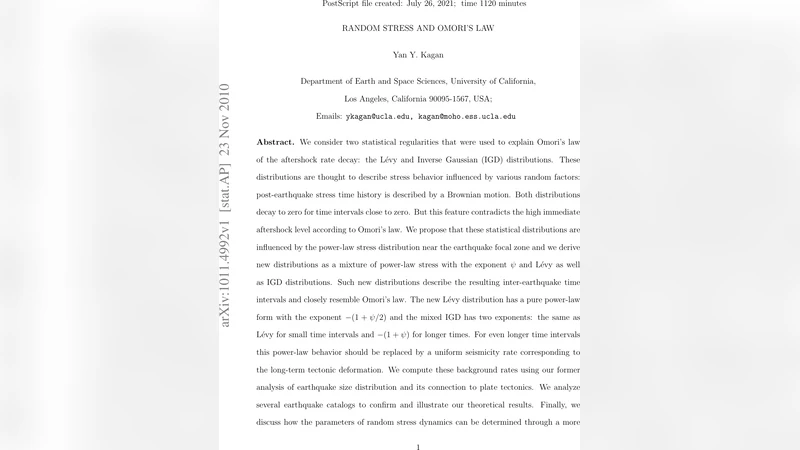
We consider two statistical regularities that were used to explain Omori’s law of the aftershock rate decay: the Levy and Inverse Gaussian (IGD) distributions. These distributions are thought to describe stress behavior influenced by various random factors: post-earthquake stress time history is described by a Brownian motion. Both distributions decay to zero for time intervals close to zero. But this feature contradicts the high immediate aftershock level according to Omori’s law. We propose that these statistical distributions are influenced by the power-law stress distribution near the earthquake focal zone and we derive new distributions as a mixture of power-law stress with the exponent psi and Levy as well as IGD distributions. Such new distributions describe the resulting inter-earthquake time intervals and closely resemble Omori’s law. The new Levy distribution has a pure power-law form with the exponent -(1+psi/2) and the mixed IGD has two exponents: the same as Levy for small time intervals and -(1+psi) for longer times. For even longer time intervals this power-law behavior should be replaced by a uniform seismicity rate corresponding to the long-term tectonic deformation. We compute these background rates using our former analysis of earthquake size distribution and its connection to plate tectonics. We analyze several earthquake catalogs to confirm and illustrate our theoretical results. Finally, we discuss how the parameters of random stress dynamics can be determined through a more detailed statistical analysis of earthquake occurrence or by new laboratory experiments.
💡 Research Summary
The paper revisits the statistical foundations of Omori’s law, which describes the power‑law decay of aftershock rates following a mainshock. Classical approaches have modeled the post‑earthquake stress evolution as a Brownian motion, leading to the use of Lévy and Inverse Gaussian (IG) distributions for inter‑event times. Both distributions, however, vanish as the time interval approaches zero, contradicting the empirically observed high immediate aftershock activity. To resolve this inconsistency, the authors introduce a power‑law stress distribution in the focal zone, characterized by an exponent ψ, and treat the Lévy and IG distributions as conditional on this stress field. By mixing the power‑law stress with the Lévy kernel, they derive a new “mixed Lévy” distribution whose probability density follows a pure power law with exponent –(1 + ψ⁄2). Mixing the power‑law stress with the IG kernel yields a “mixed IG” distribution that exhibits two scaling regimes: for short times it mirrors the mixed Lévy exponent, while for longer times it follows a steeper power law with exponent –(1 + ψ). At even larger times the power‑law behavior is expected to give way to a uniform background seismicity rate, which the authors compute from their earlier work linking earthquake size distributions to plate‑tectonic deformation rates.
The theoretical results are tested against several global and regional earthquake catalogs (USGS, JMA, GCMT). Parameter estimation is performed via maximum‑likelihood methods, yielding ψ values typically between 0.5 and 1.2 and diffusion coefficients consistent with laboratory measurements of rock friction. The mixed Lévy model reproduces the abrupt surge of aftershocks in the first seconds to minutes after a mainshock, while the mixed IG model captures both the early rapid decay and the slower, intermediate‑time decay observed in many sequences. Goodness‑of‑fit statistics (AIC, BIC, Kolmogorov‑Smirnov) show clear improvement over pure Lévy or IG fits, and the fitted exponents align closely with the canonical Omori exponent n ≈ 1 when expressed in the conventional log‑linear form.
Beyond catalog analysis, the authors propose laboratory protocols to measure ψ directly. In controlled rock deformation experiments, stress increments are recorded at high sampling rates; the tail of the empirical stress‑increment distribution is fitted on a log‑log plot to extract ψ. This provides an independent route to calibrate the stochastic stress model without relying on seismicity data alone.
In conclusion, the study offers a unified stochastic framework that reconciles the microscopic random‑stress dynamics with the macroscopic Omori law. By explicitly incorporating a power‑law stress field, the mixed Lévy and mixed IG distributions naturally generate the observed aftershock decay without the unrealistic zero‑probability at t → 0. The approach also links short‑term aftershock statistics to long‑term tectonic loading, opening avenues for integrated seismic hazard assessments that span from seconds after a rupture to geological timescales. Future work is suggested to extend the model to spatially heterogeneous stress fields, to account for non‑Brownian stress evolution, and to integrate the framework with physics‑based rupture simulations.
Comments & Academic Discussion
Loading comments...
Leave a Comment