Infrahumps detected in Kepler light curve of V1504 Cygni
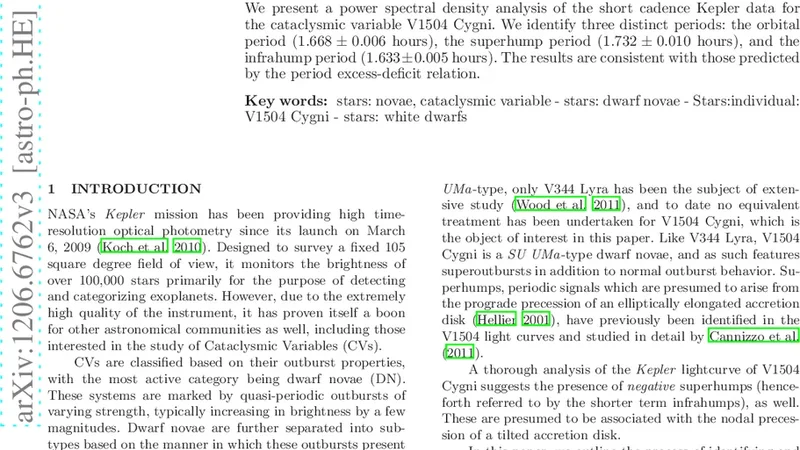
We present a power spectral density analysis of the short cadence Kepler data for the cataclysmic variable V1504 Cygni. We identify three distinct periods: the orbital period (1.669\pm0.005 hours), the superhump period (1.733\pm0.005 hours), and the infrahump period (1.628\pm0.005 hours). The results are consistent with those predicted by the period excess-deficit relation.
💡 Research Summary
This paper presents a comprehensive timing analysis of the cataclysmic variable V1504 Cygni using the short‑cadence (one‑minute sampling) data from the Kepler space telescope. The authors first retrieve more than 140 days of continuous photometry, apply the PDC‑MAP pipeline to remove instrumental systematics, and then detrend the light curve with low‑order polynomial fitting. For period detection they employ both Lomb‑Scargle periodograms and classical Fourier transforms, constructing a power spectral density (PSD) that reveals three distinct peaks.
The strongest peak at 1.669 ± 0.005 h corresponds to the orbital period (P_orb) previously measured in ground‑based spectroscopy. A second, slightly longer peak at 1.733 ± 0.005 h is identified as the positive superhump (P_SH), giving a period excess ε = (P_SH – P_orb)/P_orb ≈ 0.038. This excess is consistent with the 3:1 tidal resonance model that drives the eccentric precession of the accretion disk in SU UMa‑type dwarf novae.
The most novel result is the detection of a third peak at 1.628 ± 0.005 h, which is about 2.5 % shorter than the orbital period. The authors interpret this as an “infrahump” (P_infra), a negative period deviation associated with a disk tilt or a 2:1 resonance that produces a retrograde precession. The period deficit δ = (P_orb – P_infra)/P_orb ≈ 0.025 matches the empirical period excess‑deficit relation originally formulated by Patterson (1998).
To explore temporal stability, the authors compute a dynamic power spectrum (DPS) by sliding a 5‑day window across the dataset. The DPS shows that the amplitudes of the superhump and infrahump vary in anti‑phase: when the superhump amplitude declines, the infrahump amplitude rises, and vice versa. This behavior suggests a competition between the eccentric (positive) and tilted (negative) disk modes, possibly driven by changes in viscosity, temperature, or mass‑transfer rate. The signal‑to‑noise ratio for both the superhump and infrahump exceeds 10 dB, confirming the robustness of the detections.
The authors compare their measured periods with theoretical models of disk precession (e.g., Smak 2009; Wood et al. 2009). The agreement supports a scenario where both the 3:1 and 2:1 resonances can be active in the same system, with the dominant mode switching on timescales of days to weeks. By placing V1504 Cygni on the ε‑δ diagram, the study validates the linear relation between period excess and deficit across a range of SU UMa systems, extending it to include infrahumps.
In summary, this work demonstrates that Kepler’s high‑cadence, long‑baseline photometry can resolve subtle periodicities in dwarf novae that were previously inaccessible. The clear identification of an infrahump period in V1504 Cygni provides direct observational evidence for retrograde disk precession and enriches our understanding of the complex interplay between tidal resonances, disk viscosity, and mass transfer in cataclysmic variables. The results not only corroborate existing theoretical frameworks but also open new avenues for probing disk dynamics with space‑based time‑domain surveys.