Locating and Identifying Codes in Circulant Networks
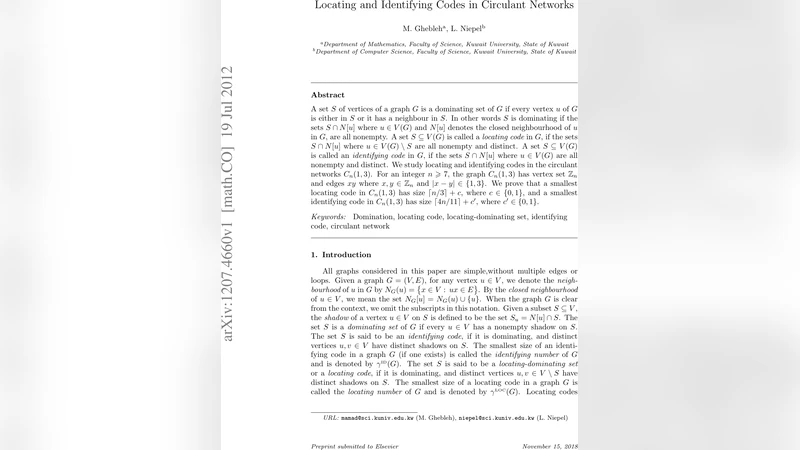
A set S of vertices of a graph G is a dominating set of G if every vertex u of G is either in S or it has a neighbour in S. In other words, S is dominating if the sets S\cap N[u] where u \in V(G) and N[u] denotes the closed neighbourhood of u in G, are all nonempty. A set S \subseteq V(G) is called a locating code in G, if the sets S \cap N[u] where u \in V(G) \setminus S are all nonempty and distinct. A set S \subseteq V(G) is called an identifying code in G, if the sets S\cap N[u] where u\in V(G) are all nonempty and distinct. We study locating and identifying codes in the circulant networks C_n(1,3). For an integer n>6, the graph C_n(1,3) has vertex set Z_n and edges xy where x,y \in Z_n and |x-y| \in {1,3}. We prove that a smallest locating code in C_n(1,3) has size \lceil n/3 \rceil + c, where c \in {0,1}, and a smallest identifying code in C_n(1,3) has size \lceil 4n/11 \rceil + c’, where c’ \in {0,1}.
💡 Research Summary
The paper investigates two closely related combinatorial objects—locating codes and identifying codes—within the family of circulant graphs denoted Cₙ(1,3). A circulant graph Cₙ(1,3) has vertex set ℤₙ (the integers modulo n) and edges between any two vertices whose distance modulo n equals 1 or 3. Consequently each vertex has degree four, being adjacent to its immediate neighbours (±1) and to vertices three steps away (±3). The authors first recall the classical notion of a dominating set: a vertex subset S ⊆ V(G) such that every vertex u ∈ V(G) either belongs to S or has a neighbour in S. From this foundation they define a locating code as a dominating set with the additional property that for every vertex u ∉ S the intersection S ∩ N
Comments & Academic Discussion
Loading comments...
Leave a Comment