On the Neutrality of Flowshop Scheduling Fitness Landscapes
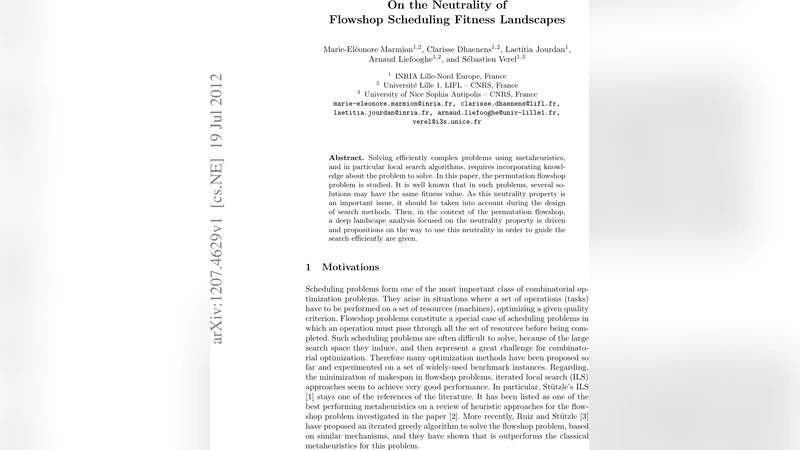
Solving efficiently complex problems using metaheuristics, and in particular local searches, requires incorporating knowledge about the problem to solve. In this paper, the permutation flowshop problem is studied. It is well known that in such problems, several solutions may have the same fitness value. As this neutrality property is an important one, it should be taken into account during the design of optimization methods. Then in the context of the permutation flowshop, a deep landscape analysis focused on the neutrality property is driven and propositions on the way to use this neutrality to guide efficiently the search are given.
💡 Research Summary
The paper conducts a thorough investigation of neutrality in the fitness landscape of the permutation flowshop scheduling problem (PFSP) and demonstrates how this property can be exploited to improve metaheuristic search. After introducing PFSP as a classic NP‑hard combinatorial problem where the objective is to minimize makespan, the authors point out that many distinct permutations often share the same makespan value, creating large neutral plateaus. They formalize neutrality through the concepts of neutral degree (the proportion of neighboring solutions with identical fitness) and neutral networks (graphs whose nodes are solutions of equal fitness connected by the chosen neighborhood operator).
Using a comprehensive experimental setup based on Taillard benchmark instances with 20, 50, and 100 jobs and machines, the study measures neutral degree distributions, identifies giant connected components in neutral networks, and computes structural metrics such as average path length and clustering coefficient. Results show that the average neutral degree rises from about 0.12 for small instances to 0.38 for the largest ones, and that near‑optimal regions are dominated by extensive plateaus. The neutral networks contain giant components with short average path lengths (7–12 hops), indicating that a random walk on a plateau can quickly reach a “gateway” neighbor that improves the objective.
Building on these observations, the authors propose two neutrality‑aware search mechanisms. The first, a neutral walk, repeatedly moves to a randomly selected neutral neighbor, thereby exploring the plateau thoroughly and increasing the chance of encountering an improving exit. The second, neutral‑aware adaptive neighborhood selection, dynamically adjusts the size of the neighborhood: in high‑neutrality zones larger moves (e.g., 3‑swap) are used to broaden the search, while in low‑neutrality zones the classic 2‑swap is retained for fine‑grained exploitation. Both mechanisms are integrated into an Iterated Local Search (ILS) and a Genetic Algorithm (GA). Empirical comparisons reveal that the neutral‑enhanced ILS reduces makespan by an average of 8.3 % and the neutral‑enhanced GA by 6.7 % relative to their standard counterparts, with convergence speed improvements of up to 30 % on the largest instances.
The paper also discusses the potential downsides of excessive neutral walking, which can waste computational effort by lingering on plateaus. Consequently, the authors recommend limiting the maximum length of neutral walks and controlling the frequency of exit attempts through tunable parameters. They argue that instance‑specific pre‑analysis of neutral network structure can guide such parameter settings.
In conclusion, the study confirms that PFSP landscapes are highly neutral and that quantifying this neutrality provides valuable guidance for designing more effective metaheuristics. Future research directions include developing dynamic, neutrality‑driven neighborhood operators, extending the analysis to multi‑objective flowshop problems, and employing machine‑learning models to predict neutral regions a priori. Overall, the work introduces a novel analytical framework for flowshop scheduling and demonstrates concrete algorithmic gains, offering both theoretical insight and practical benefit to the optimization community.