Model of cell response to {alpha}-particle radiation
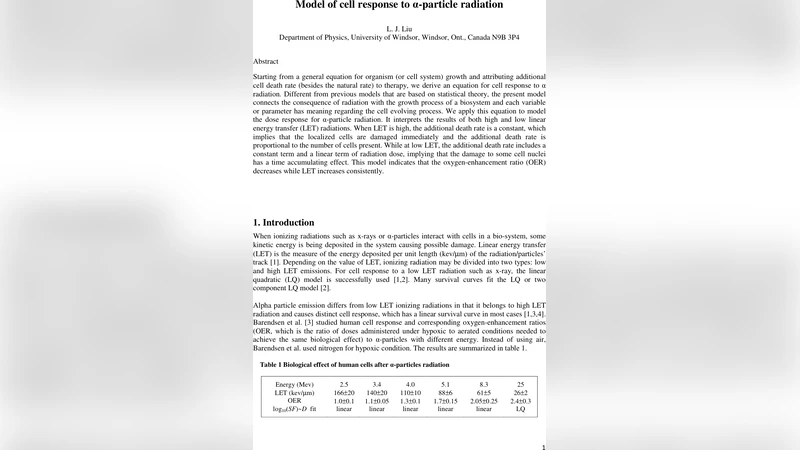
Starting from a general equation for organism (or cell system) growth and attributing additional cell death rate (besides the natural rate) to therapy, we derive an equation for cell response to {\alpha} radiation. Different from previous models that are based on statistical theory, the present model connects the consequence of radiation with the growth process of a biosystem and each variable or parameter has meaning regarding the cell evolving process. We apply this equation to model the dose response for {\alpha}-particle radiation. It interprets the results of both high and low linear energy transfer (LET) radiations. When LET is high, the additional death rate is a constant, which implies that the localized cells are damaged immediately and the additional death rate is proportional to the number of cells present. While at low LET, the additional death rate includes a constant term and a linear term of radiation dose, implying that the damage to some cell nuclei has a time accumulating effect. This model indicates that the oxygen-enhancement ratio (OER) decreases while LET increases consistently.
💡 Research Summary
The paper introduces a mechanistic model for cellular response to α‑particle (high‑LET) radiation that is rooted in a general growth‑death equation for a cell population. Starting from the classic differential equation dN/dt = (r − d) N, where N(t) is the number of cells, r is the intrinsic proliferation rate, and d is the natural death rate, the authors add an “additional death rate” term α(D) that captures the lethal effect of radiation dose D. The resulting equation dN/dt = (r − d − α(D)) N directly links radiation‑induced mortality to the underlying growth dynamics, giving each parameter a clear biological interpretation.
A central contribution is the explicit dependence of α(D) on linear energy transfer (LET). For high‑LET radiation such as α particles, the authors argue that damage to cell nuclei occurs essentially instantaneously; therefore α(D) can be approximated by a constant k, independent of dose. In this regime the death rate is proportional to the instantaneous cell count, leading to an exponential decline N(t) = N₀ exp
Comments & Academic Discussion
Loading comments...
Leave a Comment