Tractable Set Constraints
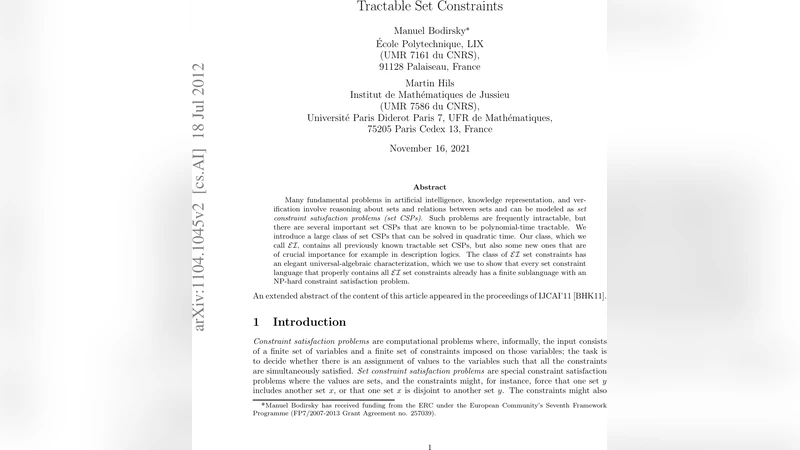
Many fundamental problems in artificial intelligence, knowledge representation, and verification involve reasoning about sets and relations between sets and can be modeled as set constraint satisfaction problems (set CSPs). Such problems are frequently intractable, but there are several important set CSPs that are known to be polynomial-time tractable. We introduce a large class of set CSPs that can be solved in quadratic time. Our class, which we call EI, contains all previously known tractable set CSPs, but also some new ones that are of crucial importance for example in description logics. The class of EI set constraints has an elegant universal-algebraic characterization, which we use to show that every set constraint language that properly contains all EI set constraints already has a finite sublanguage with an NP-hard constraint satisfaction problem.
💡 Research Summary
The paper addresses the computational complexity of set constraint satisfaction problems (set CSPs), which arise in many areas of artificial intelligence, knowledge representation, and verification. While many set CSPs are NP‑hard, several important subclasses are known to be tractable. The authors introduce a broad new class called EI (for “E” – complement, and “I” – intersection) that subsumes all previously identified tractable set‑CSP languages and also captures new, practically relevant constraints, especially those appearing in description logics.
Definition of EI.
An EI constraint is either a complement constraint of the form x = E(y) (x must be the complement of y) or an inclusion‑intersection constraint of the form x ⊆ I(y₁,…,y_k) (x must be a subset of the intersection of several variables). By allowing arbitrary nesting of these two primitive forms, EI can express a rich set of relationships while remaining syntactically simple.
Quadratic‑time algorithm.
The authors transform an EI instance into a directed hypergraph where vertices correspond to variables, ordinary arcs encode complement constraints, and hyper‑arcs encode intersection‑inclusion constraints. They compute strongly connected components (SCCs) to resolve cycles locally, then process the SCC condensation in topological order. Within each SCC, the complement operation determines a variable’s value uniquely once any member is fixed; the intersection operation computes the greatest lower bound of the involved variables. Because each constraint is examined a constant number of times and each set operation can be performed in constant time, the overall running time is O(n·m), i.e., quadratic in the size of the input (n variables, m constraints).
Universal‑algebraic characterization.
Using clone theory, the paper shows that the polymorphisms preserving EI are exactly those generated by the Boolean complement (a “switch” function) and all monotone functions. This clone is known to yield polynomial‑time solvable CSPs. Conversely, adding any operation outside this clone—such as a general set difference or a non‑monotone Boolean function—produces a clone capable of expressing NP‑complete problems. Hence EI is precisely the maximal class whose polymorphism clone lies in the tractable region.
Maximality / hardness result.
The authors prove a dichotomy: any set‑constraint language that strictly contains EI already has a finite sublanguage whose CSP is NP‑hard. The proof proceeds by constructing, for any extra operation, a reduction from a known NP‑complete problem (e.g., 3‑SAT) to a CSP using only a bounded number of constraints from the enlarged language. This establishes EI as a boundary of tractability for set constraints.
Relation to existing work and applications.
The paper demonstrates that all earlier tractable classes—Horn‑type set constraints, 2‑variable inclusion constraints, and the fragment of description logic 𝔖𝔥𝔬𝔴𝔢𝔯𝔰𝔞𝔱𝔦𝔣𝔦𝔠𝔞𝔱𝔦𝔬𝔫 𝔏𝔬𝔤𝔦𝔠 𝔄𝔏𝔠𝔥𝔢𝔪𝔶 𝔖𝔱𝔯𝔞𝔱𝔢𝔤𝔶—are contained within EI. Moreover, the authors illustrate practical scenarios such as policy verification, database integrity, and security model analysis where EI constraints naturally arise and where the quadratic algorithm outperforms generic CSP solvers.
Conclusion.
By introducing the EI class, providing a concrete O(n·m) decision procedure, and giving a clean universal‑algebraic maximality theorem, the paper significantly advances the theory of set constraints. It not only unifies previously known tractable fragments but also delineates the exact frontier beyond which set‑CSPs become computationally intractable. This work offers both a powerful tool for practitioners dealing with complex set‑based specifications and a robust theoretical framework for future investigations into constraint languages.
Comments & Academic Discussion
Loading comments...
Leave a Comment