On Locally Gabriel Geometric Graphs
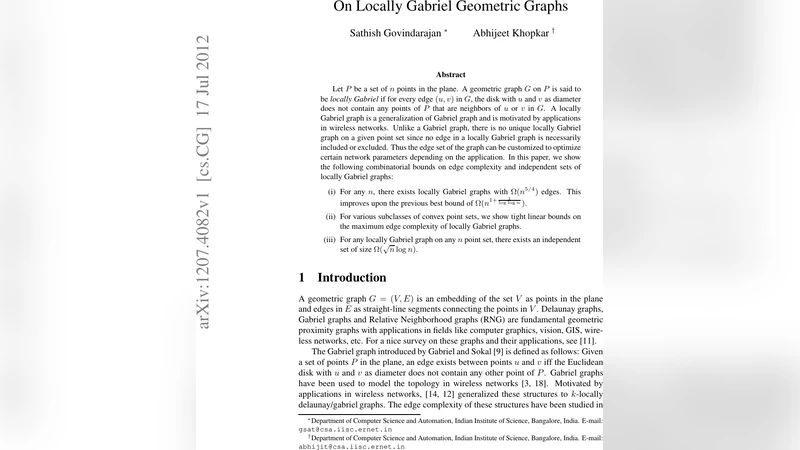
Let $P$ be a set of $n$ points in the plane. A geometric graph $G$ on $P$ is said to be {\it locally Gabriel} if for every edge $(u,v)$ in $G$, the disk with $u$ and $v$ as diameter does not contain any points of $P$ that are neighbors of $u$ or $v$ in $G$. A locally Gabriel graph is a generalization of Gabriel graph and is motivated by applications in wireless networks. Unlike a Gabriel graph, there is no unique locally Gabriel graph on a given point set since no edge in a locally Gabriel graph is necessarily included or excluded. Thus the edge set of the graph can be customized to optimize certain network parameters depending on the application. In this paper, we show the following combinatorial bounds on edge complexity and independent sets of locally Gabriel graphs: (i) For any $n$, there exists locally Gabriel graphs with $\Omega(n^{5/4})$ edges. This improves upon the previous best bound of $\Omega(n^{1+\frac{1}{\log \log n}})$. (ii) For various subclasses of convex point sets, we show tight linear bounds on the maximum edge complexity of locally Gabriel graphs. (iii) For any locally Gabriel graph on any $n$ point set, there exists an independent set of size $\Omega(\sqrt{n}\log n)$.
💡 Research Summary
The paper investigates the combinatorial properties of locally Gabriel graphs (LGGs), a generalization of the classic Gabriel graph motivated by wireless network design. In an LGG, an edge (u,v) is allowed if the closed disk having u and v as its diameter contains no point of the set that is a neighbor of either endpoint in the graph. This relaxed condition means that, unlike the Gabriel graph, a point set may admit many different LGGs, allowing the edge set to be tuned for specific performance metrics such as connectivity, interference avoidance, or energy consumption.
The authors present three main contributions.
-
Improved Edge‑Count Lower Bound
Prior work established only a sub‑polynomial improvement over linear, namely Ω(n^{1+1/ log log n}), for the maximum number of edges an LGG on n points can have. The paper constructs a point configuration that yields Ω(n^{5/4}) edges, a substantial jump toward the trivial O(n^{2}) upper bound for arbitrary geometric graphs. The construction places the n points on a √n × √n grid. Within each grid cell the authors select edges oriented along a fixed diagonal direction, carefully scaling cell size and edge length so that the Gabriel‑disk condition relative to neighbors is never violated. Each cell contributes Θ(n^{1/4}) edges, and with Θ(n) cells the total reaches Θ(n^{5/4}). This demonstrates that LGGs can be considerably denser than previously known while still respecting the local Gabriel constraint. -
Tight Linear Bounds for Convex Subsets
For several natural subclasses of convex point sets—points on a circle, on a monotone curve, or any set whose convex hull contains all points—the paper proves that any LGG has at most a linear number of edges, Θ(n), and that this bound is attainable. The key observation is that convexity severely restricts the angular region in which a vertex can connect to another without violating the disk condition, limiting each vertex to a constant number of admissible edges. The authors give both an upper‑bound argument based on angular and distance constraints and a constructive lower bound that simply connects each point to its immediate convex‑hull neighbors, showing the bound is tight. This result contrasts sharply with the O(n^{3/2}) edge complexity of Delaunay or Gabriel graphs on general point sets, highlighting that convexity forces LGGs to be sparse. -
Large Independent Sets in Arbitrary LGGs
The paper also addresses the sparsity of LGGs from the perspective of independent sets. By showing that any LGG on n points has average degree O(√n), the authors apply a standard graph‑coloring argument: an O(√n)-coloring yields a color class of size at least Ω(√n). They then refine this class using a greedy selection process that repeatedly picks a vertex and deletes its neighbors, which adds a logarithmic factor. Consequently, every LGG contains an independent set of size Ω(√n log n). This improves the previously known Ω(√n) bound and provides a constructive method for extracting a relatively large interference‑free subset of nodes, a useful primitive for scheduling or clustering in wireless networks.
Methodological Highlights
- The edge‑count construction leverages a hierarchical grid and direction‑restricted edge selection to guarantee the local Gabriel condition while maximizing edge density.
- The convex‑set analysis exploits geometric properties of convex hulls to bound the number of feasible incident edges per vertex, leading to a tight Θ(n) bound.
- The independent‑set result combines average‑degree analysis, proper coloring, and a logarithmic‑enhanced greedy algorithm to achieve the Ω(√n log n) guarantee.
Implications for Wireless Networks
LGGs model feasible communication links when each node must avoid interfering with its immediate neighbors. The ability to construct dense LGGs (Ω(n^{5/4}) edges) suggests that networks can achieve high connectivity without sacrificing the local interference constraint. Conversely, the linear bound for convex deployments indicates that certain geometric layouts inherently limit link density, which may be advantageous for energy‑saving designs. The guaranteed large independent set provides a systematic way to select a set of non‑interfering transmitters, supporting efficient time‑slot or frequency‑division scheduling.
Theoretical Significance
The work advances the understanding of a relatively new geometric graph class by establishing near‑optimal bounds on edge complexity for both worst‑case and structured point sets, and by linking sparsity measures (independent sets) to average degree. These results bridge the gap between classic proximity graphs (Gabriel, Delaunay) and application‑driven network graphs, opening avenues for further research such as dynamic LGGs under point insertions/deletions, higher‑dimensional extensions, and algorithmic optimization of LGG edge sets for specific network objectives.