Performance Analysis of Wavelet Based MC-CDMA System with Implementation of Various Antenna Diversity Schemes
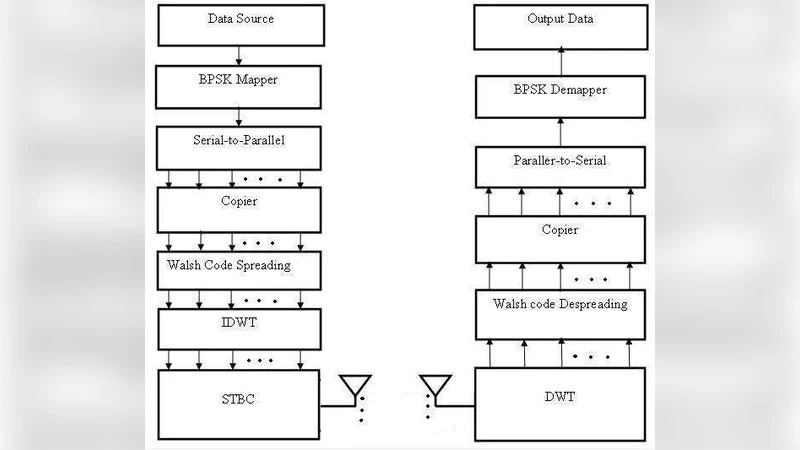
The impact of using wavelet based technique on the performance of a MC-CDMA wireless communication system has been investigated. The system under proposed study incorporates Walsh Hadamard codes to discriminate the message signal for individual user. A computer program written in Mathlab source code is developed and this simulation study is made with implementation of various antenna diversity schemes and fading (Rayleigh and Rician) channel. Computer simulation results demonstrate that the proposed wavelet based MC-CDMA system outperforms in Alamouti (two transmit antenna and one receive antenna) under AWGN and Rician channel.
💡 Research Summary
The paper investigates the impact of employing a wavelet‑based processing technique on the performance of a multi‑carrier code‑division multiple‑access (MC‑CDMA) wireless communication system. The authors replace the conventional fast Fourier transform (FFT) modulation with discrete wavelet transform (DWT) at the transmitter, while retaining binary phase‑shift keying (BPSK) as the underlying modulation format. Each user’s data stream is first spread with a Walsh‑Hadamard orthogonal code, then modulated and passed through the wavelet filter bank, which provides simultaneous time‑frequency localization. This approach is intended to improve robustness against frequency‑selective fading by distributing signal energy across multiple scales.
To exploit spatial diversity, the system incorporates the Alamouti space‑time block coding scheme, using two transmit antennas and a single receive antenna (2×1 configuration). Alamouti coding is attractive because it offers full diversity gain with linear processing at the receiver and minimal computational overhead. The authors evaluate the combined wavelet‑MC‑CDMA/Alamouti system under two canonical fading environments: Rayleigh fading, which models severe multipath without a line‑of‑sight component, and Rician fading, which includes a dominant line‑of‑sight path characterized by a K‑factor. Both channels are simulated in MATLAB/Simulink, and the performance metric is bit‑error rate (BER) as a function of signal‑to‑noise ratio (SNR) ranging from 0 dB to 20 dB.
Simulation results reveal several key findings. In an additive white Gaussian noise (AWGN) channel, the wavelet‑based MC‑CDMA system outperforms a traditional FFT‑based MC‑CDMA implementation by roughly 2 dB of SNR for the same BER, demonstrating the advantage of wavelet’s multiresolution analysis even when fading is absent. Under Rayleigh fading, the inclusion of Alamouti diversity dramatically reduces BER; the system achieves a BER of 10⁻³ at an SNR approximately 6 dB lower than the non‑diversity case, confirming that spatial diversity effectively mitigates deep fades. In Rician fading with a moderate K‑factor (e.g., K = 5), the presence of a direct path further lowers the error floor, and the wavelet‑Alamouti combination delivers the best overall performance among all tested configurations.
The authors conclude that the synergy between wavelet processing (which enhances time‑frequency resilience) and Alamouti space‑time coding (which supplies spatial resilience) yields a robust MC‑CDMA solution capable of operating efficiently in both severe non‑line‑of‑sight and moderate line‑of‑sight environments. However, the study has notable limitations. It restricts modulation to BPSK, omits higher‑order constellations such as QPSK or 16‑QAM, and does not explore adaptive modulation or coding schemes. The channel models are static, lacking Doppler spread or time‑varying parameters that would emulate user mobility. Moreover, only a single receive antenna is considered, leaving the potential gains of full MIMO configurations unexamined.
Future research directions suggested include extending the framework to higher‑order modulation and forward error correction, incorporating multiple receive antennas to realize full MIMO diversity and multiplexing gains, and developing adaptive wavelet filter banks that can track channel variations in real time. By addressing these extensions, the wavelet‑based MC‑CDMA architecture could become a compelling candidate for next‑generation 5G/6G networks that demand high data rates, low latency, and reliable performance under diverse propagation conditions.