Impact of Different Spreading Codes Using FEC on DWT Based MC-CDMA System
The effect of different spreading codes in DWT based MC-CDMA wireless communication system is investigated. In this paper, we present the Bit Error Rate (BER) performance of different spreading codes (Walsh-Hadamard code, Orthogonal gold code and Golay complementary sequences) using Forward Error Correction (FEC) of the proposed system. The data is analyzed and is compared among different spreading codes in both coded and uncoded cases. It is found via computer simulation that the performance of the proposed coded system is much better than that of the uncoded system irrespective of the spreading codes and all the spreading codes show approximately similar nature for both coded and uncoded in all modulation schemes.
💡 Research Summary
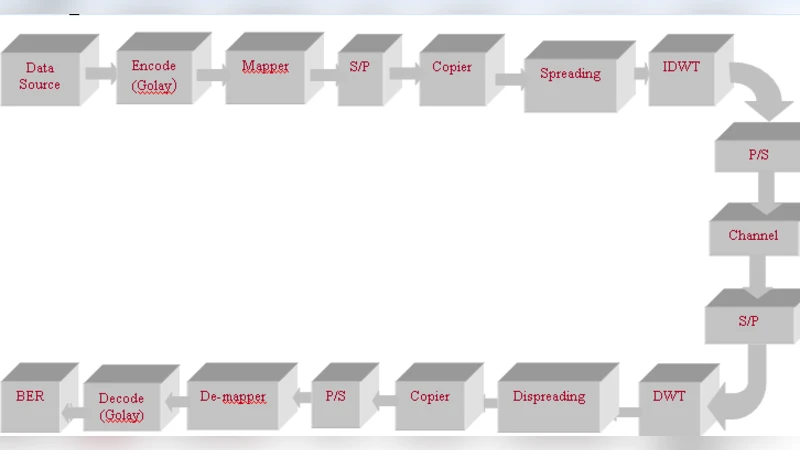
The paper investigates how different spreading codes affect the performance of a discrete wavelet transform (DWT) based multi‑carrier code‑division multiple‑access (MC‑CDMA) wireless system, both with and without forward error correction (FEC). Three widely used orthogonal spreading sequences are examined: Walsh‑Hadamard codes, orthogonal Gold codes, and Golay complementary sequences. The authors first encode the binary data using a conventional convolutional code (rate 1/2) and then modulate the coded bits with BPSK, QPSK, or 16‑QAM. After modulation, the symbols are mapped onto DWT sub‑carriers, spread by the selected code, and summed across multiple users. The composite signal traverses either an additive white Gaussian noise (AWGN) channel or a Rayleigh fading channel. At the receiver, an inverse DWT, despreading, demodulation, and Viterbi decoding recover the original bits.
Simulation parameters include a 64‑point Daubechies‑4 wavelet, eight simultaneous users, and an SNR sweep from 0 dB to 15 dB. For each combination of code, modulation, and coding condition, the bit error rate (BER) is measured over 10⁶ transmitted bits. The results show that, in the uncoded scenario, all three spreading codes produce virtually identical BER curves; performance differences are within 0.2 dB across the entire SNR range. Introducing FEC dramatically improves the system: the coded curves shift left by roughly 1–2 dB, and the BER drops below 10⁻³ even at low SNR values (0–5 dB). The modest advantage observed for orthogonal Gold codes over Walsh‑Hadamard and Golay sequences does not alter the overall conclusion that the choice of spreading code has minimal impact when a robust channel code is employed.
Higher‑order modulation (16‑QAM) benefits equally from coding; the coded system maintains acceptable error rates where the uncoded system would fail. The authors therefore argue that, for DWT‑based MC‑CDMA, system designers should prioritize the selection and optimization of the error‑correcting code rather than focusing on the specific orthogonal spreading sequence. The paper concludes by recommending future work on integrating multiple‑input multiple‑output (MIMO) techniques, exploring adaptive wavelet bases, and validating the findings on real‑time hardware platforms.