Relating Operator Spaces via Adjunctions
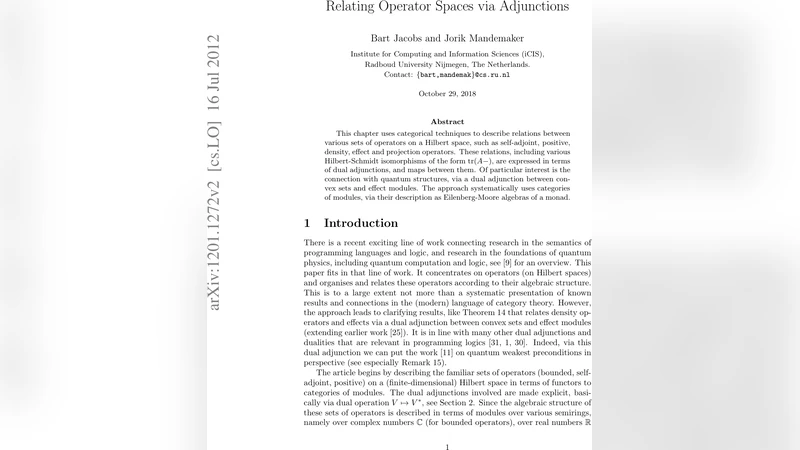
This chapter uses categorical techniques to describe relations between various sets of operators on a Hilbert space, such as self-adjoint, positive, density, effect and projection operators. These relations, including various Hilbert-Schmidt isomorphisms of the form tr(A-), are expressed in terms of dual adjunctions, and maps between them. Of particular interest is the connection with quantum structures, via a dual adjunction between convex sets and effect modules. The approach systematically uses categories of modules, via their description as Eilenberg-Moore algebras of a monad.
💡 Research Summary
This chapter presents a categorical framework that unifies and clarifies the relationships among several important classes of operators on a Hilbert space (H): self‑adjoint operators (SA(H)), positive operators (Pos(H)), density operators (Dens(H)), effects (Eff(H)) and projections (Proj(H)). The authors begin by recalling that each of these sets carries a distinct physical interpretation—observables, states, measurement outcomes, etc.—and that traditional linear‑algebraic treatments treat them as isolated objects. They then introduce the categorical machinery needed to relate them: a monad (T) (essentially the probability‑distribution monad on the category of sets), its Eilenberg‑Moore algebras, and the notion of adjunction.
The first major technical contribution is the identification of two pairs of dual adjunctions that arise from the Hilbert‑Schmidt inner product (\langle A,B\rangle = \operatorname{tr}(A^{\dagger}B)). For the self‑adjoint/positive pair, the map \
Comments & Academic Discussion
Loading comments...
Leave a Comment