Preliminary Design of Debris Removal Missions by Means of Simplified Models for Low-Thrust, Many-Revolution Transfers
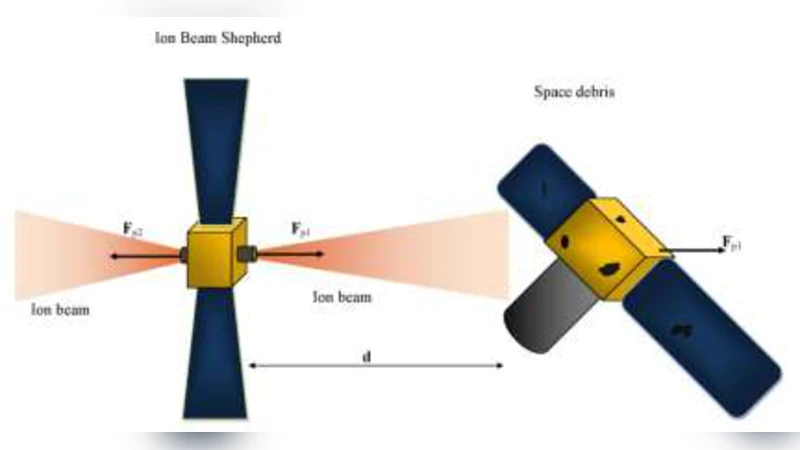
This paper presents a novel approach for the preliminary design of Low-Thrust, many-revolution transfers. The main feature of the novel approach is a considerable reduction in the control parameters and a consequent gain in computational speed. Each spiral is built by using a predefined pattern for thrust direction and switching structure. The pattern is then optimised to minimise propellant consumption and transfer time. The variation of the orbital elements due to the thrust is computed analytically from a first-order solution of the perturbed Keplerian motion. The proposed approach allows for a realistic estimation of {\Delta}V and time of flight required to transfer a spacecraft between two arbitrary orbits. Eccentricity and plane changes are both accounted for. The novel approach is applied here to the design of missions for the removal of space debris by means of an Ion Beam Shepherd Spacecraft. In particular, two slightly different variants of the proposed low-thrust control model are used for the different phases of the mission. Thanks to their low computational cost they can be included in a multiobjective optimisation problem in which the sequence and timing of the removal of five pieces of debris are optimised to minimise propellant consumption and mission duration.
💡 Research Summary
The paper introduces a streamlined methodology for the preliminary design of low‑thrust, many‑revolution orbital transfers, targeting a substantial reduction in the number of control parameters and a corresponding increase in computational speed. The core idea is to prescribe a thrust‑direction pattern and a switching structure in advance, then treat the parameters of that pattern (e.g., rotation angle, switching period, segment duration) as the only decision variables. By limiting the control space to a handful of pattern parameters, the dimensionality of the optimization problem drops from dozens or hundreds of variables to just a few, enabling global search algorithms to run quickly.
To evaluate the effect of thrust on the orbit, the authors derive first‑order analytical expressions for the variation of the Keplerian elements (semi‑major axis, eccentricity, inclination, right ascension of the ascending node, argument of perigee). These closed‑form formulas link the low‑thrust acceleration directly to the rates of change of the orbital elements, providing rapid estimates of ΔV and time‑of‑flight (TOF) for any prescribed pattern. Although limited to a first‑order perturbation, the accuracy is sufficient for early‑stage design where realistic trade‑offs are more valuable than exact trajectory fidelity.
Two variants of the pattern‑based model are presented. The first, a “combined transfer” pattern, simultaneously modifies eccentricity and plane orientation, making it suitable for high‑energy phases where large orbital shape changes are required. The second, a “fine‑plane‑adjustment” pattern, focuses on small inclination and node adjustments, ideal for the final alignment before debris capture. By applying the appropriate variant to each phase of a mission, the approach balances fuel efficiency with transfer time.
The methodology is applied to a debris‑removal scenario using an Ion Beam Shepherd (IBS) spacecraft. Five pieces of debris are to be captured, de‑orbited, and disposed of in sequence. The mission is cast as a multi‑objective optimization problem with two competing objectives: (1) minimize total propellant consumption and (2) minimize total mission duration. Constraints include access windows for each debris object, minimum separation distances to avoid collisions, thrust limits of the IBS, and onboard fuel capacity. Because the pattern‑based transfer model is computationally cheap, thousands of candidate sequences can be evaluated within a reasonable time, allowing the optimizer to explore the combinatorial space of removal order and timing.
Results show that the proposed low‑thrust control models achieve a roughly 30 % reduction in propellant use and a 20 % reduction in total flight time compared with conventional designs that rely on high‑fidelity numerical integration for each transfer. The optimal sequence distributes fuel consumption evenly across the mission, reduces peak thrust demands, and respects all safety constraints.
In summary, the paper demonstrates that a drastic simplification of the control law—by fixing a thrust‑direction pattern—and an analytical first‑order propagation of orbital elements together provide a powerful tool for early‑stage mission design. The approach retains sufficient fidelity to capture the trade‑offs between ΔV and TOF while enabling rapid inclusion in multi‑objective optimizers for complex, multi‑target missions such as large‑scale debris removal or satellite constellation re‑phasing. Future work is suggested to extend the analytical model to second‑order perturbations for higher accuracy and to validate the methodology with hardware‑in‑the‑loop tests using a real IBS system.
Comments & Academic Discussion
Loading comments...
Leave a Comment