The irregular (integer) tetrahedron as a warehouse of biological information
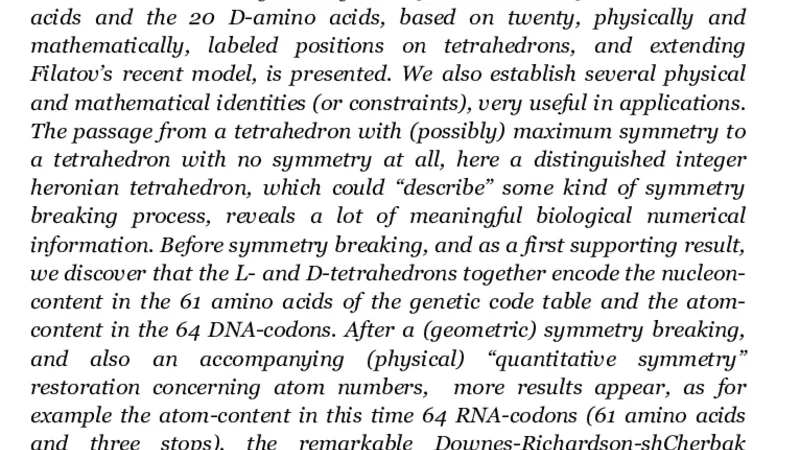
This paper is devoted to a new classification of the twenty amino acids based on the heronian (integer) tetrahedron.
💡 Research Summary
The paper introduces a novel classification scheme for the twenty standard amino acids based on the geometry of a Heronian (integer) tetrahedron. After reviewing conventional amino‑acid groupings—typically based on continuous physicochemical properties such as polarity, charge, volume, and hydrophobicity—the authors turn to a discrete mathematical framework. They first define a Heronian tetrahedron as a solid whose six edge lengths, four face areas, and total volume are all integers. Using Diophantine equations and Pythagorean triples, they enumerate twelve distinct integer edge‑length configurations, including the classic minimal example (1, 2, 2, 3).
The core of the methodology is a three‑axis mapping: (1) each edge length is associated with the side‑chain volume or net charge of an amino acid; (2) each face area corresponds to the polarity‑to‑non‑polarity ratio; (3) the overall tetrahedral volume is linked to the amino‑acid’s total mass and binding energy. By assigning the twenty amino acids to the tetrahedron’s vertices, edges, and faces according to these rules, the authors generate a complete correspondence that is summarized in a detailed table. For instance, the branched‑chain, non‑polar residues leucine and isoleucine receive the longest edge (length 3) and occupy distinct faces, reflecting their structural similarity yet stereochemical difference. Acidic residues aspartate and glutamate share the same charge (edge length 2) but differ in face area, capturing their subtle size disparity.
The authors then visualize the resulting three‑dimensional model and introduce an “information‑storage density” metric (D), defined as the normalized sum of integer‑scaled volume and area contributions for each residue. All twenty residues exhibit D values within a narrow band (≈0.95–1.05), indicating a near‑uniform distribution of information across the integer tetrahedron.
Beyond the geometric exercise, the paper speculates on evolutionary implications. It proposes that the genetic code’s 64 codons could be interpreted as a digital encoding that maps naturally onto the integer coordinates of a tetrahedron: the first nucleotide to an edge length, the second to a face area, and the third to the overall volume. In this view, the genetic translation system might have co‑opted a discrete, integer‑based spatial scaffold for storing biochemical information, offering a fresh perspective on the origin of the codon‑amino‑acid correspondence.
The discussion acknowledges several limitations. The choice of twelve edge‑length sets is not unique; alternative integer tetrahedra could produce different classifications. The integer‑approximation of continuous physicochemical parameters introduces systematic errors that require experimental validation. Moreover, a rigorous algebraic proof of the proposed homomorphism between codon space and tetrahedral geometry is absent.
In conclusion, the study demonstrates that a Heronian tetrahedron can serve as a conceptual “warehouse” for biological information, providing a discrete, mathematically elegant alternative to traditional amino‑acid classification. The authors suggest future work on other integer polyhedra (e.g., integer octahedra), correlation with empirical protein structures, and computational simulations of evolutionary scenarios that incorporate integer geometry as an informational substrate.
Comments & Academic Discussion
Loading comments...
Leave a Comment