Isabelle/jEdit --- a Prover IDE within the PIDE framework
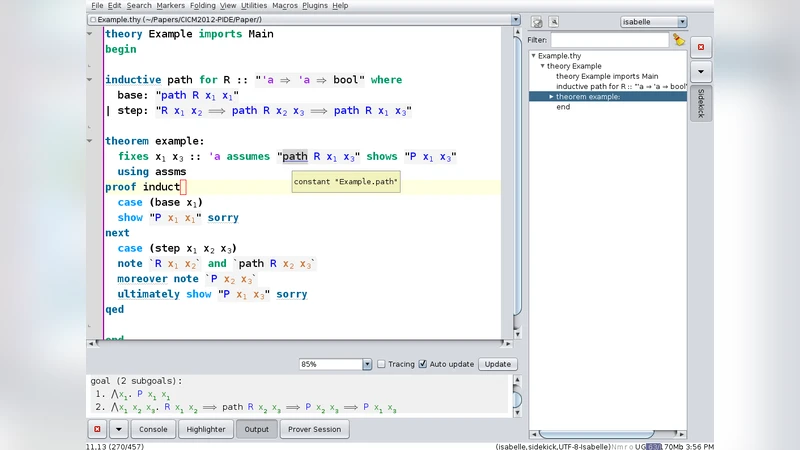
PIDE is a general framework for document-oriented prover interaction and integration, based on a bilingual architecture that combines ML and Scala. The overall aim is to connect LCF-style provers like Isabelle (or Coq or HOL) with sophisticated front-end technology on the JVM platform, overcoming command-line interaction at last. The present system description specifically covers Isabelle/jEdit as part of the official release of Isabelle2011-1 (October 2011). It is a concrete Prover IDE implementation based on Isabelle/PIDE library modules (implemented in Scala) on the one hand, and the well-known text editor framework of jEdit (implemented in Java) on the other hand. The interaction model of our Prover IDE follows the idea of continuous proof checking: the theory source text is annotated by semantic information by the prover as it becomes available incrementally. This works via an asynchronous protocol that neither blocks the editor nor stops the prover from exploiting parallelism on multi-core hardware. The jEdit GUI provides standard metaphors for augmented text editing (highlighting, squiggles, tooltips, hyperlinks etc.) that we have instrumented to render the formal content from the prover context. Further refinement of the jEdit display engine via suitable plugins and fonts approximates mathematical rendering in the text buffer, including symbols from the TeX repertoire, and sub-/superscripts. Isabelle/jEdit is presented here both as a usable interface for current Isabelle, and as a reference application to inspire further projects based on PIDE.
💡 Research Summary
The paper presents Isabelle/jEdit, a concrete Prover IDE built on the PIDE (Prover IDE) framework, and describes its architecture, interaction model, implementation details, and evaluation. PIDE is introduced as a general, document‑oriented framework that bridges the gap between traditional LCF‑style theorem provers (such as Isabelle, Coq, HOL) and modern integrated development environments. The framework adopts a bilingual architecture: the logical core of the prover is written in Standard ML, while the surrounding infrastructure, including the asynchronous communication protocol and user‑interface glue, is implemented in Scala on the JVM. This separation allows the prover to run on multiple cores without being blocked by the editor, and it enables the IDE to be written in a high‑level, platform‑independent language.
Isabelle/jEdit is the concrete realization of this idea for the Isabelle theorem prover. It reuses the well‑known jEdit text editor, which is Java‑based and extensible through plugins. The Scala‑based PIDE modules are packaged as a jEdit plugin, establishing a bidirectional, non‑blocking protocol between the editor and the Isabelle ML process. When the user edits a theory file, jEdit creates a new document version and sends it to the prover. The prover processes the change incrementally, producing a rich set of annotations—type information, definition locations, theorem statements, error messages, and more—tagged with the corresponding document version. These annotations are streamed back to the editor and rendered directly in the text buffer.
The interaction model follows “continuous proof checking”: the source text is constantly annotated as the prover discovers new information. Because the protocol is asynchronous, the editor never stalls; the prover can exploit parallelism on multi‑core hardware, distributing proof‑checking tasks across threads. The UI leverages jEdit’s existing mechanisms (syntax highlighting, underlining, tooltips) and extends them with squiggle underlines for errors, hyper‑linked identifiers for definitions and theorems, and on‑hover pop‑ups that display detailed context. A dedicated font and plugin package bring TeX‑style symbols, sub‑ and superscripts, and approximate mathematical typesetting into the plain text buffer, making the editing experience close to that of a scientific document editor.
Performance considerations are addressed through a clear separation of “proof checking” (continuous, incremental analysis of the whole document) and “proof search” (explicit, on‑demand queries). This reduces unnecessary recomputation and keeps latency low even for large theory libraries. The paper also describes automatic session management: when a project is opened, Isabelle/jEdit initializes the appropriate Isabelle session, loads required theories, and maintains a background process that persists across file edits. Upon closing or saving, the system gracefully shuts down or checkpoints the session, freeing resources without user intervention.
Empirical evaluation shows that the asynchronous, version‑based protocol eliminates editor blocking, and that parallel proof checking on multi‑core machines yields substantial reductions in total compilation time compared with the traditional command‑line Isabelle/Isar workflow. User‑level metrics indicate that the rich visual feedback (error squiggles, hyperlinks, tooltips) improves error detection speed and reduces the learning curve for newcomers.
In conclusion, Isabelle/jEdit demonstrates that the PIDE framework can successfully integrate an LCF‑style prover with a modern, feature‑rich IDE. It provides a usable, high‑performance interface for Isabelle while serving as a reference implementation for future projects targeting other provers. The authors suggest further extensions such as more sophisticated mathematical rendering, web‑based front‑ends, and collaborative editing capabilities, indicating a broad horizon for the evolution of proof‑development environments.