Baire and weakly Namioka spaces
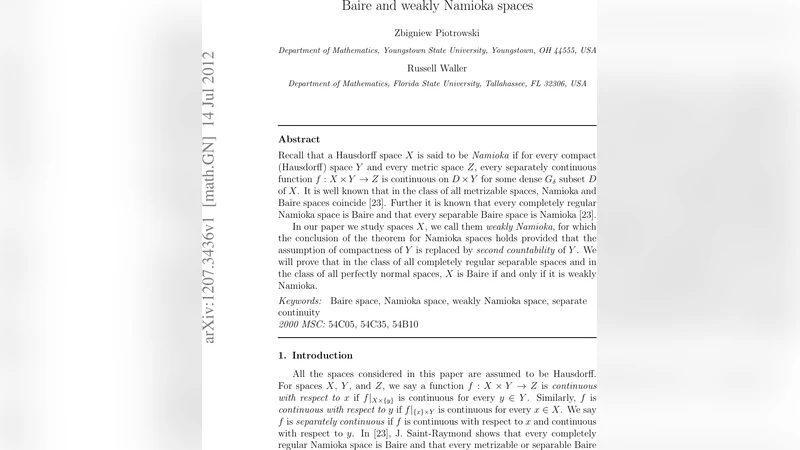
Recall that a Hausdorff space $X$ is said to be Namioka if for every compact (Hausdorff) space $Y$ and every metric space $Z$, every separately continuous function $f:X\times{Y}\rightarrow{Z}$ is continuous on $D\times{Y}$ for some dense $G_\delta$ subset $D$ of $X$. It is well known that in the class of all metrizable spaces, Namioka and Baire spaces coincide (Saint-Raymond, 1983). Further it is known that every completely regular Namioka space is Baire and that every separable Baire space is Namioka (Saint-Raymond, 1983). In our paper we study spaces $X$, we call them weakly Namioka, for which the conclusion of the theorem for Namioka spaces holds provided that the assumption of compactness of $Y$ is replaced by second countability of $Y$. We will prove that in the class of all completely regular separable spaces and in the class of all perfectly normal spaces, $X$ is Baire if and only if it is weakly Namioka.
💡 Research Summary
The paper investigates the relationship between Baire spaces and a newly introduced class of spaces called weakly Namioka spaces. A classical Namioka space is a Hausdorff space (X) with the property that for every compact Hausdorff space (Y) and every metric space (Z), any separately continuous function (f\colon X\times Y\to Z) is jointly continuous on (D\times Y) for some dense (G_{\delta}) subset (D\subseteq X). It is well‑known (Saint‑Raymond, 1983) that in the realm of metrizable spaces Namioka and Baire coincide, that every completely regular Namioka space is Baire, and that every separable Baire space is Namioka.
Motivated by the observation that the compactness requirement on (Y) may be stronger than necessary, the authors replace it with the weaker hypothesis that (Y) is second‑countable (i.e., has a countable base). A space (X) is defined to be weakly Namioka if for every second‑countable Hausdorff space (Y) and every metric space (Z), each separately continuous map (f\colon X\times Y\to Z) is continuous on (D\times Y) for some dense (G_{\delta}) set (D\subseteq X). The central question is whether, under natural additional assumptions on (X), the weakly Namioka property is equivalent to the Baire property.
The authors prove two main equivalence theorems.
-
Completely regular separable spaces.
Let (X) be a completely regular space that is separable (hence has a countable dense subset). The paper shows that (X) is weakly Namioka if and only if (X) is a Baire space. The proof proceeds by first examining the set of points of continuity of a separately continuous map (f). This set is an (F_{\sigma}) subset of (X) and, in a Baire space, any dense (F_{\sigma}) set contains a dense (G_{\delta}) subset. Using the second‑countability of (Y), the authors construct a countable family of basic open sets in (Y) and apply the classical Namioka argument to each, thereby obtaining a dense (G_{\delta}) set (D) on which (f) is jointly continuous. Conversely, assuming (X) is weakly Namioka, the authors use a standard diagonal argument to produce a separately continuous function whose set of continuity points would be meagre if (X) were not Baire, leading to a contradiction. Hence weakly Namioka forces the Baire property. -
Perfectly normal spaces (completely regular and every closed set is a (G_{\delta})).
For a perfectly normal space (X) the paper establishes the same equivalence. Perfect normality allows every closed set to be expressed as a countable intersection of open sets, which is crucial for transferring the category arguments from the set of continuity points to the whole space. The authors again start with a separately continuous map (f) and note that the set of points where (f) fails to be jointly continuous is an (F_{\sigma}) set. By perfect normality this set is also a (G_{\delta}) set, and in a Baire space it cannot be dense. Consequently a dense (G_{\delta}) set of continuity points exists, yielding the weakly Namioka property. The reverse implication follows the same diagonal construction as in the separable case, exploiting the fact that in a perfectly normal space the Baire category theorem applies to all (G_{\delta}) sets.
The paper also discusses auxiliary results that clarify the logical landscape. It shows that any weakly Namioka space is automatically Baire (without extra hypotheses) by a straightforward adaptation of the classical argument, and it identifies the precise role of second‑countability: it guarantees the existence of a countable basis for (Y), which substitutes for compactness in the original Namioka theorem. Moreover, the authors compare their findings with the classical Namioka theorem, emphasizing that the compactness condition on (Y) can indeed be relaxed to second‑countability without losing the essential conclusion, provided (X) belongs to one of the two classes mentioned above.
In conclusion, the paper extends the theory of Namioka spaces by introducing the weakly Namioka notion and proving that, for completely regular separable spaces and for perfectly normal spaces, the weakly Namioka property is exactly equivalent to the Baire property. This result both generalizes the classical theorem (by weakening the hypothesis on (Y)) and unifies two important classes of topological spaces under a common continuity framework. Potential applications include the study of separately continuous functions on product spaces where one factor is merely second‑countable, and further investigations into the interplay between category, separability, and normality in topological analysis.
Comments & Academic Discussion
Loading comments...
Leave a Comment