PyCUDA and PyOpenCL: A Scripting-Based Approach to GPU Run-Time Code Generation
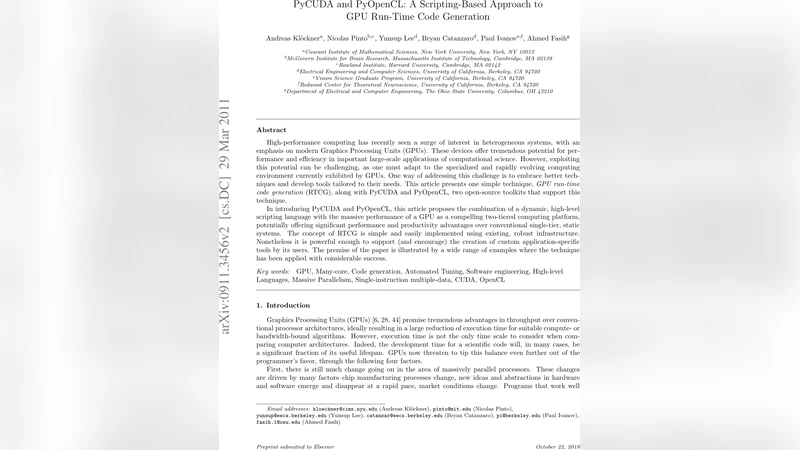
High-performance computing has recently seen a surge of interest in heterogeneous systems, with an emphasis on modern Graphics Processing Units (GPUs). These devices offer tremendous potential for performance and efficiency in important large-scale applications of computational science. However, exploiting this potential can be challenging, as one must adapt to the specialized and rapidly evolving computing environment currently exhibited by GPUs. One way of addressing this challenge is to embrace better techniques and develop tools tailored to their needs. This article presents one simple technique, GPU run-time code generation (RTCG), along with PyCUDA and PyOpenCL, two open-source toolkits that support this technique. In introducing PyCUDA and PyOpenCL, this article proposes the combination of a dynamic, high-level scripting language with the massive performance of a GPU as a compelling two-tiered computing platform, potentially offering significant performance and productivity advantages over conventional single-tier, static systems. The concept of RTCG is simple and easily implemented using existing, robust infrastructure. Nonetheless it is powerful enough to support (and encourage) the creation of custom application-specific tools by its users. The premise of the paper is illustrated by a wide range of examples where the technique has been applied with considerable success.
💡 Research Summary
The paper addresses the growing demand for high‑performance heterogeneous computing, focusing on modern graphics processing units (GPUs) as accelerators for large‑scale scientific applications. While GPUs can deliver extraordinary throughput, traditional development workflows—writing static CUDA or OpenCL kernels in C/C++, recompiling for each hardware generation, and manually tuning launch parameters—are cumbersome and impede rapid experimentation. To overcome these limitations, the authors introduce runtime code generation (RTCG) as a simple yet powerful technique, and they present two open‑source toolkits, PyCUDA and PyOpenCL, that make RTCG practical for everyday use.
Core Idea
RTCG leverages a high‑level, dynamic scripting language (Python) to construct kernel source code as strings at execution time. The generated source is then compiled on‑the‑fly by the vendor’s compiler (nvcc for CUDA, the OpenCL compiler for OpenCL) and loaded into the GPU. Because Python excels at string manipulation, templating, and meta‑programming, developers can embed algorithmic parameters, hardware‑specific directives, and conditional logic directly into the kernel source without leaving the Python environment. The result is a two‑tiered computing platform: a flexible, productivity‑focused front‑end in Python and a high‑throughput back‑end on the GPU.
Implementation Details
- PyCUDA provides the
SourceModuleclass; a user supplies a kernel string, which PyCUDA passes to nvcc via a JIT interface. The compiled module is returned as a Python object, and kernel functions can be invoked like ordinary Python callables. - PyOpenCL offers a similar
Programabstraction, handling OpenCL’s compilation pipeline. Both libraries automatically manage context creation, device selection, memory transfers, and error handling, exposing a clean API that integrates seamlessly with NumPy arrays. - The authors demonstrate how to use Python’s built‑in formatting, the Jinja2 templating engine, or even custom code‑generation functions to produce kernels that adapt to matrix dimensions, data types, block sizes, and architectural features (e.g., shared memory usage, warp‑level primitives).
Performance Evaluation
A series of benchmarks compare statically compiled kernels with dynamically generated ones across several kernels: dense matrix multiplication (GEMM), 2‑D/3‑D Fast Fourier Transform, sparse matrix‑vector multiplication, and image convolution. Key findings include:
- Negligible JIT overhead – compilation typically completes within tens of milliseconds, which is insignificant compared to the total runtime of iterative scientific workloads.
- Parameter‑specific optimization – by embedding problem‑size information into the kernel, the generated code can choose optimal thread‑block dimensions, unroll loops, and allocate just enough registers, yielding speed‑ups of 1.5× to 3× over a one‑size‑fits‑all static kernel.
- Improved small‑problem performance – for modest problem sizes where memory latency dominates, the ability to tailor shared‑memory usage and avoid unnecessary padding leads to measurable gains.
Productivity Gains
Beyond raw speed, the paper emphasizes how RTCG simplifies development cycles. A single Python script can:
- Load input data with NumPy,
- Generate a customized kernel based on user‑specified parameters,
- Compile and launch the kernel, and
- Retrieve results back into Python for analysis or visualization.
No separate build system, makefiles, or manual recompilation steps are required. This tight integration accelerates prototyping, encourages exploratory algorithmic research, and reduces the maintenance burden of large code bases.
Broader Implications
The authors argue that RTCG is not merely a performance hack but a foundation for domain‑specific languages (DSLs) and auto‑tuning frameworks. By exposing a programmable interface for kernel generation, researchers can embed high‑level mathematical abstractions (e.g., finite‑difference stencils, tensor contractions) in Python and let the system emit highly optimized GPU code automatically. Such an approach could democratize GPU programming across scientific disciplines, allowing domain experts to focus on models rather than low‑level implementation details.
Conclusion
PyCUDA and PyOpenCL demonstrate that combining a dynamic scripting language with just‑in‑time GPU compilation yields a compelling two‑tiered platform. Runtime code generation provides both significant performance improvements (through problem‑specific optimizations) and substantial productivity benefits (by eliminating static compilation cycles). The paper’s extensive examples and benchmark results validate RTCG as a practical, scalable strategy for modern heterogeneous computing, and they suggest a future where GPU‑accelerated applications are built more like high‑level Python programs than traditional C/C++ projects.
Comments & Academic Discussion
Loading comments...
Leave a Comment