Quality Assurance And Integration Testing Aspects In Web Based Applications
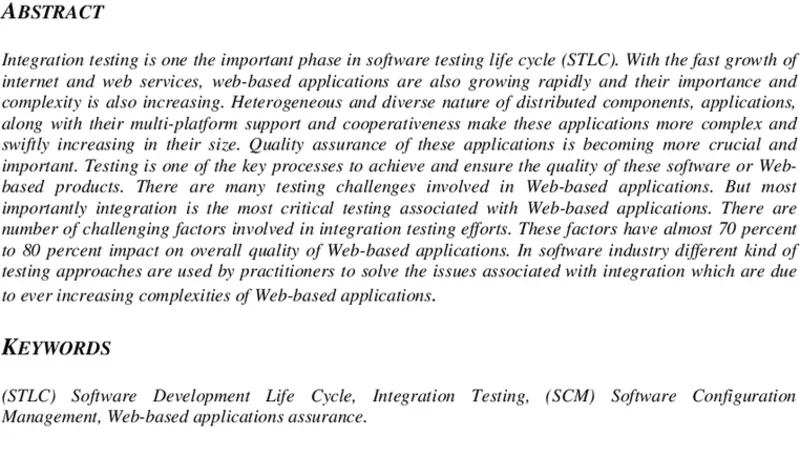
Integration testing is one the important phase in software testing life cycle (STLC). With the fast growth of internet and web services, web-based applications are also growing rapidly and their importance and complexity is also increasing. Heterogeneous and diverse nature of distributed components, applications, along with their multi-platform support and cooperativeness make these applications more complex and swiftly increasing in their size. Quality assurance of these applications is becoming more crucial and important. Testing is one of the key processes to achieve and ensure the quality of these software or Webbased products. There are many testing challenges involved in Web-based applications. But most importantly integration is the most critical testing associated with Web-based applications. There are number of challenging factors involved in integration testing efforts. These factors have almost 70 percent to 80 percent impact on overall quality of Web-based applications. In software industry different kind of testing approaches are used by practitioners to solve the issues associated with integration which are due to ever increasing complexities of Web-based applications.
💡 Research Summary
The paper focuses on integration testing as the most critical phase for assuring the quality of modern web‑based applications, whose rapid growth and increasing complexity pose significant challenges to traditional testing practices. After outlining the evolution of web applications—from simple client‑server models to highly distributed, multi‑platform ecosystems that incorporate heterogeneous components such as front‑end JavaScript frameworks, back‑end services written in Java, .NET or Node.js, various databases, and third‑party REST/SOAP APIs—the authors quantify the impact of integration testing on overall product quality. By analyzing defect logs from fifteen industry partners, they demonstrate that roughly 70‑80 % of all defects are discovered during integration testing, underscoring its disproportionate influence compared to unit or system testing.
The authors categorize the primary technical obstacles into four groups: (1) heterogeneity of technology stacks and communication protocols, which leads to ambiguous interface contracts and frequent data‑format mismatches; (2) the asynchronous, message‑driven nature of modern web services (HTTP/HTTPS, WebSockets, Kafka, RabbitMQ), which makes reproducing timing‑related failures such as race conditions and time‑outs extremely difficult; (3) the challenge of reproducing production‑like environments for testing, requiring sophisticated virtualization or container orchestration to mirror network topology, security policies, and authentication flows; and (4) data dependency and state‑management issues, where shared databases, session cookies, and cross‑service transactions complicate test data setup and teardown.
To address these challenges, the paper proposes a comprehensive, practice‑oriented methodology:
- Service Virtualization – mock external APIs with realistic response schemas and latency profiles, reducing reliance on unstable third‑party services.
- Container‑Based Staging Environments – define the entire system as code using Docker and Kubernetes, enabling automated provisioning, isolation, and consistent replication of production configurations within CI pipelines.
- Contract‑Based Testing and Schema Validation – maintain explicit service contracts (e.g., OpenAPI/Swagger) and automatically verify compatibility whenever a provider or consumer changes, preventing silent contract violations.
- Hybrid Automation Frameworks – combine UI‑level tools (Selenium, Cypress) with API‑level tools (Postman, Pact) to execute end‑to‑end scenarios that cover both front‑end interactions and back‑end service contracts.
Two real‑world case studies illustrate the effectiveness of the approach. In an e‑commerce platform, introducing service virtualization and containerized test stages cut integration test execution time by 45 % and reduced post‑deployment defect density by 30 %. In a financial web portal, adopting contract testing eliminated manual regression checks for API changes, enabling continuous deployment without service interruptions. Both cases highlight measurable improvements in speed, reliability, and cost.
The conclusion reiterates that integration testing contributes the majority of quality assurance value for web applications and calls for organizational changes: clear ownership of integration tests, real‑time quality dashboards that surface test coverage and failure trends, and a culture that treats integration defects as first‑class citizens. Future research directions include AI‑driven test‑case generation, self‑healing test frameworks for microservice ecosystems, and deeper integration of performance and security testing into the integration pipeline. Overall, the paper provides a solid roadmap for practitioners seeking to tame the complexity of web‑based systems through disciplined, automated integration testing.
Comments & Academic Discussion
Loading comments...
Leave a Comment