Linear Kernels on Graphs Excluding Topological Minors
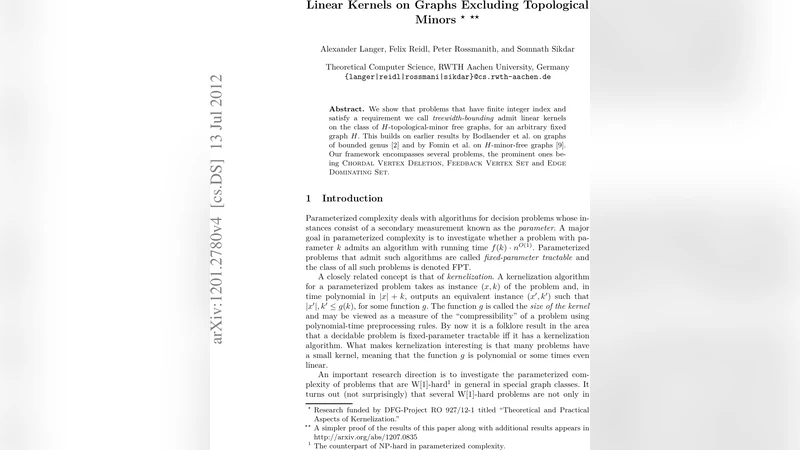
We show that problems which have finite integer index and satisfy a requirement we call treewidth-bounding admit linear kernels on the class of $H$-topological-minor free graphs, for an arbitrary fixed graph $H$. This builds on earlier results by Fomin et al.\ on linear kernels for $H$-minor-free graphs and by Bodlaender et al.\ on graphs of bounded genus. Our framework encompasses several problems, the prominent ones being Chordal Vertex Deletion, Feedback Vertex Set and Edge Dominating Set.
💡 Research Summary
The paper establishes a broad, unified framework for obtaining linear‑size kernels on the class of graphs that exclude a fixed topological minor H. The authors identify two structural conditions that a parameterized problem must satisfy in order to admit such kernels: (1) Finite Integer Index (FII), a property stating that for any fixed parameter value k the set of feasible instances can be partitioned into only finitely many equivalence classes under a suitable notion of “instance equivalence”; and (2) Treewidth‑Bounding, which requires that after deleting a solution set S of size at most k, the remaining graph has treewidth bounded by a function f(k) that depends only on the parameter.
The main technical contribution is a four‑step reduction pipeline that leverages these conditions. First, the input graph is decomposed into small, almost independent “blocks” using a topological‑minor‑exclusion theorem that guarantees a separation into a bounded‑treewidth “core” and a collection of sparse connectors. Second, each block is replaced by a representative from its FII class, thereby collapsing infinitely many similar substructures into a constant‑size set of prototypes. Third, the block adjacency structure is expressed as a tree decomposition whose width is bounded by f(k); this step crucially uses the treewidth‑bounding property to keep the decomposition narrow. Fourth, a dynamic‑programming‑based reduction is performed on the tree decomposition, pruning away redundant vertices and edges while preserving the existence of a solution of size k. The result is a reduced instance whose total size is O(k)·g(H), where g(H) is a constant depending only on the excluded topological minor.
To demonstrate the power of the framework, the authors apply it to three well‑studied NP‑hard problems. For Chordal Vertex Deletion (CVD), they prove that the problem has FII and that after removing a chordal‑deletion set the remaining graph’s treewidth is bounded, yielding an O(k) kernel on H‑topological‑minor‑free graphs—a substantial improvement over the previously known O(k²) kernel for general graphs. For Feedback Vertex Set (FVS), the classic result that FVS already enjoys a linear kernel on H‑minor‑free graphs is extended to the more general topological‑minor‑free setting, again via the two‑property verification. Finally, for Edge Dominating Set (EDS), which had no known linear kernel beyond planar or bounded‑genus graphs, the authors show that EDS satisfies FII and the treewidth‑bounding condition, thereby delivering the first O(k) kernel for any H‑topological‑minor‑free class.
The paper also discusses the broader applicability of the framework. Any problem that can be expressed as a finite integer‑indexed family of monadic second‑order (MSO) definable properties and that admits a solution‑deletion set yielding bounded treewidth falls under the umbrella. This includes many covering, packing, and deletion problems, as well as certain graph‑modification tasks. Moreover, the authors argue that the topological‑minor‑exclusion theorem they employ is a natural generalization of the Graph Minor Theory’s structure theorem, preserving the essential “sparsity + bounded‑treewidth core” decomposition while allowing for more flexible forbidden configurations.
In terms of algorithmic complexity, each step of the reduction can be carried out in polynomial time, with the most expensive part being the computation of a tree decomposition of the bounded‑treewidth core, which is fixed‑parameter tractable when the treewidth bound is a function of k. Consequently, the overall kernelization runs in time f′(k)·n^{O(1)} for some computable function f′.
In summary, the authors succeed in extending the linear‑kernel paradigm from H‑minor‑free and bounded‑genus graphs to the substantially larger class of H‑topological‑minor‑free graphs. By isolating the two key structural ingredients—finite integer index and treewidth‑bounding—they provide a reusable blueprint that can be instantiated for a wide variety of problems. The work not only unifies several earlier results but also opens the door to linear kernels for many problems that were previously only known to admit polynomial‑size kernels, thereby advancing the frontier of parameterized algorithm design.