Superpotential algebras and manifolds
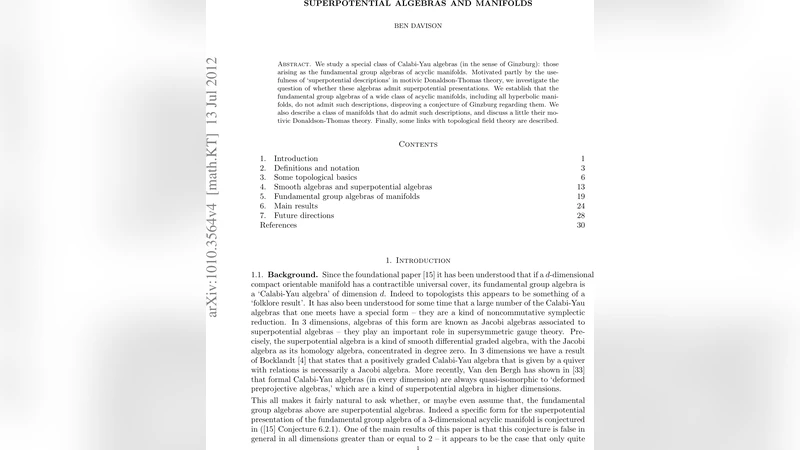
In this paper we study a special class of Calabi-Yau algebras (in the sense of Ginzburg): those arising as the fundamental group algebras of acyclic manifolds. Motivated partly by the usefulness of `superpotential descriptions’ in motivic Donaldson-Thomas theory, we investigate the question of whether these algebras admit superpotential presentations. We establish that the fundamental group algebras of a wide class of acyclic manifolds, including all hyperbolic manifolds, do not admit such descriptions, disproving Ginzburg’s conjecture regarding them. We also describe a class of manifolds that do admit such descriptions, and discuss a little their motivic Donaldson-Thomas theory. Finally, some links with topological field theory are described.
💡 Research Summary
The paper investigates a distinguished class of Calabi‑Yau algebras—those that arise as group algebras of the fundamental groups of acyclic manifolds—in the framework introduced by Ginzburg. The motivation stems from the pivotal role that superpotential (or “potential”) presentations play in motivic Donaldson‑Thomas (DT) theory, where a Jacobian algebra defined by a quiver Q and a cyclic potential W provides a tractable model for computing DT invariants. The central question is whether every such fundamental‑group algebra k
Comments & Academic Discussion
Loading comments...
Leave a Comment