Monte Carlo simulations of global Compton cooling in inner regions of hot accretion flows
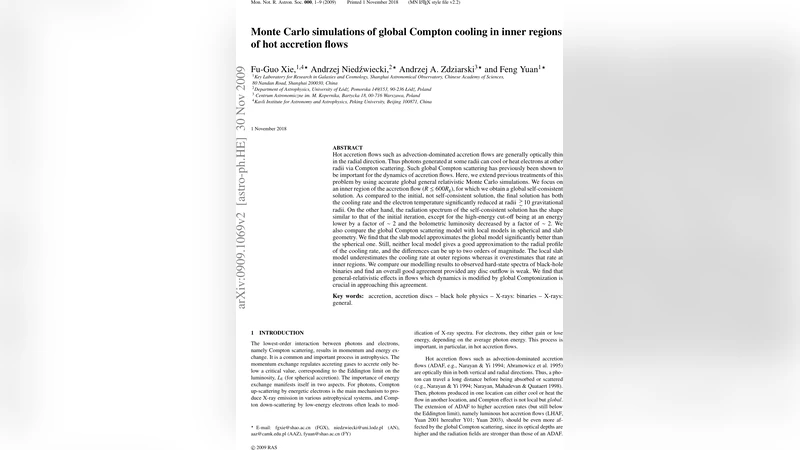
Hot accretion flows such as advection-dominated accretion flows are generally optically thin in the radial direction. Thus photons generated at some radii can cool or heat electrons at other radii via Compton scattering. Such global Compton scattering has previously been shown to be important for the dynamics of accretion flows. Here, we extend previous treatments of this problem by using accurate global general relativistic Monte Carlo simulations. We focus on an inner region of the accretion flow (R < 600R_g), for which we obtain a global self-consistent solution. As compared to the initial, not self-consistent solution, the final solution has both the cooling rate and the electron temperature significantly reduced at radii >=10 gravitational radii. On the other hand, the radiation spectrum of the self-consistent solution has the shape similar to that of the initial iteration, except for the high-energy cut-off being at an energy lower by a factor of ~2 and the bolometric luminosity decreased by a factor of ~2. We also compare the global Compton scattering model with local models in spherical and slab geometry. We find that the slab model approximates the global model significantly better than the spherical one. Still, neither local model gives a good approximation to the radial profile of the cooling rate, and the differences can be up to two orders of magnitude. The local slab model underestimates the cooling rate at outer regions whereas it overestimates that rate at inner regions. We compare our modelling results to observed hard-state spectra of black-hole binaries and find an overall good agreement provided any disc outflow is weak. We find that general-relativistic effects in flows which dynamics is modified by global Comptonization is crucial in approaching this agreement.
💡 Research Summary
The paper investigates the role of global Compton scattering in hot, optically‑thin accretion flows (e.g., advection‑dominated accretion flows, ADAFs) by performing fully relativistic Monte‑Carlo (MC) simulations that treat photon transport self‑consistently across the inner region of the flow (R < 600 R_g). Traditional treatments have usually adopted local approximations, assuming that photons interact only with electrons at the radius where they are produced. In reality, photons can travel hundreds of gravitational radii before scattering, thereby coupling distant zones of the flow.
To capture this coupling, the authors construct a GR‑MC code that follows photon trajectories in the Schwarzschild metric, includes gravitational redshift and light‑bending, and computes Compton scattering with electrons whose temperature and distribution are taken from an underlying hydrodynamic solution. The procedure is iterative: an initial 1‑D ADAF solution provides electron temperature and density profiles; the MC simulation then yields a radial cooling‑rate profile; this cooling profile is fed back into the energy equation, updating the electron temperature; the cycle repeats until convergence, producing a self‑consistent solution.
The converged solution shows two striking changes relative to the initial (non‑self‑consistent) model. First, beyond ∼10 R_g the electron temperature drops markedly, indicating that photons generated at larger radii efficiently cool the inner flow. Second, the emergent spectrum retains the same overall shape but the high‑energy cutoff shifts down by a factor of ≈2 (from ∼200 keV to ∼100 keV) and the bolometric luminosity is reduced by roughly a factor of two. These effects arise because the lower electron temperature reduces the efficiency of inverse‑Compton up‑scattering, suppressing the production of the hardest photons.
The authors then compare the global MC results with two commonly used local Compton models: a spherical geometry (isotropic photon field) and a slab geometry (plane‑parallel photon field). The slab model reproduces the global cooling rate more closely than the spherical model, yet both fail to capture the correct radial dependence. The slab model underestimates cooling in the outer zones (R > 100 R_g) and overestimates it in the innermost region (R < 10 R_g), with discrepancies reaching up to two orders of magnitude. The failure of the local models is traced to their neglect of photon anisotropy, photon travel across large radii, and general‑relativistic effects such as light bending and gravitational redshift.
Finally, the authors confront their self‑consistent spectra with observed hard‑state X‑ray spectra of black‑hole binaries (e.g., Cyg X‑1, GX 339‑4). When the accretion flow is assumed to have only a weak disc outflow (i.e., the mass accretion rate is roughly conserved inward), the model reproduces the observed photon index (Γ ≈ 1.5–1.7) and the high‑energy cutoff (∼100–200 keV) quite well. Strong outflows would lower the electron temperature further, making the spectrum too soft compared with observations. Thus, incorporating global Compton cooling and full GR photon transport is essential for achieving quantitative agreement with data.
In summary, this work provides a robust framework for coupling global radiative transfer with the dynamics of hot accretion flows. It demonstrates that global Compton cooling can substantially modify both the thermodynamic structure and the emergent spectrum, and that local approximations are insufficient for accurate modeling. The methodology paves the way for more realistic multi‑dimensional MHD simulations and for interpreting high‑quality X‑ray observations from current and upcoming missions.
Comments & Academic Discussion
Loading comments...
Leave a Comment