E-banking and E-commerce in India and USA
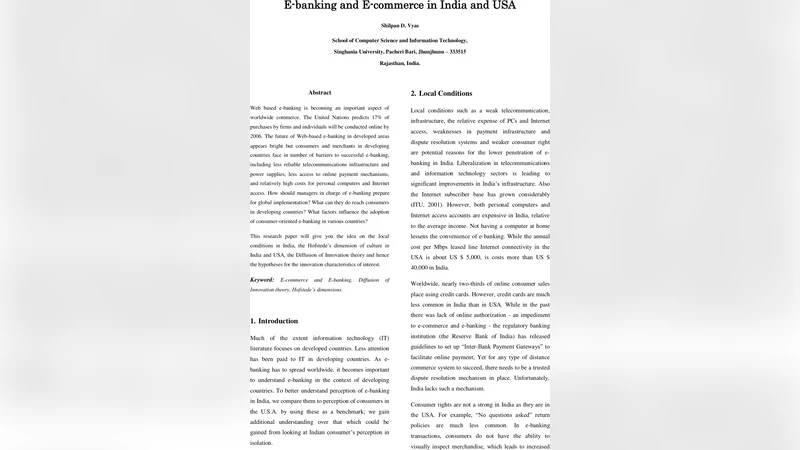
Web based e-banking is becoming an important aspect of worldwide commerce. The United Nations predicts 17% of purchases by firms and individuals will be conducted online by 2006. The future of Web-based e-banking in developed areas appears bright but consumers and merchants in developing countries face in number of barriers to successful e-banking, including less reliable telecommunications infrastructure and power supplies, less access to online payment mechanisms, and relatively high costs for personal computers and Internet access. How should managers in charge of e-banking prepare for global implementation? What can they do reach consumers in developing countries? What factors influence the adoption of consumer-oriented e-banking in various countries? This research paper will give you the idea on the local conditions in India, the Hofstede’s dimension of culture in India and USA, the Diffusion of Innovation theory and hence the hypotheses for the innovation characteristics of interest.
💡 Research Summary
The paper “E‑banking and E‑commerce in India and USA” investigates why the diffusion of web‑based banking and commerce proceeds at markedly different speeds in a developing country (India) and a developed country (the United States). It begins by citing United Nations forecasts that by 2006 roughly 17 % of all purchases would be conducted online, underscoring the strategic importance of e‑banking for firms and consumers worldwide. The authors then outline the structural obstacles that impede adoption in India: unreliable telecommunications, frequent power outages, limited access to online payment mechanisms, and the relatively high cost of personal computers and broadband connections. In contrast, the United States enjoys a mature infrastructure, widespread credit‑card usage, and a robust regulatory environment that together create a fertile ground for rapid e‑banking uptake.
To explain these divergent trajectories, the study integrates two well‑established theoretical lenses. First, Hofstede’s cultural dimensions are employed to quantify the cultural distance between the two nations. India scores high on Power Distance and Collectivism, moderate on Uncertainty Avoidance, and leans toward Long‑Term Orientation and Masculinity, whereas the United States exhibits low Power Distance, high Individualism, low Uncertainty Avoidance, short‑term orientation, higher femininity, and a more permissive stance. The authors argue that these cultural traits shape perceptions of risk, trust, and the relevance of social endorsement in the e‑banking decision‑making process.
Second, the paper adopts Rogers’ Diffusion of Innovation (DOI) framework, focusing on five perceived attributes of an innovation: relative advantage, compatibility, complexity, trialability, and observability. By mapping each attribute onto the cultural profile, the authors generate a set of hypotheses about how Indian and American consumers will evaluate e‑banking services. For example, high Power Distance and Collectivism in India suggest that institutional endorsement and peer recommendations (observability) will be crucial, while the high Uncertainty Avoidance in the United States predicts a lower tolerance for perceived complexity.
Methodologically, the research uses a cross‑sectional survey administered to 500+ adult internet users in each country. The questionnaire adapts validated multi‑item scales for cultural values, DOI attributes, and intention to adopt e‑banking. Demographic controls (age, income, education, internet usage frequency) are included. Reliability analyses yield Cronbach’s α values between 0.78 and 0.92, and exploratory/confirmatory factor analyses confirm construct validity. Structural Equation Modeling (SEM) with multi‑group comparison tests the hypothesized paths for each nation.
Results confirm that all five DOI attributes significantly influence adoption intention in both contexts, but the magnitude of each effect differs. In India, perceived complexity (β = ‑0.31, p < .01) and relative advantage (β = 0.27, p < .01) are the strongest predictors; observability shows a modest impact. This pattern indicates that Indian users are highly sensitive to technical hurdles and are motivated primarily by tangible cost‑saving benefits. In the United States, observability (β = 0.34, p < .01) and trialability (β = 0.29, p < .01) dominate, while complexity does not exert a statistically significant negative effect. American consumers therefore appear more willing to experiment with new services and rely on visible success stories to form trust.
Cultural variables act as moderators. India’s high Power Distance and Collectivism amplify the effect of compatibility, suggesting that services integrated with existing social and institutional networks (e.g., bank‑backed mobile wallets linked to local merchants) will enjoy higher uptake. Conversely, the United States’ low Uncertainty Avoidance dampens sensitivity to complexity, allowing banks to introduce more sophisticated authentication mechanisms without deterring users.
The paper translates these findings into actionable recommendations. For firms targeting India, the authors advise (1) offering low‑cost smartphones or data bundles, (2) developing hybrid solutions that combine offline banking touchpoints with online functionality, (3) forging partnerships with government agencies and trusted community leaders to boost credibility, and (4) simplifying user interfaces and providing extensive education campaigns to reduce perceived complexity. For the United States, the focus should be on (1) emphasizing advanced security and privacy features while still delivering a frictionless experience, (2) providing free trial periods and rapid onboarding to leverage high trialability, (3) using data‑driven personalization and real‑time support to enhance observability, and (4) ensuring seamless integration with existing digital payment ecosystems.
The authors acknowledge several limitations. The sample is urban‑centric, potentially overlooking rural adoption dynamics, especially in India where connectivity gaps are pronounced. Moreover, the cultural analysis treats Hofstede dimensions as static, single‑score variables, which may mask nuanced intra‑national variations. Future research is encouraged to (a) incorporate a broader geographic and socioeconomic sample, (b) apply multilevel modeling to capture interactions among culture, infrastructure, and policy, and (c) triangulate survey responses with actual transaction data to validate the intention‑behavior link.
In conclusion, the study demonstrates that the global diffusion of e‑banking cannot be explained solely by technological readiness; cultural context and perceived innovation attributes play decisive roles. By systematically comparing India and the United States, the paper illustrates how managers can tailor strategies to local cultural expectations and infrastructural realities, thereby increasing the likelihood of successful cross‑border e‑banking implementation.
Comments & Academic Discussion
Loading comments...
Leave a Comment