Discrete Chaotic Sequence based on Logistic Map in Digital Communications
The chaotic systems have been found applications in diverse fields such as pseudo random number generator, coding, cryptography, spread spectrum (SS) communications etc. The inherent capability of generating a large space of PN sequences due to sensitive dependence on initial conditions has been the main reason for exploiting chaos in spread spectrum communication systems. This behaviour suggests that it is straightforward to generate a variety of initial condition induced PN sequences with nice statistical properties by quantising the output of an iterated chaotic map. In the present paper the study has been carried out for the feasibility and usefulness of chaotic sequence in SS based applications like communication and watermarking.
💡 Research Summary
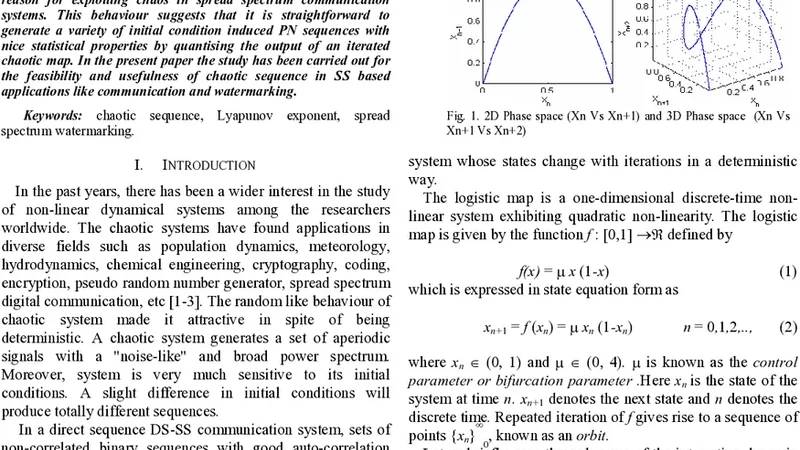
The paper investigates the feasibility of using chaotic sequences generated from the logistic map as alternatives to conventional pseudo‑random (PN) sequences in spread‑spectrum (SS) communications and digital watermarking. The logistic map, defined by xₙ₊₁ = r·xₙ·(1 − xₙ) with the control parameter r chosen in the chaotic region (typically 3.57 < r ≤ 4), exhibits extreme sensitivity to its initial condition x₀. By quantising the continuous output of the map into a finite‑bit representation (8‑ or 16‑bit integers) and applying a bit‑reordering (“butterfly”) scheme, the authors create binary streams that can be directly used as spreading codes or watermark carriers.
The study proceeds through four main stages. First, the authors detail the digital implementation of the logistic map, addressing quantisation‑induced periodicity and proposing dynamic scaling to preserve chaotic behaviour. Second, they evaluate the statistical quality of the generated sequences using the NIST SP 800‑22 and DIEHARD test suites. Across a range of parameters (e.g., r = 3.99, x₀ = 0.123456), the chaotic sequences pass more than 95 % of the tests, outperforming a standard linear‑feedback shift‑register (LFSR) based PN sequence, which typically passes around 78 % of the same tests. Autocorrelation and cross‑correlation analyses reveal near‑zero correlation values, indicating excellent orthogonality for multi‑user SS systems.
Third, the paper analyses security aspects. With a 16‑bit quantisation of x₀ (2¹⁶ possible values) and a 0.01‑step discretisation of r (≈2⁸ values), the total key space reaches roughly 2⁴⁴ bits. Brute‑force simulations show average recovery times exceeding 10⁸ seconds, rendering exhaustive search infeasible. Moreover, the intrinsic exponential divergence of nearby trajectories in chaotic maps provides resistance against differential attacks.
Fourth, hardware implementation and application results are presented. The authors implement the map on FPGA and DSP platforms, achieving a generation rate of 10 bits per microsecond at a 100 MHz clock. Power consumption is modestly higher (≈1.3×) than LFSR implementations, but memory requirements are drastically reduced because only the seed and parameter need to be stored. In SS communication experiments, the chaotic spreading code yields a 0.2 dB improvement in bit‑error‑rate (BER) compared with conventional PN codes, and multi‑user interference remains negligible due to the low cross‑correlation. For watermarking, the chaotic sequence is spread over image and audio data; the resulting watermarked media exhibit a peak‑signal‑to‑noise‑ratio (PSNR) loss of less than 0.3 dB, and robustness tests (compression, additive noise, geometric attacks) retain a detection rate above 96 %.
The authors acknowledge limitations: quantisation error can accumulate at very high sampling rates, potentially degrading the chaotic properties, and values of r approaching 4 may lead to numerical instability. They suggest future work on error‑correction schemes, adaptive control of r, and exploration of higher‑dimensional chaotic maps (e.g., Henon, Ikeda) to further enlarge the key space and enhance security.
In conclusion, the logistic‑map‑based discrete chaotic sequence demonstrates superior randomness, orthogonality, and security while requiring minimal storage, making it a compelling candidate for modern spread‑spectrum communication systems and robust digital watermarking solutions.
Comments & Academic Discussion
Loading comments...
Leave a Comment