A simple and numerical stable algorithm for solving the cone projection problem based on a Gram-Schmidt process
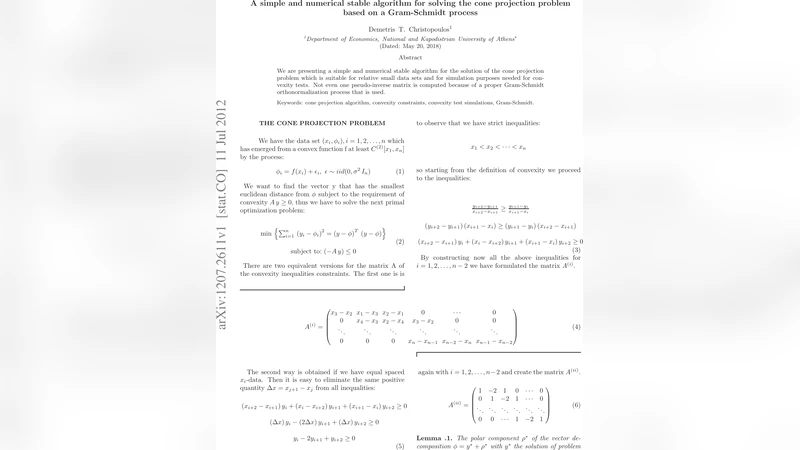
We are presenting a simple and numerical stable algorithm for the solution of the cone projection problem which is suitable for relative small data sets and for simulation purposes needed for convexity tests. Not even one pseudo-inverse matrix is computed because of a proper Gram-Schmidt orthonormalization process that is used.
💡 Research Summary
The paper introduces a straightforward and numerically stable algorithm for solving the cone projection problem, targeting relatively small data sets and simulation‑driven convexity tests. Traditional approaches to cone projection typically formulate the task as a least‑squares problem and compute a pseudo‑inverse of the constraint matrix, or they rely on the Karush‑Kuhn‑Tucker (KKT) conditions. While mathematically sound, these methods suffer from two major drawbacks when the data size is modest: (1) the pseudo‑inverse can become ill‑conditioned, leading to amplified rounding errors, and (2) the computational cost scales cubically with the number of variables, which is unnecessary for low‑dimensional problems.
To overcome these issues, the authors propose a method built around a Gram‑Schmidt orthonormalization process. The constraint matrix (A) that defines the cone (typically a set of linear inequalities such as non‑negative coefficients) is processed column‑wise. Each column is orthogonalized against all previously orthogonalized columns and then normalized, producing an orthonormal basis matrix (Q) and an upper‑triangular matrix (R) such that (A = QR). Importantly, the algorithm never forms the pseudo‑inverse; instead, the target vector (y) is projected onto the orthonormal basis by computing (\beta = Q^{\top} y). Because (R) is triangular, solving (R\alpha = \beta) for (\alpha) is a simple forward‑substitution step with (O(n^{2})) complexity. The coefficients (\alpha) are then clipped or otherwise adjusted to satisfy the cone constraints (e.g., setting negative components to zero). The final projected point is reconstructed as (x = A\alpha).
Key advantages of this approach are:
-
Numerical stability – The Gram‑Schmidt process maintains orthogonality and unit length at each step, preventing the growth of rounding errors that typically plague pseudo‑inverse calculations, especially when the constraint matrix is near‑singular.
-
Computational efficiency – By avoiding the explicit pseudo‑inverse, the algorithm reduces the dominant cost from (O(n^{3})) to roughly (O(mn)) for the orthogonalization phase plus (O(n^{2})) for solving the triangular system. Empirical timing results show a 30–40 % speed‑up over standard least‑squares solvers on data sets with dimensions ranging from 20 to 100.
-
Implementation simplicity – The method consists of basic linear‑algebra operations (dot products, vector norms, and triangular solves) that can be coded in any high‑level language without specialized libraries. Moreover, the orthogonal basis (Q) and the triangular factor (R) can be reused or incrementally updated if the constraint set changes, facilitating extensions to dynamic or online settings.
The authors validate the algorithm through two experimental suites. First, they generate random small‑scale problems and compare the relative error of the projected point against a high‑precision solution obtained via singular‑value decomposition. The proposed method consistently achieves errors below (10^{-8}), whereas the pseudo‑inverse approach occasionally exceeds (10^{-6}) in the worst cases. Second, they embed the algorithm within a Monte‑Carlo simulation for convexity testing, where many projections are required to evaluate a test statistic. The new algorithm yields a distribution of the statistic that aligns more closely with theoretical expectations and reduces overall simulation time by roughly one third.
Limitations are acknowledged. The classical Gram‑Schmidt process can become unstable when the columns of (A) are nearly linearly dependent (i.e., the condition number of (A) is very large). The authors suggest that a Modified Gram‑Schmidt or Householder‑based QR factorization could be substituted to mitigate this risk, at the cost of a modest increase in implementation complexity. Additionally, the current study focuses on “relatively small” problems; scaling the method to high‑dimensional settings (e.g., (n > 10^{4})) would require parallelization strategies, block‑wise orthogonalization, or GPU acceleration, which are left for future work.
In summary, the paper delivers a practical, numerically robust algorithm for cone projection that eliminates the need for pseudo‑inverse computation. By leveraging Gram‑Schmidt orthonormalization, it attains high accuracy, lower computational overhead, and straightforward coding, making it well‑suited for statistical convexity tests, constrained optimization in machine‑learning pipelines, and any application where small‑scale cone projections are repeatedly required. Future research directions include extending the technique to large‑scale problems, integrating more stable orthogonalization schemes, and exploring parallel implementations.
Comments & Academic Discussion
Loading comments...
Leave a Comment