Some Euler-type formulas for planar graphs
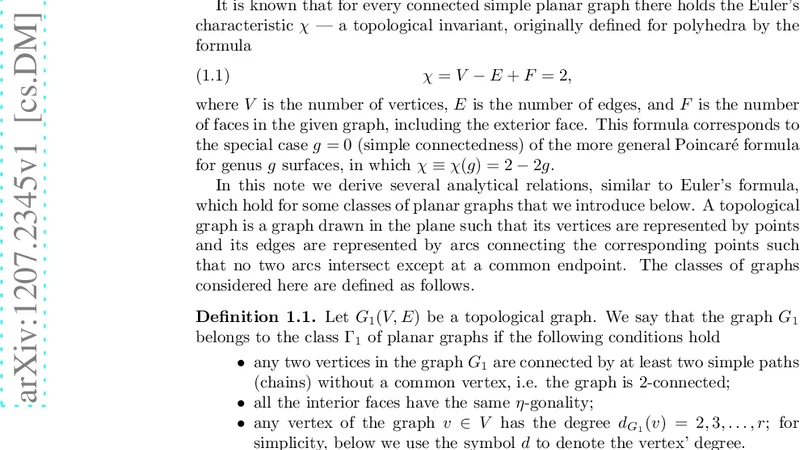
The aim of this paper is to derive on the basis of the Euler’s formula several analytical relations which hold for certain classes of planar graphs and which can be useful in algorithmic graph theory.
💡 Research Summary
The paper “Some Euler‑type formulas for planar graphs” builds on the classical Euler relation V − E + F = 2 and derives a family of more detailed identities that connect the degree distribution of vertices with the size distribution of faces in planar graphs. The authors first partition the vertex set V into subsets V_k, where V_k denotes the number of vertices of degree k, and similarly partition the face set F into subsets F_l, where F_l counts faces whose boundary consists of l edges. Using the well‑known handshaking lemmas Σ_k k·V_k = 2E and Σ_l l·F_l = 2E, they substitute these expressions into Euler’s formula and obtain the general “Euler‑type” identity
Σ_k (k − 2)·V_k = Σ_l (l − 2)·F_l.
This equation states that the total “excess” degree (over 2) contributed by vertices equals the total “excess” edge count (over 2) contributed by faces. It refines the global Euler invariant into a balance between local vertex and face characteristics.
The paper then specializes this identity for several important subclasses of planar graphs:
-
Triangulations (all faces are triangles). Here F_l is non‑zero only for l = 3, and V_k exists only for k ≥ 3. The identity reduces to Σ_k (k − 2)·V_k = F_3. Combining with V − E + F = 2 yields V − 2 = Σ_k (k − 4)·V_k, a compact relation that directly links the number of vertices to the distribution of vertex degrees in a triangulation. This formula can be used to bound the number of high‑degree vertices or to verify whether a given degree sequence can be realized as a planar triangulation.
-
Quadrangulations with degree restriction (all faces are quadrilaterals, vertices have degree 2 or 4 only). Substituting k ∈ {2,4} and l = 4 gives 0·V_2 + 2·V_4 = 2·F_4, i.e., V_4 = F_4. Thus the number of degree‑4 vertices equals the number of quadrilateral faces. This identity explains the regularity observed in square grids and provides a quick consistency check for any candidate quadrangulation.
-
Mixed‑size faces (triangles and quadrilaterals) with minimum degree 3. The general identity becomes Σ_k (k − 2)·V_k = F_3 + 2·F_4. This relation can be rearranged to express, for example, the proportion of triangular to quadrilateral faces in terms of the average vertex degree, which is useful in mesh generation and in analyzing planar subdivisions arising in geographic information systems.
Beyond theoretical derivations, the authors discuss algorithmic applications. Given a prescribed degree sequence {V_k}, the identity can be used as a feasibility test: solve for integer {F_l} that satisfy the equation; if no integer solution exists, the degree sequence cannot correspond to any planar embedding. When a solution exists, the paper outlines a constructive approach that integrates the feasibility check with incremental planar embedding algorithms (such as canonical ordering or the de Fraysseix‑Pach‑Pollack method). This pre‑validation step dramatically reduces the search space for embedding algorithms, leading to faster generation of planar graphs that meet specific structural constraints.
The paper also demonstrates that the new formulas subsume several classical results. For triangulations, the inequality 3V − 6 ≥ E (a standard bound derived from Euler’s formula) follows directly from Σ_k (k − 2)·V_k = F_3. For quadrangulations, the equality V_4 = F_4 recovers the known relationship between the number of degree‑4 vertices and faces in regular square grids.
In the concluding section, the authors suggest extensions to non‑planar surfaces (e.g., toroidal embeddings) where the Euler characteristic differs, and they propose exploring analogous degree‑face balance equations for higher‑genus graphs. They also hint at potential applications in optimization problems such as minimizing the number of faces of a given size under degree constraints, or designing planar networks with prescribed robustness properties.
Overall, the paper enriches planar graph theory by providing a systematic way to translate the global Euler invariant into a set of local balance equations. These equations not only deepen the theoretical understanding of how vertex degrees and face sizes interact but also offer practical tools for algorithm designers who need to generate, validate, or manipulate planar graphs with specific structural requirements.
Comments & Academic Discussion
Loading comments...
Leave a Comment