Metadynamics with adaptive Gaussians
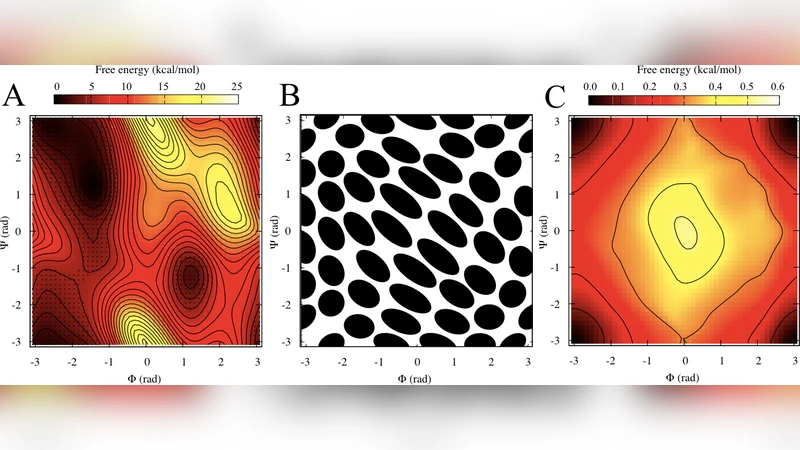
Metadynamics is an established sampling method aimed at reconstructing the free-energy surface relative to a set of appropriately chosen collective variables. In standard metadynamics the free-energy surface is filled by the addition of Gaussian potentials of pre-assigned and typically diagonal covariance. Asymptotically the free-energy surface is proportional to the bias deposited. Here we consider the possibility of using Gaussians whose variance is adjusted on the fly to the local properties of the free-energy surface. We suggest two different prescriptions: one is based on the local diffusivity and the other on the local geometrical properties. We further examine the problem of extracting the free-energy surface when using adaptive Gaussians. We show that the standard relation between the bias and the free energy does not hold. In the limit of narrow Gaussians an explicit correction can be evaluated. In the general case we propose to use instead a relation between bias and free energy borrowed from umbrella sampling. This relation holds for all kinds of incrementally deposited bias. We illustrate on the case of alanine dipeptide the advantage of using adaptive Gaussians in conjunction with the new free-energy estimator both in terms of accuracy and speed of convergence.
💡 Research Summary
Metadynamics is a powerful enhanced‑sampling technique that reconstructs the free‑energy surface (FES) as a function of a set of collective variables (CVs) by progressively depositing Gaussian bias potentials. In the conventional formulation the Gaussians have fixed height, width and a diagonal covariance matrix that is chosen a priori. While this approach guarantees that, in the long‑time limit, the accumulated bias V(s) converges to the negative of the underlying free energy F(s), in practice the fixed‑width Gaussians can be poorly matched to the local curvature of the FES. In regions of high curvature the bias may be too broad, leading to oversmoothing, whereas in flat regions it may be too narrow, causing inefficient filling and slow convergence.
The authors propose a novel “adaptive Gaussian” scheme in which the covariance of each deposited Gaussian is updated on the fly according to local properties of the FES. Two concrete prescriptions are introduced. The first, diffusion‑based, estimates the local diffusion coefficient D(s) from recent CV fluctuations and sets the Gaussian width σ(s) ∝ √