Atoms of multistationarity in chemical reaction networks
Chemical reaction systems are dynamical systems that arise in chemical engineering and systems biology. In this work, we consider the question of whether the minimal (in a precise sense) multistationary chemical reaction networks, which we propose to call atoms of multistationarity,' characterize the entire set of multistationary networks. Our main result states that the answer to this question is yes’ in the context of fully open continuous-flow stirred-tank reactors (CFSTRs), which are networks in which all chemical species take part in the inflow and outflow. In order to prove this result, we show that if a subnetwork admits multiple steady states, then these steady states can be lifted to a larger network, provided that the two networks share the same stoichiometric subspace. We also prove an analogous result when a smaller network is obtained from a larger network by removing species.' Our results provide the mathematical foundation for a technique used by Siegal-Gaskins et al. of establishing bistability by way of network ancestry.’ Additionally, our work provides sufficient conditions for establishing multistationarity by way of atoms and moreover reduces the problem of classifying multistationary CFSTRs to that of cataloging atoms of multistationarity. As an application, we enumerate and classify all 386 bimolecular and reversible two-reaction networks. Of these, exactly 35 admit multiple positive steady states. Moreover, each admits a unique minimal multistationary subnetwork, and these subnetworks form a poset (with respect to the relation of `removing species’) which has 11 minimal elements (the atoms of multistationarity).
💡 Research Summary
The paper addresses the fundamental problem of determining which chemical reaction networks (CRNs) admit multiple positive steady states—a property known as multistationarity, which underlies bistable behavior in biochemical switches and chemical engineering processes. The authors introduce the notion of “atoms of multistationarity,” defined as minimal networks that are themselves multistationary and lose this property upon removal of any species or reaction. The central question is whether these atoms fully characterize the set of all multistationary networks, at least within the class of fully open continuous‑flow stirred‑tank reactors (CFSTRs), where every species participates in both inflow and outflow reactions.
The paper proceeds in several logical stages. First, it formalizes the language of CRNs, defining species, complexes, reactions, and the stoichiometric subspace. A CFSTR is a special case in which the stoichiometric subspace coincides with the whole concentration space, because the inflow reactions span the canonical basis. The dynamics are governed by mass‑action kinetics, yielding polynomial ODEs of the form (\dot x = \sum_k \kappa_k x^{y_k}(y’_k - y_k)).
The main theoretical contribution is a pair of “lifting” theorems. Theorem 3.1 shows that if a subnetwork (N) shares the same stoichiometric subspace as a larger network (M) and possesses a non‑degenerate pair of positive steady states for some choice of rate constants, then those steady states can be lifted to (M) under the same constants. The proof extends the earlier work of Craciun and Feinberg by exploiting the equality of stoichiometric subspaces and the full rank of the Jacobian restricted to that subspace. Theorem 4.2 (and its corollary 4.6) adapts this result to CFSTRs and to “embedded” networks—networks obtained by simultaneously deleting species and reactions while preserving the involvement of the remaining species. Consequently, any embedded CFSTR that is multistationary forces the original CFSTR to be multistationary as well. This provides a rigorous foundation for the “network ancestry” technique previously used heuristically by Siegal‑Gaskins et al. to infer bistability.
Having established that multistationarity propagates upward in the partial order defined by embedding, the authors define atoms of multistationarity as the minimal elements of this poset. In other words, a CFSTR is an atom if it is multistationary and no proper embedded CFSTR retains multistationarity.
The second major component of the work is a systematic enumeration and classification of a concrete class of networks: reversible, bimolecular (each complex contains at most two molecules) networks with exactly two non‑flow reactions. Using combinatorial generation of reaction graphs and isomorphism reduction, the authors identify 386 distinct fully open CFSTRs of this type (Algorithm 6.4). For each network they apply a suite of analytical tools: the Jacobian Criterion, injectivity tests, and the newly proved lifting theorems. They also perform explicit parameter searches to locate positive steady states when needed.
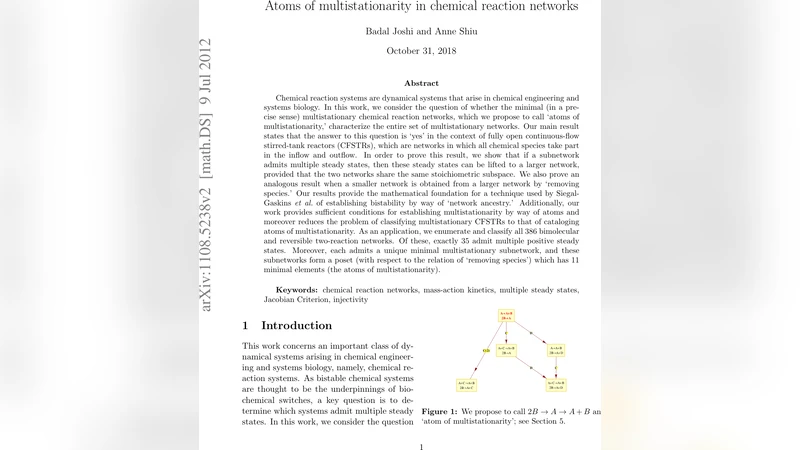
The outcome of this exhaustive analysis is striking: only 35 of the 386 networks admit multiple positive steady states under mass‑action kinetics. Moreover, each of these 35 networks contains a unique minimal multistationary sub‑CFSTR. The collection of these minimal subnetworks forms a poset under the embedding relation, and this poset has exactly 11 minimal elements. These 11 networks constitute the atoms of multistationarity for the class of bimolecular two‑reaction CFSTRs. Figure 3 in the paper displays these atoms, which typically involve a simple feedback loop such as (2B \rightarrow A \rightarrow A + B).
The authors discuss the implications of these findings. By cataloguing the atoms, one can decide multistationarity of any larger network in the same class simply by checking for the presence of an atom as an embedded subnetwork. This reduces the otherwise intractable problem of solving high‑dimensional polynomial systems with unknown parameters to a combinatorial subgraph‑search problem. The approach also complements existing deficiency‑theory and injectivity methods, offering a new, computationally efficient pathway for analyzing bistability in synthetic biology circuit design and in the analysis of industrial reaction networks.
Finally, the paper outlines future directions, including extending the atom catalog to networks with more reactions, higher molecularity, or non‑reversible steps, and exploring the structural properties that make a network an atom (e.g., the presence of self‑activation motifs). The work thus bridges rigorous mathematical theory with practical tools for the systematic design and analysis of multistationary chemical reaction systems.
Comments & Academic Discussion
Loading comments...
Leave a Comment