Generating the bounded derived category and perfect ghosts
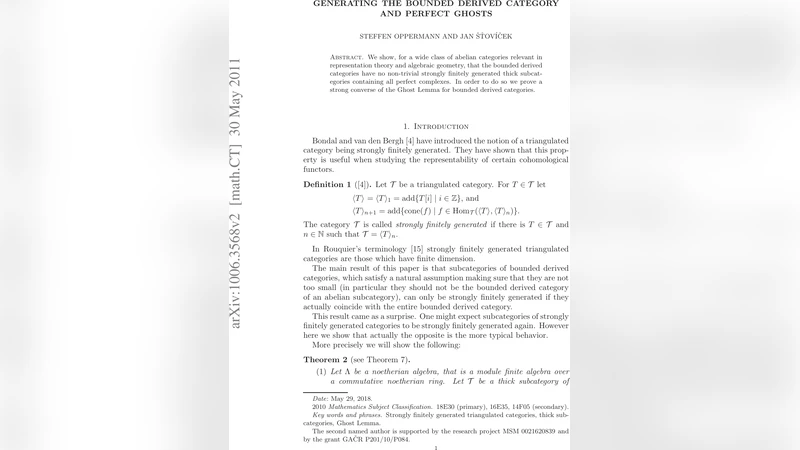
We show, for a wide class of abelian categories relevant in representation theory and algebraic geometry, that the bounded derived categories have no non-trivial strongly finitely generated thick subcategories containing all perfect complexes. In order to do so we prove a strong converse of the Ghost Lemma for bounded derived categories.
💡 Research Summary
The paper investigates the structure of bounded derived categories D⁽ᵇ⁾(𝒜) for a broad class of abelian categories 𝒜 that arise naturally in representation theory and algebraic geometry. The central objects of interest are the perfect complexes, denoted Perf(𝒜), which are those complexes admitting a finite resolution by projective objects. The authors focus on thick subcategories 𝒯 of D⁽ᵇ⁾(𝒜) that contain Perf(𝒜) and ask whether such subcategories can be strongly finitely generated, i.e., generated by a single object through a finite number of cones, shifts, and direct summands.
The main theorem (Theorem A) asserts that if 𝒜 satisfies reasonable finiteness conditions—enough projectives, finite‑dimensional Ext groups, and a Krull–Schmidt property—then no thick subcategory 𝒯 containing Perf(𝒜) can be strongly finitely generated. Equivalently, every such 𝒯 must contain non‑trivial “ghost” maps, morphisms that become zero after applying any functor represented by a perfect complex.
To reach this conclusion the authors develop a strong converse to the classical Ghost Lemma. They introduce the notion of ghost length, measuring how many successive ghost maps are needed to annihilate a given morphism. In a strongly finitely generated thick subcategory, ghost length is uniformly bounded; the paper shows that this boundedness cannot hold when Perf(𝒜) is present. The proof proceeds in three stages: (1) constructing families of objects whose Ext‑groups with perfect complexes are non‑zero in arbitrarily high degrees (using Koszul complexes and tilting objects), (2) proving that bounded ghost length would force these Ext‑groups to vanish beyond a fixed degree, and (3) deriving a contradiction.
The authors illustrate the theorem with several concrete settings. For a finite‑dimensional algebra A, the bounded derived category D⁽ᵇ⁾(A‑mod) contains Perf(A) = K⁽ᵇ⁾(proj‑A); the result shows that any thick subcategory containing all perfect complexes is necessarily not strongly finitely generated. For a Noetherian scheme X, the same statement holds for D⁽ᵇ⁾(Coh X) with Perf(X) ⊂ D⁽ᵇ⁾(Coh X). Similar conclusions are drawn for representation‑finite algebras, finite group schemes, and regular schemes of finite Krull dimension.
Beyond the immediate structural result, the paper proposes a new invariant—ghost dimension—that quantifies the complexity of ghost maps in a triangulated category. The authors suggest that this invariant could be used to detect whether a given thick subcategory is strongly finitely generated, opening a pathway to algorithmic classification problems in triangulated categories.
In summary, the work establishes that the presence of all perfect complexes forces a thick subcategory of a bounded derived category to be “infinitely generated” in the strong sense, and it does so by proving a robust converse to the Ghost Lemma. This deepens our understanding of the interplay between perfect objects, ghost morphisms, and generation properties, with implications across representation theory, algebraic geometry, and the broader theory of triangulated categories.
Comments & Academic Discussion
Loading comments...
Leave a Comment