Turbulent mixing driven by mean-flow shear and internal gravity waves in oceans and atmospheres
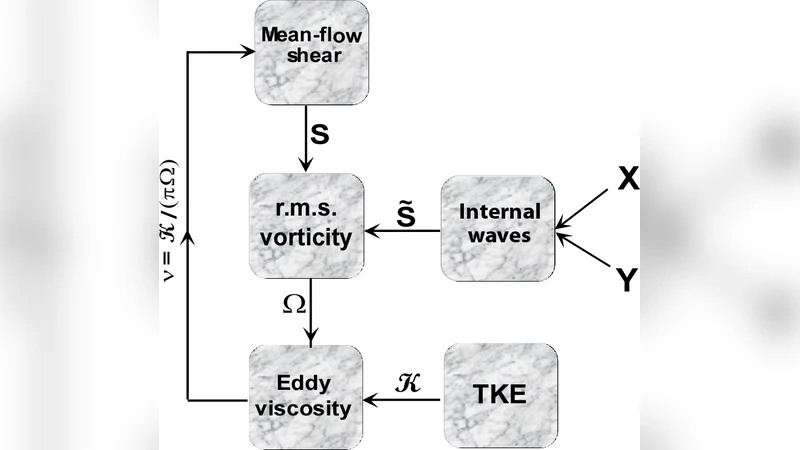
This study starts with balances deduced by Baumert and Peters (2004, 2005) from results of stratified-shear experiments made in channels and wind tunnels by Itsweire (1984) and Rohr and Van Atta (1987), and of free-decay experiments in a resting stratified tank by Dickey and Mellor (1980). Using a modification of Canuto’s (2002) ideas on turbulence and waves, these balances are merged with an (internal) gravity-wave energy balance presented for the open ocean by Gregg (1989), without mean-flow shear. The latter was augmented by a linear (viscous) friction term. Gregg’s wave-energy source is interpreted on its long-wave spectral end as internal tides, topography, large-scale wind, and atmospheric low-pressure actions. In addition, internal eigen waves, generated by mean-flow shear, and the aging of the wave field from a virginal (linear) into a saturated state are taken into account. Wave packets and turbulence are treated as particles (vortices, packets) by ensemble kinetics so that the loss terms in all three balances have quadratic form. Following a proposal by Peters (2008), the mixing efficiency of purely wave-generated turbulence is treated as a universal constant, as well as the turbulent Prandtl number under neutral conditions. It is shown that: (i) in the wind tunnel, eigen waves are switched off, (ii) due to remotely generated long waves or other non-local energy sources, coexistence equilibria of turbulence and waves are stable even at Richardson numbers as high as $10^3$; (iii) the three-equation system is compatible with geophysically shielded settings like certain stratified laboratory flows. The agreement with a huge body of observations surprises. Gregg’s (1989) wave-model component and the a.m. universal constants taken apart, the equations contain only one additional dimensionless parameter for the eigen-wave closure, estimated as $Y\approx 1.35.$
💡 Research Summary
The paper develops a unified theoretical framework for turbulent mixing in stratified geophysical flows where both mean‑flow shear and internal gravity waves are active. Starting from the energy balances derived by Baumert and Peters (2004, 2005) – which themselves are grounded in channel and wind‑tunnel experiments by Itsweire (1984) and Rohr & Van Atta (1987) as well as free‑decay tank studies by Dickey & Mellor (1980) – the authors incorporate a modified version of Canuto’s (2002) turbulence‑wave interaction ideas. They merge these balances with Gregg’s (1989) internal‑wave energy equation for the open ocean, adding a linear viscous friction term to represent small‑scale dissipation.
In this combined system, the wave‑energy source on the long‑wave end of the spectrum is interpreted as a mixture of internal tides, topographic forcing, large‑scale wind, and atmospheric low‑pressure systems. The model also accounts for eigen‑waves generated directly by the mean shear and for the “aging” of an initially linear wave field into a saturated, nonlinear state. Both wave packets and turbulent eddies are treated as particles in an ensemble‑kinetic description, which forces all loss terms in the three coupled balances to assume a quadratic (energy × energy) form. Following Peters (2008), the mixing efficiency of turbulence that is purely wave‑generated is taken as a universal constant, as is the turbulent Prandtl number under neutral stratification.
Key findings are: (i) in wind‑tunnel conditions eigen‑waves are effectively switched off, leaving only shear‑generated turbulence; (ii) when remote long‑wave energy (e.g., internal tides) or other non‑local sources are present, a stable coexistence equilibrium of turbulence and waves can persist even at Richardson numbers as high as 10³, far beyond the classic critical value; (iii) the three‑equation system remains valid for “geophysically shielded” laboratory flows where external energy input is blocked. The model reproduces a wide body of observational data with surprising accuracy. Apart from Gregg’s wave‑model component and the universal constants, the only additional dimensionless closure parameter required for the eigen‑wave contribution is Y≈1.35. This parsimonious parameterization offers a practical route to embed coupled shear‑wave‑turbulence dynamics into large‑scale oceanic and atmospheric circulation models.
Comments & Academic Discussion
Loading comments...
Leave a Comment