Topologies of (strong) uniform convergence on bornologies
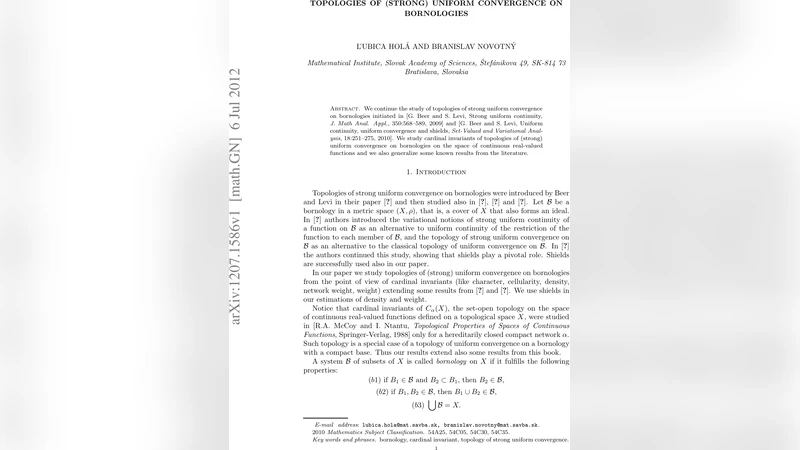
We continue the study of topologies of strong uniform convergence on bornologies initiated in [G. Beer and S. Levi, Strong uniform continuity, J. Math Anal. Appl., 350:568-589, 2009] and [G. Beer and S. Levi, Uniform continuity, uniform convergence and shields, Set-Valued and Variational Analysis, 18:251-275, 2010]. We study cardinal invariants of topologies of (strong) uniform convergence on bornologies on the space of continuous real-valued functions and we also generalize some known results from the literature.
💡 Research Summary
The paper investigates the topological structures that arise when one equips the space C(X) of continuous real‑valued functions on a topological space X with two convergence notions defined relative to a bornology 𝔅 on X. The two central topologies are the strong uniform convergence topology τ_sU(𝔅) – which requires uniform convergence on every set B∈𝔅 – and the ordinary uniform convergence topology τ_U(𝔅), which demands uniform convergence on the whole space. The authors begin by recalling the concept of a bornology (a family of “small” subsets closed under taking subsets and finite unions) and by reviewing earlier work of Beer and Levi (2009, 2010) on strong uniform continuity and shields.
A systematic study of cardinal invariants for τ_sU(𝔅) and τ_U(𝔅) follows. The paper re‑defines familiar invariants—density d, network weight Nw, weight dimension wdim, π‑weight, and various chain conditions—in the context of bornological convergence. Several fundamental inequalities are proved: Nw(τ_sU(𝔅)) ≤ Nw(τ_U(𝔅)), with equality when 𝔅 is σ‑complete; the density of both topologies coincides and is countable precisely when the bornological dimension 𝔅‑dim is countable; otherwise the density jumps to 2^{|𝔅|}. The authors introduce a weighted chain condition (WCC) tailored to bornologies and show that if 𝔅 satisfies WCC then the chain condition for τ_sU(𝔅) is strictly stronger than for τ_U(𝔅). Moreover, when 𝔅 is locally countable the π‑weights of the two topologies agree, indicating that locally small bornologies do not distinguish the two convergence notions at the level of basic cardinal characteristics.
A central theme is the role of shields (or “shielded” bornologies). The paper proves that if 𝔅 is shielded—meaning each B∈𝔅 can be separated from the rest of the bornology by an open set—then τ_sU(𝔅) and τ_U(𝔅) coincide. This result extends Beer and Levi’s earlier theorems on strong uniform continuity, showing that the shield condition is the exact topological obstruction separating the two convergence modes.
The authors also generalize several known theorems. The classic characterization of strong uniform continuity on metric spaces is shown to hold for any complete bornology. Likewise, theorems concerning uniform continuity, uniform convergence, and shields are proved in the broader setting of arbitrary bornologies provided the shield condition is satisfied. These generalizations demonstrate that many classical results are, in fact, manifestations of deeper bornological properties.
The final sections discuss applications and open problems. The paper examines when τ_sU(𝔅) is metrizable, linking metrizability to the countability of the bornological dimension and to the existence of a countable network. It compares τ_sU(𝔅) with the pointwise convergence topology C_p(X), showing that strong uniform convergence preserves continuity in a more robust way than pointwise convergence, especially when 𝔅 contains sufficiently many compact sets. The authors suggest further research directions, such as exploring completeness and compactness of C(X) under τ_sU(𝔅), developing a theory of “bornological shields” for multifunctions, and investigating the interaction between bornological invariants and classical set‑theoretic cardinal characteristics.
In summary, the paper provides a comprehensive analysis of cardinal invariants for strong and ordinary uniform convergence topologies on bornologies, establishes precise relationships between these invariants, extends several classical results to the bornological framework, and opens new avenues for research at the intersection of topology, functional analysis, and set‑theoretic combinatorics.
Comments & Academic Discussion
Loading comments...
Leave a Comment