UPPAAL-SMC: Statistical Model Checking for Priced Timed Automata
This paper offers a survey of uppaalsmc, a major extension of the real-time verification tool uppaal. uppaalsmc allows for the efficient analysis of performance properties of networks of priced timed automata under a natural stochastic semantics. In particular, uppaalsmc relies on a series of extensions of the statistical model checking approach generalized to handle real-time systems and estimate undecidable problems. uppaalsmc comes together with a friendly user interface that allows a user to specify complex problems in an efficient manner as well as to get feedback in the form of probability distributions and compare probabilities to analyze performance aspects of systems. The focus of the survey is on the evolution of the tool - including modeling and specification formalisms as well as techniques applied - together with applications of the tool to case studies.
💡 Research Summary
The paper presents UPPAAL‑SMC, an extension of the well‑known real‑time verification tool UPPAAL that incorporates statistical model checking (SMC) techniques for the analysis of priced timed automata (PTA). A PTA is a timed automaton enriched with cost variables (prices) attached to locations and edges, allowing the simultaneous quantitative treatment of time and resource consumption. The authors define a natural stochastic semantics for PTAs by assigning probability distributions to nondeterministic choices and by treating time progress as a continuous stochastic process. Consequently, system executions correspond to infinite families of paths, but SMC enables the extraction of a finite, representative sample set for quantitative evaluation.
Two principal SMC tasks are supported. The first, probability estimation, computes point estimates and confidence intervals for properties such as “the probability that response time ≤ 5 ms”. Both Bayesian and frequentist estimators are implemented, and the required number of samples is adjusted dynamically to meet a user‑specified confidence level. The second, hypothesis testing, employs sequential probability ratio tests (SPRT) and related sequential methods to decide statements of the form “the probability is at least p₀?” within user‑defined Type‑I (α) and Type‑II (β) error bounds. By avoiding exhaustive state‑space exploration, these techniques dramatically reduce computational effort while still providing rigorous statistical guarantees.
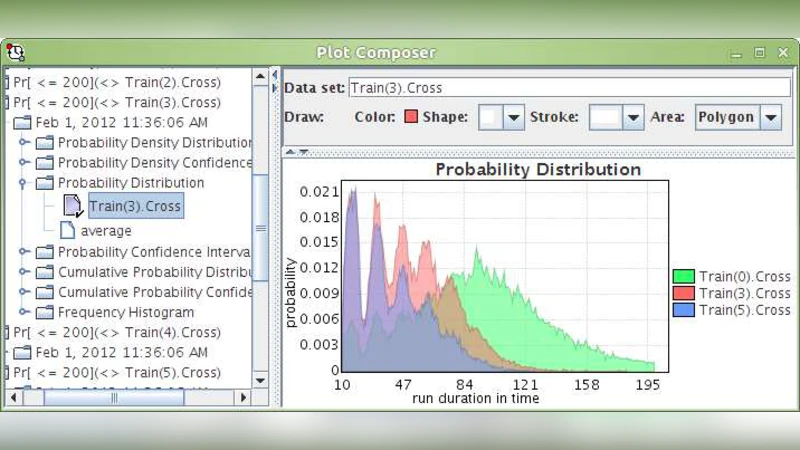
From an algorithmic standpoint, UPPAAL‑SMC reuses the existing UPPAAL simulation engine and augments it with modules that handle real‑valued price accumulation and probabilistic branching. Simulation proceeds via a hybrid of time‑step and event‑driven mechanisms; price variables are updated continuously and reported at the end of each run. The tool also offers distribution estimation facilities that construct histograms or kernel density estimates for time‑ and price‑related observables, giving designers immediate visual feedback on performance characteristics.
The user interface extends the UPPAAL modelling language with price and probability annotations. For example, a transition may be labeled price = 3.5 to indicate a cost of 3.5 units incurred when the transition fires. Verification commands are grouped under simulate, estimate, and hypothesis, each accepting options for sample size, confidence level, and error thresholds. Results are presented both as textual logs and as graphical outputs (probability distributions, cumulative cost curves), making the analysis accessible to engineers without deep expertise in formal methods.
Three case studies illustrate the practical impact of the tool. (1) In a wireless sensor network, the authors model a routing protocol that trades off packet delay against energy consumption. Using UPPAAL‑SMC they demonstrate, with 95 % confidence, that a particular routing strategy yields an average delay below 10 ms while consuming less than 0.5 J per packet. (2) In a real‑time manufacturing scenario, job sequencing is modelled with both makespan and production cost. Hypothesis testing rejects the claim that a priority‑based scheduler reduces cost by 10 % at a significance level of 0.01, guiding the designers toward alternative scheduling policies. (3) For an urban traffic‑signal control system, the tool estimates the distribution of vehicle waiting times under different signal periods; the analysis shows that a modest adjustment of the cycle length can reduce average waiting time by roughly 20 %. These examples highlight the ability of UPPAAL‑SMC to handle undecidable or computationally prohibitive verification problems that involve continuous cost variables and stochastic behavior.
In conclusion, UPPAAL‑SMC integrates quantitative PTA modelling, stochastic semantics, and statistical verification into a single, user‑friendly environment. It opens a new avenue for the design and analysis of complex embedded and cyber‑physical systems where performance, reliability, and resource usage must be evaluated jointly. The authors suggest future work on adaptive sampling strategies to further improve sample efficiency, on multivariate cost analysis to capture correlations among different resources, and on cloud‑based large‑scale simulation pipelines to support industrial‑scale case studies.
Comments & Academic Discussion
Loading comments...
Leave a Comment