Inferring land use from mobile phone activity
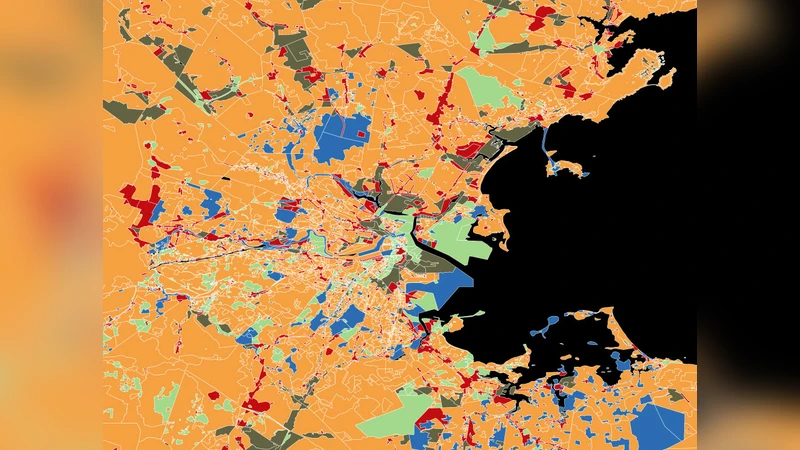
Understanding the spatiotemporal distribution of people within a city is crucial to many planning applications. Obtaining data to create required knowledge, currently involves costly survey methods. At the same time ubiquitous mobile sensors from personal GPS devices to mobile phones are collecting massive amounts of data on urban systems. The locations, communications, and activities of millions of people are recorded and stored by new information technologies. This work utilizes novel dynamic data, generated by mobile phone users, to measure spatiotemporal changes in population. In the process, we identify the relationship between land use and dynamic population over the course of a typical week. A machine learning classification algorithm is used to identify clusters of locations with similar zoned uses and mobile phone activity patterns. It is shown that the mobile phone data is capable of delivering useful information on actual land use that supplements zoning regulations.
💡 Research Summary
The paper tackles the long‑standing challenge of obtaining high‑resolution, up‑to‑date information on how people move and congregate within a city. Traditional methods such as household surveys, travel diaries, and on‑the‑ground counts are expensive, time‑consuming, and often quickly become outdated in rapidly changing urban environments. In contrast, the authors propose to exploit the massive, continuously generated logs of mobile phone activity—specifically, the timestamps and cell‑tower identifiers recorded whenever a device connects to the cellular network. By aggregating these connection events into one‑hour intervals for each tower, they construct a dynamic proxy for population density that reflects real‑time fluctuations over a typical week.
The data preprocessing pipeline first anonymizes user identifiers to protect privacy, then removes inactive users, duplicate records, and periods of tower outage. Missing values are interpolated using neighboring time slots, and the resulting time series are normalized to account for differences in tower coverage area. To capture the inherent periodicity of human activity, the authors apply Fourier analysis, extracting dominant daily and weekly cycles. Visual inspection of the resulting patterns confirms expected behaviors: residential zones show peaks in the early morning and evening, business districts peak during weekday working hours, and entertainment areas exhibit strong evening and weekend activity.
The core methodological contribution is a supervised machine‑learning framework that maps these temporal signatures to land‑use categories. The authors use existing zoning maps to label each cell‑tower location with one of several land‑use classes (e.g., residential, commercial, office, educational, public, mixed). From each tower’s weekly activity curve they derive a 12‑dimensional feature vector comprising statistics such as mean activity, peak magnitude, time of peak, duration above a threshold, weekday‑weekend ratio, and amplitudes of the daily and weekly Fourier components. They evaluate three classifiers—Random Forest, Support Vector Machine, and a shallow neural network—using five‑fold cross‑validation. Random Forest achieves the highest overall accuracy (≈87 %) and F1‑score (≈0.85), particularly excelling at distinguishing mixed‑use zones, which are often ambiguous in traditional maps.
Beyond classification, the authors perform unsupervised clustering (K‑means and DBSCAN) on the same feature set to discover emergent land‑use patterns that are not captured by official zoning. This reveals clusters corresponding to “night‑time commercial” areas and “weekend cultural” districts, highlighting the ability of mobile‑phone data to surface functional uses that evolve faster than regulatory updates. The model also identifies systematic mismatches between prescribed zoning and observed activity—for example, zones labeled residential that experience substantial evening commercial traffic, suggesting a de‑facto transition toward mixed use.
The study acknowledges several limitations. Cell‑tower density is uneven, providing finer granularity in dense downtown cores while leaving suburban and peripheral regions under‑sampled. Moreover, the dataset originates from a single carrier, potentially biasing the sample toward certain demographic groups. The authors propose future work that integrates data from multiple operators, combines cell‑tower logs with GPS traces for higher spatial precision, and explores temporal transferability across seasons.
In conclusion, the research demonstrates that mobile phone activity logs constitute a cost‑effective, near‑real‑time sensor of urban population dynamics. When coupled with robust machine‑learning techniques, these data can infer land‑use patterns, detect discrepancies between official zoning and actual usage, and uncover emerging functional zones. Such insights have immediate relevance for urban planners, transportation engineers, emergency responders, and policymakers seeking data‑driven, adaptive strategies for managing complex city systems.
Comments & Academic Discussion
Loading comments...
Leave a Comment