Living Devices
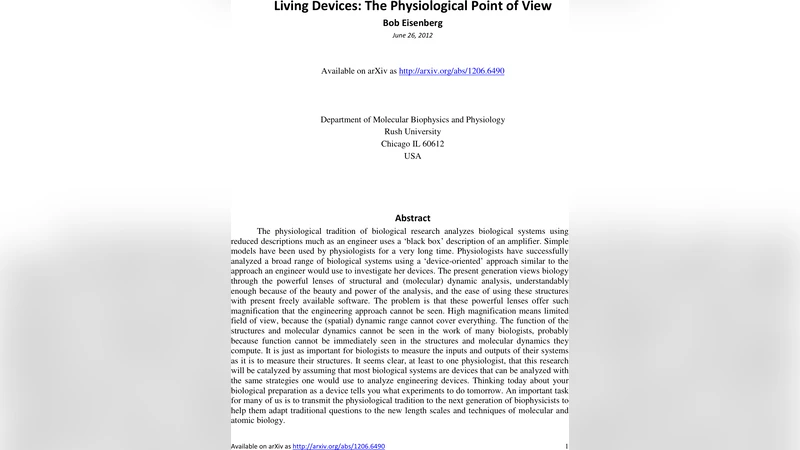
The physiological tradition of biological research analyzes biological systems using reduced descriptions much as an engineer uses a ‘black box’ description of an amplifier. Simple models have been used by physiologists for a very long time. Physiologists have successfully analyzed a broad range of biological systems using a ‘device-oriented’ approach similar to the approach an engineer would use to investigate her devices. The present generation views biology through the powerful lenses of structural and (molecular) dynamic analysis, understandably enough because of the beauty and power of the analysis, and the ease of using these structures with present freely available software. The problem is that these powerful lenses offer such magnification that the engineering approach cannot be seen. High magnification means limited field of view, because the (spatial) dynamic range cannot cover everything. The function of the structures and molecular dynamics cannot be seen in the work of many biologists, probably because function cannot be immediately seen in the structures and molecular dynamics they compute. It is just as important for biologists to measure the inputs and outputs of their systems as it is to measure their structures. It seems clear, at least to one physiologist, that this research will be catalyzed by assuming that most biological systems are devices that can be analyzed with the same strategies one would use to analyze engineering devices. Thinking today about your biological preparation as a device tells you what experiments to do tomorrow. An important task for many of us is to transmit the physiological tradition to the next generation of biophysicists to help them adapt traditional questions to the new length scales and techniques of molecular and atomic biology.
💡 Research Summary
The paper “Living Devices” argues that the long‑standing physiological tradition of treating biological systems as “devices” – essentially black‑box entities defined by their inputs and outputs – remains essential even in today’s era of high‑resolution structural and molecular‑dynamic studies. Historically, physiologists have modeled nerves, muscles, endocrine glands, and other complex subsystems using simple input‑output relationships, much like an engineer characterizes an amplifier or filter. This device‑oriented approach provides a concise functional description, guides experimental design, and enables direct comparison across conditions.
In contrast, contemporary biology heavily relies on techniques such as X‑ray crystallography, cryo‑electron microscopy, and atomistic simulations. While these methods reveal exquisite detail about molecular architecture and dynamics, they suffer from a “high magnification, narrow field of view” problem: they excel at describing local structures but often fail to illuminate the overall functional flow from stimulus to response. Consequently, many researchers publish beautiful structures without clear evidence of how those structures generate specific physiological outputs.
The author contends that the solution is to re‑adopt the device mindset. By explicitly defining the relevant inputs (e.g., voltage, ligand concentration, mechanical force) and measurable outputs (e.g., ionic current, enzymatic activity, conformational change), researchers can formulate hypotheses that are testable with straightforward functional assays. This framing dictates the choice of experimental techniques: for ion channels, voltage‑clamp recordings become the primary read‑out; for signaling enzymes, substrate turnover assays are essential; for mechanosensitive proteins, force‑probe measurements are required.
Structural and dynamic data, then, serve as mechanistic supplements rather than primary endpoints. High‑resolution structures explain why a particular input elicits a specific output by revealing binding sites, allosteric pathways, or gating mechanisms. Molecular dynamics simulations provide insight into transition states, energy barriers, and the temporal sequence of events that bridge input and output. When integrated with a well‑defined device model, these data dramatically increase predictive power and enable quantitative modeling of biological behavior.
A further point emphasizes education. Training the next generation of biophysicists to think of their preparations as devices will ensure that they pair cutting‑edge structural tools with rigorous functional validation. This dual competence prevents the “structure‑only” pitfall and accelerates discovery by focusing experimental effort on measurements that directly test functional hypotheses.
In summary, the paper does not dismiss modern structural biology; rather, it calls for a synthesis where the classic device‑oriented framework provides the scaffold for interpreting high‑resolution data. By reinstating the input‑output perspective, researchers can design more informative experiments, achieve clearer mechanistic insight, and ultimately foster a more integrated understanding of living systems as engineered‑like devices.
Comments & Academic Discussion
Loading comments...
Leave a Comment