A Variational Approach to Parameter Estimation in Ordinary Differential Equations
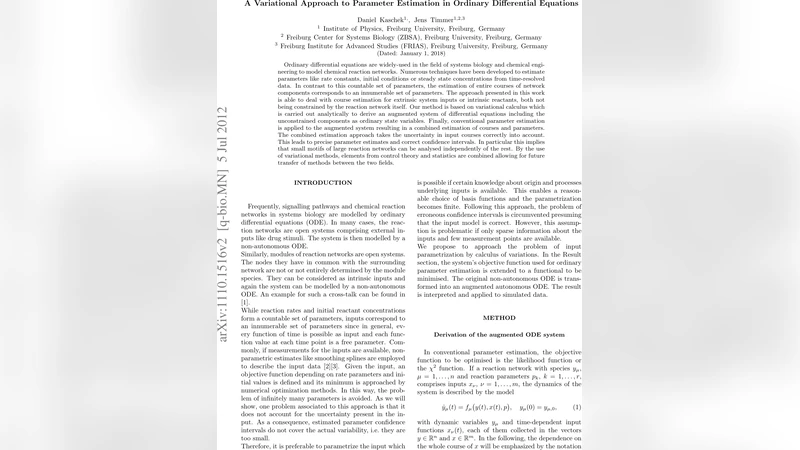
Ordinary differential equations are widely-used in the field of systems biology and chemical engineering to model chemical reaction networks. Numerous techniques have been developed to estimate parameters like rate constants, initial conditions or steady state concentrations from time-resolved data. In contrast to this countable set of parameters, the estimation of entire courses of network components corresponds to an innumerable set of parameters. The approach presented in this work is able to deal with course estimation for extrinsic system inputs or intrinsic reactants, both not being constrained by the reaction network itself. Our method is based on variational calculus which is carried out analytically to derive an augmented system of differential equations including the unconstrained components as ordinary state variables. Finally, conventional parameter estimation is applied to the augmented system resulting in a combined estimation of courses and parameters. The combined estimation approach takes the uncertainty in input courses correctly into account. This leads to precise parameter estimates and correct confidence intervals. In particular this implies that small motifs of large reaction networks can be analysed independently of the rest. By the use of variational methods, elements from control theory and statistics are combined allowing for future transfer of methods between the two fields.
💡 Research Summary
The paper addresses a fundamental limitation in the parameter estimation of ordinary differential equation (ODE) models that are widely used in systems biology and chemical engineering. While traditional methods can estimate a finite set of kinetic parameters and initial conditions, they treat external inputs (e.g., drug doses, environmental signals) as known functions or as low‑dimensional parametrizations. In reality, an input is an infinite‑dimensional object: every value at every time point is a free parameter. Ignoring the uncertainty associated with this “function‑parameter” leads to overly optimistic confidence intervals for the kinetic parameters and can introduce bias, especially when input measurements are sparse or noisy.
To overcome this, the authors formulate the input as a functional variable and extend the usual χ² (or log‑likelihood) objective to a functional that depends on the whole input trajectory (
Comments & Academic Discussion
Loading comments...
Leave a Comment