Borels Conjecture in Topological Groups
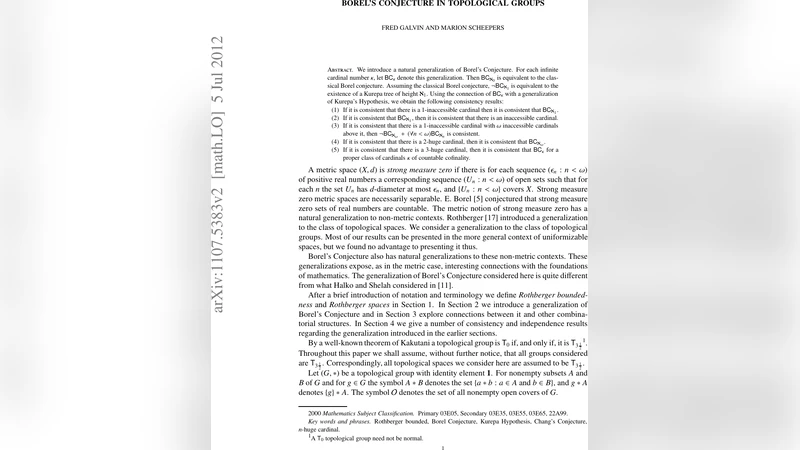
We introduce a natural generalization of Borel’s Conjecture. For each infinite cardinal number $\kappa$, let {\sf BC}${\kappa}$ denote this generalization. Then ${\sf BC}{\aleph_0}$ is equivalent to the classical Borel conjecture. Assuming the classical Borel conjecture, $\neg{\sf BC}{\aleph_1}$ is equivalent to the existence of a Kurepa tree of height $\aleph_1$. Using the connection of ${\sf BC}{\kappa}$ with a generalization of Kurepa’s Hypothesis, we obtain the following consistency results: (1)If it is consistent that there is a 1-inaccessible cardinal then it is consistent that ${\sf BC}{\aleph_1}$. (2)If it is consistent that ${\sf BC}{\aleph_1}$ holds, then it is consistent that there is an inaccessible cardinal. (3)If it is consistent that there is a 1-inaccessible cardinal with $\omega$ inaccessible cardinals above it, then $\neg{\sf BC}{\aleph{\omega}} , +, (\forall n<\omega){\sf BC}{\aleph_n}$ is consistent. (4)If it is consistent that there is a 2-huge cardinal, then it is consistent that ${\sf BC}{\aleph_{\omega}}$. (5)If it is consistent that there is a 3-huge cardinal, then it is consistent that ${\sf BC}_{\kappa}$ holds for a proper class of cardinals $\kappa$ of countable cofinality.
💡 Research Summary
The paper proposes a natural extension of Borel’s Conjecture from the real line to arbitrary topological groups. In the metric setting Borel’s Conjecture asserts that every strong‑measure‑zero set of reals is countable. The authors replace “strong measure zero” by Rothberger boundedness, a selection principle S₁(O_nbd,O_X) that coincides with strong measure zero in metrizable groups. For a topological group G they define O_nbd as the family of left translates of a neighbourhood of the identity, and a subset X⊆G is Rothberger bounded if one can select a single translate from each neighbourhood so that the chosen points cover X. In ℵ₀‑bounded groups (those that embed into a product of countably many second‑countable groups) Rothberger bounded sets are zero‑dimensional and, under the classical Borel conjecture, must be countable.
The central new statement is BC_κ: “Every Rothberger‑bounded subset of an ℵ₀‑bounded group of weight κ has cardinality ≤κ.” For κ=ℵ₀ this is exactly the original Borel conjecture. The authors relate BC_κ to a generalized Kurepa hypothesis KH(κ,ℵ₁): the existence of a (κ,ℵ₁)‑Kurepa family, i.e. a family F⊆P(κ) with |F|>κ but such that for every countable A⊆κ the set {X∩A : X∈F} is countable. They prove:
- If KH(κ,ℵ₁) holds then the product ∏_{α<κ} G_α (each G_α a non‑trivial topological group) contains a Rothberger‑bounded subgroup of size κ⁺ (Theorem 9).
- Conversely, if BC_κ fails then one can extract from a counterexample a (κ,ℵ₁)‑Kurepa family, so ¬BC_κ ⇒ KH(κ,ℵ₁) (Theorem 11).
Thus, assuming the classical Borel conjecture (BC_ℵ₀), BC_κ is equivalent to ¬KH(κ,ℵ₁). This equivalence allows the authors to translate consistency results about Kurepa families into consistency results about the generalized Borel conjecture.
Using large‑cardinal assumptions they obtain several consistency statements:
- If a 1‑inaccessible cardinal exists, then it is consistent that BC_{ℵ₁} holds.
- If BC_{ℵ₁} is consistent, then an inaccessible cardinal must be consistent.
- If there is a 1‑inaccessible cardinal with ω many inaccessible cardinals above it, then it is consistent that BC_{ℵ_n} holds for every finite n while BC_{ℵ_ω} fails.
- If a 2‑huge cardinal exists, then BC_{ℵ_ω} is consistent.
- If a 3‑huge cardinal exists, then BC_κ holds for a proper class of cardinals κ of countable cofinality.
These results show that the strength required to obtain BC_κ grows with κ: the failure of Kurepa families at higher levels corresponds to stronger large‑cardinal hypotheses. The paper also discusses the preservation properties of Rothberger boundedness under continuous homomorphisms, products, and countable unions, and proves that every Rothberger‑bounded σ‑compact subgroup of a topological group is itself a Rothberger space.
In summary, the authors successfully lift Borel’s conjecture to the setting of topological groups, identify its exact set‑theoretic strength via generalized Kurepa hypotheses, and map out the large‑cardinal landscape needed for various instances of the conjecture. The work bridges selection principles, descriptive set theory, and high‑level set theory, providing a clear roadmap for future investigations into the interplay between combinatorial properties of groups and deep consistency results.
Comments & Academic Discussion
Loading comments...
Leave a Comment