Geodesic Flows and Neumann Systems on Stiefel Varieties. Geometry and Integrability
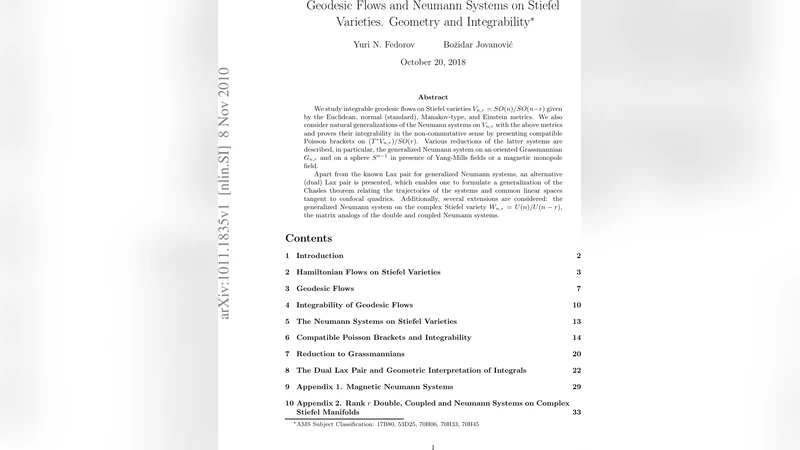
We study integrable geodesic flows on Stiefel varieties $V_{n,r}=SO(n)/SO(n-r)$ given by the Euclidean, normal (standard), Manakov-type, and Einstein metrics. We also consider natural generalizations of the Neumann systems on $V_{n,r}$ with the above metrics and proves their integrability in the non-commutative sense by presenting compatible Poisson brackets on $(T^*V_{n,r})/SO(r)$. Various reductions of the latter systems are described, in particular, the generalized Neumann system on an oriented Grassmannian $G_{n,r}$ and on a sphere $S^{n-1}$ in presence of Yang-Mills fields or a magnetic monopole field. Apart from the known Lax pair for generalized Neumann systems, an alternative (dual) Lax pair is presented, which enables one to formulate a generalization of the Chasles theorem relating the trajectories of the systems and common linear spaces tangent to confocal quadrics. Additionally, several extensions are considered: the generalized Neumann system on the complex Stiefel variety $W_{n,r}=U(n)/U(n-r)$, the matrix analogs of the double and coupled Neumann systems.
💡 Research Summary
The paper investigates a broad class of integrable dynamical systems defined on Stiefel manifolds (V_{n,r}=SO(n)/SO(n-r)). It begins by introducing four natural Riemannian metrics on (V_{n,r}): the Euclidean metric induced by the standard embedding into (\mathbb{R}^{n\times r}), the normal (or standard) metric coming from the bi‑invariant metric on (SO(n)), a Manakov‑type metric obtained by deforming the normal metric with a constant symmetric matrix (A), and an Einstein metric that makes the Stiefel manifold an Einstein space. For each metric the authors write down the explicit Lagrangian and Hamiltonian, derive the geodesic equations, and prove complete integrability in the Liouville sense by exhibiting enough commuting first integrals.
The second part of the work extends these geodesic flows to generalized Neumann systems. The Neumann potential (V(X)=\frac12\operatorname{tr}(X^{!T}BX)) (with (B) symmetric) is added to the kinetic energy while preserving the orthonormality constraint (X^{!T}X=I_r). The resulting Hamiltonian systems live on the reduced phase space ((T^{*}V_{n,r})/SO(r)). The authors construct two compatible Poisson brackets ({\cdot,\cdot}_1) and ({\cdot,\cdot}_2) on this reduced space, showing that the Neumann Hamiltonians belong to a common Poisson‑commuting family with respect to both brackets. Consequently, the systems are integrable in the non‑commutative sense of Mishchenko–Fomenko: there exist enough independent first integrals, although they need not all Poisson‑commute with each other.
A substantial portion of the paper is devoted to reductions of these systems. By quotienting the (SO(r)) symmetry one obtains dynamics on the oriented Grassmannian (G_{n,r}=SO(n)/(SO(r)\times SO(n-r))). In this setting the Neumann system appears together with a Yang–Mills field (or, in the (r=1) case, a magnetic monopole) that couples to the particle moving on the Grassmannian. The authors describe explicitly how the reduced Hamiltonian, Poisson structure and integrals descend, and they recover known integrable Neumann‑type models on (G_{n,r}). When (r=1) the Stiefel manifold reduces to the sphere (S^{n-1}); the resulting system is the classical Neumann problem on a sphere with an additional monopole field, again shown to be integrable.
A novel contribution is the presentation of an alternative (dual) Lax pair. While the standard Lax representation for the generalized Neumann system uses a matrix (L(\lambda)=\lambda X^{!T}X + \dots), the authors introduce a transposed Lax matrix (\tilde L(\lambda)) and an associated (\tilde M(\lambda)) that satisfy (\dot{\tilde L}=
Comments & Academic Discussion
Loading comments...
Leave a Comment