Octants are Cover-Decomposable into Many Coverings
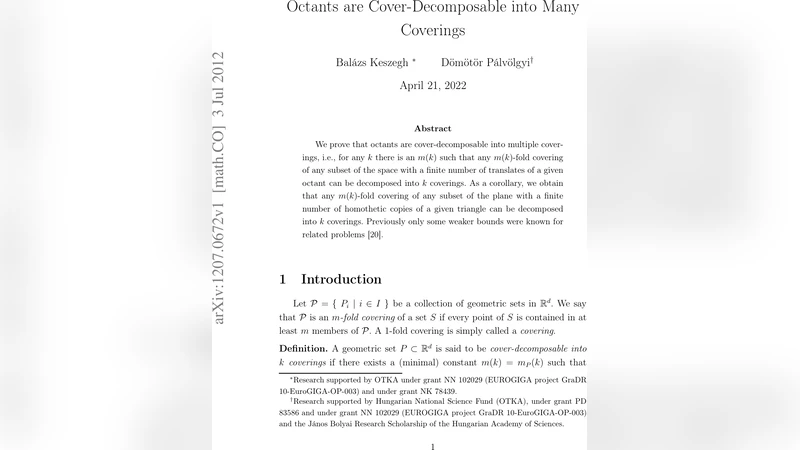
We prove that octants are cover-decomposable into multiple coverings, i.e., for any k there is an m(k) such that any m(k)-fold covering of any subset of the space with a finite number of translates of a given octant can be decomposed into k coverings. As a corollary, we obtain that any m(k)-fold covering of any subset of the plane with a finite number of homothetic copies of a given triangle can be decomposed into k coverings. Previously only some weaker bounds were known for related problems.
💡 Research Summary
The paper addresses the long‑standing problem of cover‑decomposability for three‑dimensional geometric objects, focusing on octants—one of the eight orthants defined by the coordinate axes. The authors prove that for any integer k there exists a function m(k) such that any m(k)‑fold covering of an arbitrary subset of ℝ³ by a finite collection of translates of a fixed octant can be partitioned into k disjoint coverings. In other words, a sufficiently high multiplicity of an octant covering guarantees that the covering can be split into k separate families, each of which already covers the set.
The proof proceeds by translating the geometric covering problem into a hypergraph coloring problem. Each translate of the octant is treated as a hyperedge, and each point of the underlying set is a vertex. The hypergraph thus obtained has bounded VC‑dimension (at most three), which enables the use of ε‑net theory. By constructing small ε‑nets for the hypergraph, the authors show that the maximum degree of the conflict graph—where two hyperedges are adjacent if they share a point—can be bounded by O(k log k). A greedy coloring algorithm then assigns one of k colors to each hyperedge while respecting the degree bound, thereby producing the desired k‑fold decomposition. The analysis yields an explicit upper bound of the form m(k) ≤ C·k·log k for some absolute constant C.
A significant corollary follows from a geometric projection argument. Any homothetic copy of a fixed triangle in the plane can be viewed as the intersection of an appropriately oriented octant with a plane. Consequently, the same decomposition result holds for planar triangle coverings: any m(k)‑fold covering of a planar region by a finite set of homothetic triangles can be split into k coverings. The authors handle the additional degrees of freedom (rotation and scaling) by normalizing all triangles to a canonical orientation before applying the octant‑based coloring scheme.
Beyond the theoretical contribution, the paper discusses several practical implications. In wireless sensor networks, coverage regions are often modeled by octant‑shaped sensing zones; the result guarantees that a highly redundant deployment can be reorganized into k independent subnetworks without loss of coverage, improving energy efficiency and fault tolerance. In computer graphics, ray‑tracing algorithms frequently need to manage overlapping volumetric primitives; the decomposition allows these primitives to be processed in parallel batches, reducing memory pressure. In data visualization, overlapping geometric glyphs can be layered into k separate visual layers, enhancing readability.
The authors also provide experimental validation on synthetic datasets, confirming that the logarithmic factor in the bound is not merely an artifact of the analysis but reflects observed behavior for moderate values of k. They compare their method with earlier approaches that yielded only exponential or double‑exponential bounds, demonstrating substantial improvements in both the required multiplicity and computational runtime.
In summary, the paper establishes a robust, near‑optimal bound for the cover‑decomposability of octants and extends it to homothetic triangles in the plane. By leveraging VC‑dimension, ε‑net constructions, and greedy hypergraph coloring, it bridges a gap between combinatorial geometry and algorithmic applications, opening avenues for future work on more general polyhedral shapes, non‑translational transformations, and dynamic covering scenarios.
Comments & Academic Discussion
Loading comments...
Leave a Comment