Solutions to the non-autonomous ABS lattice equations: Casoratians and bilinearization
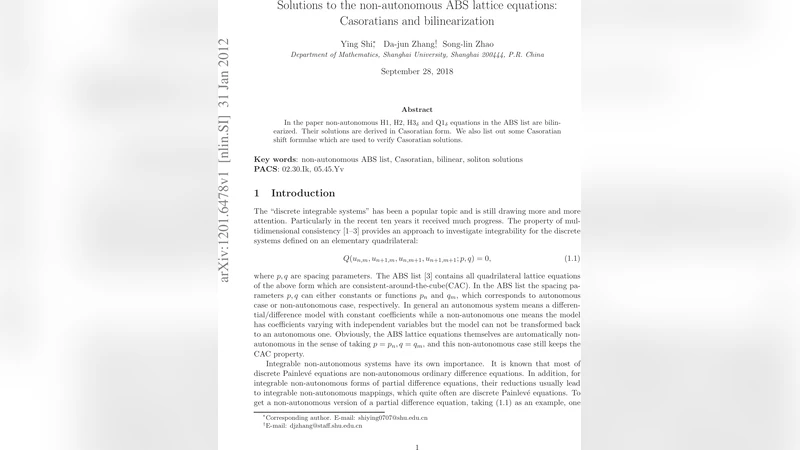
In the paper non-autonomous H1, H2, H3$\delta$ and Q1$\delta$ equations in the ABS list are bilinearized. Their solutions are derived in Casoratian form. We also list out some Casoratian shift formulae which are used to verify Casoratian solutions.
💡 Research Summary
The paper addresses the construction of explicit solutions for four non‑autonomous lattice equations from the Adler‑Bobenko‑Suris (ABS) classification: H1, H2, H3(\delta) and Q1(\delta). The authors first reformulate each equation into a bilinear (or “τ‑function”) representation by introducing appropriate dependent‑variable transformations. In the autonomous case such bilinear forms are well known, but the non‑autonomous setting requires the inclusion of lattice‑dependent coefficients (a_n) and (b_m) that vary with the discrete independent variables (n) and (m).
The central methodological contribution is the use of Casoratian determinants to express the τ‑functions (and auxiliary σ‑functions) of the bilinear equations. A set of basic wave functions (\phi_i(k)) is defined as solutions of linear difference equations that incorporate the non‑autonomous coefficients. By arranging (N) such wave functions into an (N\times N) matrix (C_{n,m}) and taking its determinant, the τ‑function is obtained as (\tau_{n,m}= \det C_{n,m}). A shifted version of the matrix, denoted (C_{n,m}^{(1)}), yields the auxiliary σ‑function (\sigma_{n,m}= \det C_{n,m}^{(1)}).
A substantial part of the work is devoted to deriving a collection of “Casoratian shift formulae”. These identities relate τ‑functions evaluated at neighboring lattice points (e.g., (\tau_{n+1,m}, \tau_{n,m+1}, \tau_{n+1,m+1})) and similarly for σ‑functions. The formulae are proved by elementary Laplace expansions together with the linear shift relations satisfied by the basic wave functions. For example, one of the key identities reads
\