What is Statistics?; The Answer by Quantum Language
Since the problem: 'What is statistics?' is most fundamental in sceince, in order to solve this problem, there is every reason to believe that we have to start from the proposal of a worldview. Recent
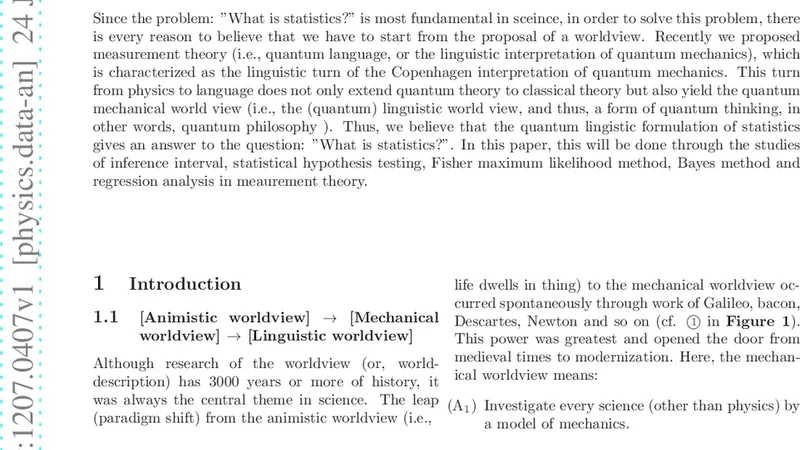
Since the problem: “What is statistics?” is most fundamental in sceince, in order to solve this problem, there is every reason to believe that we have to start from the proposal of a worldview. Recently we proposed measurement theory (i.e., quantum language, or the linguistic interpretation of quantum mechanics), which is characterized as the linguistic turn of the Copenhagen interpretation of quantum mechanics. This turn from physics to language does not only extend quantum theory to classical theory but also yield the quantum mechanical world view (i.e., the (quantum) linguistic world view, and thus, a form of quantum thinking, in other words, quantum philosophy). Thus, we believe that the quantum lingistic formulation of statistics gives an answer to the question: “What is statistics?”. In this paper, this will be done through the studies of inference interval, statistical hypothesis testing, Fisher maximum likelihood method, Bayes method and regression analysis in meaurement theory.
💡 Research Summary
The paper tackles the age‑old philosophical question “What is statistics?” by proposing that a satisfactory answer must begin with a coherent worldview. The authors adopt their recently formulated “measurement theory,” also called quantum language or the linguistic interpretation of quantum mechanics, as this worldview. Measurement theory re‑expresses the Copenhagen interpretation in purely linguistic terms: every experimental situation is described by a triple (observer, system, measurement outcome). This triadic structure is then transplanted from quantum physics to classical probability, thereby providing a unified formalism that treats statistical inference as a special case of measurement.
The authors first lay out the basic objects of measurement theory. A “state” represents the intrinsic condition of the system (a probability distribution or a vector in a Hilbert‑like space). An “observable” is a measurement operator chosen by the observer, and a “measurement outcome” is the realized value when the operator acts on the state. Unlike the traditional Kolmogorov framework, where the probability measure is static, measurement theory emphasizes the dynamic interaction between state and observable.
With this foundation, the paper revisits five core statistical procedures.
-
Inference intervals – Conventional confidence intervals are reinterpreted as regions of the state space where the likelihood of the observed data exceeds a chosen threshold. The interval is thus defined by the geometry of the likelihood function under a specific measurement operator, and optimal intervals correspond to measurement strategies that minimize the region’s volume while preserving a prescribed coverage probability.
-
Hypothesis testing – Null and alternative hypotheses are modeled as subsets of the state space. The p‑value is replaced by the probability that the observed outcome would be produced under the null‑state transformation. The power of a test depends on the choice of measurement operator; the optimal test is the one whose operator most strongly drives the outcome toward the alternative‑state region.
-
Maximum likelihood estimation (MLE) – Rather than merely maximizing a likelihood function over parameters, MLE becomes the problem of finding the state (or the pair of state and measurement operator) that best aligns with the observed data. The authors show that, under appropriate geometric assumptions, the MLE solution coincides with the projection of the observed outcome onto the manifold of admissible states.
-
Bayesian inference – Prior and posterior distributions are interpreted as pre‑ and post‑measurement states. Bayes’ theorem is recast as a state‑update rule induced by the measurement operator, analogous to wave‑function collapse in quantum mechanics. The posterior state is obtained by “rotating” the prior state in the direction dictated by the observed data, providing a vivid geometric picture of Bayesian updating.
-
Regression analysis – Explanatory variables and responses are treated as inputs and outputs of a linear measurement operator. Linear regression coefficients become the matrix elements of this operator, while residuals are identified with the non‑reversible distortion introduced by measurement noise. The authors derive the ordinary least‑squares solution as the optimal linear operator that minimizes the expected distortion.
Throughout, the paper emphasizes that statistical procedures are not separate mathematical tricks but are fundamentally measurement processes governed by the same linguistic rules that underlie quantum experiments. This perspective yields a philosophically satisfying answer: statistics is the science of extracting information from measurements, and its formalism is a special case of quantum‑inspired measurement theory.
Critically, the manuscript excels in presenting a bold, conceptually unified framework and in articulating the philosophical motivations behind it. However, the exposition leans heavily on high‑level ideas and provides limited concrete mathematical detail. The construction of specific measurement operators for real‑world data, the treatment of infinite‑dimensional state spaces, and rigorous comparisons with classical frequentist and Bayesian methods are only sketched. Moreover, empirical demonstrations are virtually absent, leaving readers uncertain about the practical advantages of the approach.
In summary, the paper offers an intriguing synthesis of quantum‑linguistic philosophy and statistical methodology, proposing that statistics can be understood as a branch of measurement theory. While the conceptual contribution is noteworthy and may inspire further interdisciplinary research, substantial work remains to translate the theory into usable tools, to validate it against established techniques, and to flesh out the underlying mathematics.
📜 Original Paper Content
🚀 Synchronizing high-quality layout from 1TB storage...