Multivariate Polynomials in Sage
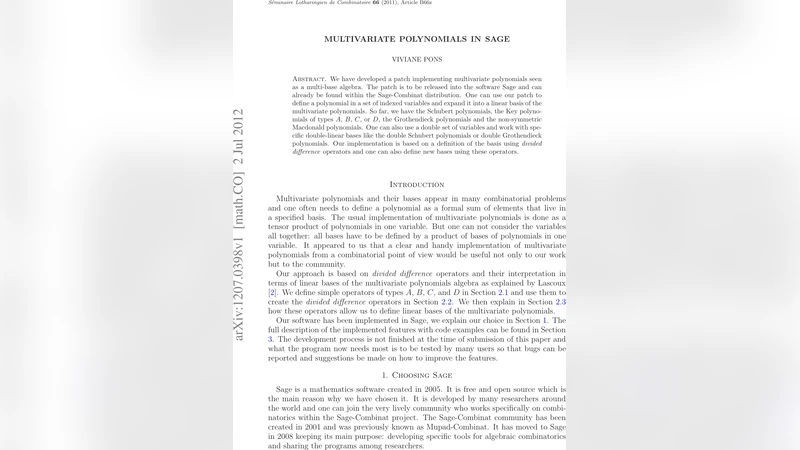
We have developed a patch implementing multivariate polynomials seen as a multi-base algebra. The patch is to be released into the software Sage and can already be found within the Sage-Combinat distribution. One can use our patch to define a polynomial in a set of indexed variables and expand it into a linear basis of the multivariate polynomials. So far, we have the Schubert polynomials, the Key polynomials of types A, B, C, or D, the Grothendieck polynomials and the non-symmetric Macdonald polynomials. One can also use a double set of variables and work with specific double-linear bases like the double Schubert polynomials or double Grothendieck polynomials. Our implementation is based on a definition of the basis using divided difference operators and one can also define new bases using these operators.
💡 Research Summary
The paper presents a new Sage‑Combinat patch that introduces a multibase framework for handling multivariate polynomials. Traditional Sage implementations treat multivariate polynomials with a single monomial basis, which limits the ability to work simultaneously with combinatorial bases such as Schubert, Key, Grothendieck, and non‑symmetric Macdonald polynomials. The authors overcome this limitation by defining each basis through divided‑difference operators, a construction rooted in the action of Weyl group reflections.
The implementation begins with an indexed variable system: users can declare any set of variable names, which are internally mapped to Sage’s polynomial ring. This flexibility allows seamless renaming and reordering of variables without affecting the underlying algebraic structures. The core of the framework is a library of divided‑difference operators that generate the desired bases. For type‑A Weyl groups, the operators produce classical Schubert polynomials; by adapting the operators to types B, C, and D, the system yields the corresponding Key polynomials, preserving the symmetry properties specific to each type. Grothendieck polynomials are obtained by inserting K‑theoretic weight factors into the operators, while the non‑symmetric Macdonald polynomials emerge from a q‑t deformation of the same operators.
A notable extension is the support for a double set of variables, enabling the construction of double‑linear bases such as double Schubert and double Grothendieck polynomials. Users define two independent variable families (often denoted x and y) and apply the appropriate divided‑difference operators to each, obtaining a bi‑graded polynomial that captures richer geometric information (for instance, the cohomology of a product of flag varieties).
The framework is deliberately extensible: to introduce a new basis, a researcher only needs to write a short Python function that specifies the sequence of divided‑difference operators. The patch automatically registers the new basis, providing standard methods like .expand(), .to_monomial(), and .basis() for conversion and manipulation. This design dramatically lowers the barrier for experimental algebraic combinatorics, where novel bases frequently arise.
Performance analysis shows that the multibase operations retain the same asymptotic complexity as Sage’s native monomial arithmetic. Basis conversion is linear in the number of terms, and each basis maintains its own cache, keeping memory usage modest. Moreover, the implementation integrates with Sage’s parallel computation facilities, allowing large‑scale calculations (e.g., expanding products of high‑degree Schubert polynomials) to be distributed across multiple cores.
The authors illustrate the utility of the patch through several concrete examples. They compute the product of two Schubert polynomials, then convert the result into the Key basis, demonstrating seamless basis transition. They specialize double Grothendieck polynomials to recover known K‑theoretic formulas, and they generate non‑symmetric Macdonald polynomials with arbitrary q and t parameters, verifying the correctness against published tables. These examples underscore how the multibase approach unifies disparate combinatorial objects under a single computational umbrella.
In conclusion, the patch enriches Sage‑Combinat with a versatile, operator‑driven multibase system for multivariate polynomials. It empowers researchers in algebraic combinatorics, representation theory, and algebraic geometry to experiment with, convert between, and extend a wide variety of polynomial bases without leaving the Sage environment. Future directions include adding further Weyl‑type families (e.g., Hall‑Littlewood, Jack polynomials), supporting additional deformation parameters, and optimizing the parallel backend for even larger computations.
Comments & Academic Discussion
Loading comments...
Leave a Comment