Randomized Distributed Decision
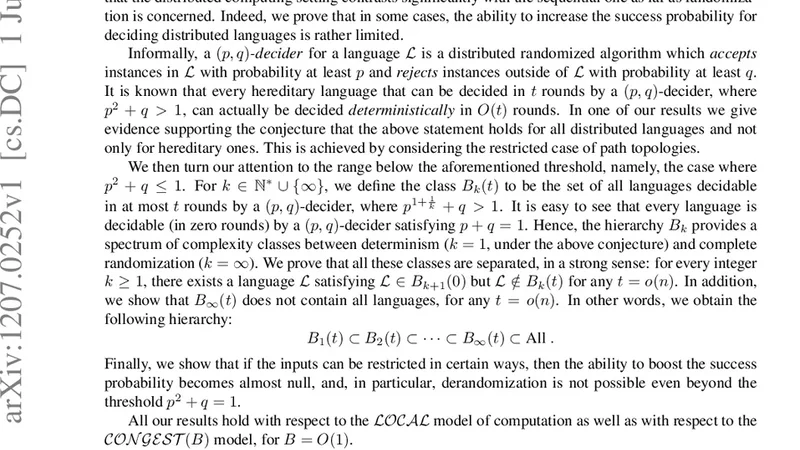
The paper tackles the power of randomization in the context of locality by analyzing the ability to`boost’ the success probability of deciding a distributed language. The main outcome of this analysis is that the distributed computing setting contrasts significantly with the sequential one as far as randomization is concerned. Indeed, we prove that in some cases, the ability to increase the success probability for deciding distributed languages is rather limited. Informally, a (p,q)-decider for a language L is a distributed randomized algorithm which accepts instances in L with probability at least p and rejects instances outside of L with probability at least q. It is known that every hereditary language that can be decided in t rounds by a (p,q)-decider, where p^2+q>1, can actually be decided deterministically in O(t) rounds. In one of our results we give evidence supporting the conjecture that the above statement holds for all distributed languages. This is achieved by considering the restricted case of path topologies. We then turn our attention to the range below the aforementioned threshold, namely, the case where p^2+q\leq1. We define B_k(t) to be the set of all languages decidable in at most t rounds by a (p,q)-decider, where p^{1+1/k}+q>1. It is easy to see that every language is decidable (in zero rounds) by a (p,q)-decider satisfying p+q=1. Hence, the hierarchy B_k provides a spectrum of complexity classes between determinism and complete randomization. We prove that all these classes are separated: for every integer k\geq 1, there exists a language L satisfying L\in B_{k+1}(0) but L\notin B_k(t) for any t=o(n). In addition, we show that B_\infty(t) does not contain all languages, for any t=o(n). Finally, we show that if the inputs can be restricted in certain ways, then the ability to boost the success probability becomes almost null.
💡 Research Summary
The paper investigates how much randomisation can improve the success probability of distributed decision algorithms. It introduces the notion of a (p,q)-decider: a randomized distributed algorithm that accepts inputs belonging to a language L with probability at least p and rejects inputs not in L with probability at least q. The authors first recall a known result for hereditary languages: if a (p,q)-decider runs in t rounds and satisfies p² + q > 1, then the language can be decided deterministically in O(t) rounds. This shows that, beyond a certain threshold, randomisation does not give any extra power in the local setting.
Motivated by the question whether the same phenomenon holds for all distributed languages, the authors study the restricted case of path topologies. Paths are the simplest graphs where each node sees only its two neighbours, making it hard to aggregate global information. The paper proves that even on paths, any (p,q)-decider with p² + q > 1 can be transformed into a deterministic O(t)‑round algorithm. This evidence supports the conjecture that the “p² + q > 1 ⇒ deterministic” implication is universal.
The second part of the work focuses on the complementary regime p² + q ≤ 1, where randomisation is weaker. To capture the fine‑grained power of randomisation in this regime, the authors define a hierarchy of classes Bₖ(t). A language belongs to Bₖ(t) if there exists a (p,q)-decider running in at most t rounds such that p^{1+1/k} + q > 1. The parameter k controls how far the success probability is from the deterministic threshold; larger k means a weaker requirement on p.
The hierarchy is shown to be strict. For every integer k ≥ 1 the authors construct a language Lₖ that lies in B_{k+1}(0) (i.e., it can be decided with zero communication using a (p,q)-decider satisfying the weaker condition) but does not belong to Bₖ(t) for any t = o(n). In other words, no sublinear‑time algorithm can achieve the stronger success guarantee required by Bₖ. Moreover, even the limit class B_∞(t) does not contain all languages when t = o(n), demonstrating that randomisation, no matter how generous, cannot compensate for insufficient communication rounds.
Finally, the paper examines scenarios where the input is restricted (for example, inputs follow a predetermined pattern or are drawn from a limited alphabet). In such settings the ability to “boost” the success probability becomes essentially null: any attempt to improve p or q beyond the trivial p + q = 1 bound fails. This highlights that the benefit of randomisation is highly sensitive to the structure of the input space.
Overall, the contribution of the work is threefold: (1) it reinforces the intuition that, above the threshold p² + q > 1, randomised local decision offers no advantage over deterministic algorithms; (2) it introduces a nuanced hierarchy Bₖ(t) that interpolates between deterministic decision (large k) and completely randomised decision (k = 0), and proves that each level of this hierarchy is strictly more powerful than the previous one; (3) it shows that input restrictions can completely eliminate the possibility of probability boosting. These results deepen our theoretical understanding of the role of randomisation in distributed computing and provide a clear framework for assessing when randomised techniques are worthwhile in the design of fast, local decision protocols.
Comments & Academic Discussion
Loading comments...
Leave a Comment