On the Complexity of Equivalence of Specifications of Infinite Objects
We study the complexity of deciding the equality of infinite objects specified by systems of equations, and of infinite objects specified by lambda-terms. For equational specifications there are sever
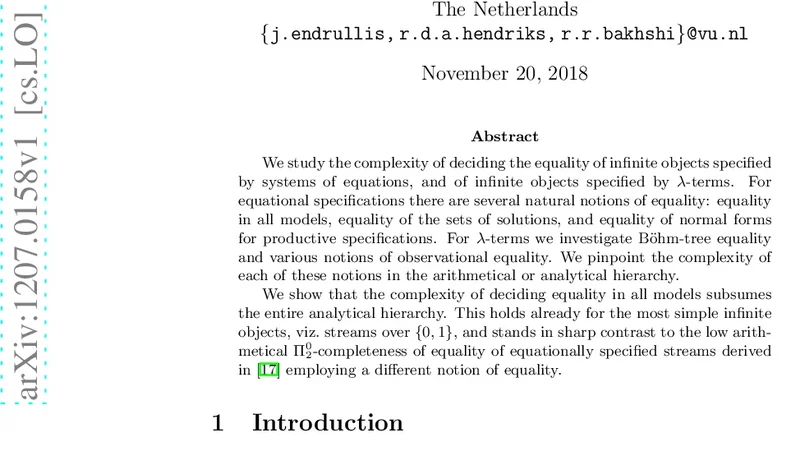
We study the complexity of deciding the equality of infinite objects specified by systems of equations, and of infinite objects specified by lambda-terms. For equational specifications there are several natural notions of equality: equality in all models, equality of the sets of solutions, and equality of normal forms for productive specifications. For lambda-terms we investigate Boehm-tree equality and various notions of observational equality. We pinpoint the complexity of each of these notions in the arithmetical or analytical hierarchy. We show that the complexity of deciding equality in all models subsumes the entire analytical hierarchy. This holds already for the most simple infinite objects, viz. streams over {0,1}, and stands in sharp contrast to the low arithmetical Pi^0_2-completeness of equality of equationally specified streams derived in [Rosu 2006] employing a different notion of equality.
💡 Research Summary
The paper investigates the decision problem of equality for infinite objects that are specified either by systems of equations or by λ‑terms. It distinguishes several natural notions of equality for each specification formalism and precisely locates the computational complexity of each notion within the arithmetical and analytical hierarchies.
For equational specifications the authors consider three notions. (1) Equality in all models asks whether two specifications denote the same object in every possible model; this is the strongest, model‑theoretic notion. (2) Equality of solution sets compares the sets of infinite objects that satisfy each specification, ignoring the particular model. (3) Normal‑form equality for productive specifications is defined only for specifications that are guaranteed to be productive; it compares the canonical infinite normal forms (e.g., the stream produced by unfolding).
The paper shows that the first notion is extraordinarily complex: deciding equality in all models subsumes the entire analytical hierarchy. By encoding arbitrary Σ¹ₙ/Π¹ₙ formulas into very simple binary stream specifications, the authors prove that for each level of the analytical hierarchy there exists a pair of specifications whose equality in all models is equivalent to the truth of a formula at that level. Consequently, even for the most elementary infinite objects—binary streams over {0,1}—the problem is not arithmetical at any finite level.
In contrast, normal‑form equality for productive specifications is shown to be Π⁰₂‑complete. This matches the earlier result of Rosu (2006) for a different equality notion, but the present work highlights that the choice of equality definition dramatically changes the complexity landscape. Equality of solution sets falls somewhere between Σ⁰₁ and Π⁰₁, depending on whether one asks for inclusion or exact coincidence.
Turning to λ‑terms, the authors study Böhm‑tree equality and several variants of observational equivalence. Böhm‑tree equality, which compares the infinite Böhm trees obtained by full head‑normal‑form expansion, is proved Π¹₁‑complete, again placing it at a high analytical level. Observational equivalences are classified more finely: strong observational equivalence (requiring indistinguishability under all contexts) is Π⁰₂‑complete, while weak observational equivalence (allowing a more limited set of observations) is Σ⁰₁‑complete. Intermediate notions, such as context‑sensitive or body‑level observations, occupy Σ⁰₂ or Π⁰₃, illustrating a rich hierarchy of complexities even within the arithmetical realm.
Methodologically, the paper employs encoding techniques that translate arbitrary formulas of a given hierarchy level into equational or λ‑term specifications. For the analytical‑hierarchy lower bounds, the construction builds a pair of stream equations whose universal model equality mirrors the truth of a Σ¹ₙ formula. For the arithmetical results, reductions from classic decision problems (e.g., halting of Turing machines, Post’s correspondence problem) are used. The λ‑term results rely on game‑semantic characterisations of observational equivalence and on known completeness results for Böhm‑tree comparison.
The significance of these findings is twofold. First, they demonstrate that the notion of “equality” is not monolithic; the computational burden varies dramatically with the chosen semantic criterion. Second, they provide a detailed map of where each equality problem sits in the hierarchy, informing the design of verification tools, program transformation systems, and languages that manipulate infinite data structures. In practice, a tool that checks equality of productive streams can be implemented with a Π⁰₂ decision procedure, whereas a tool that must guarantee equality in all models would face undecidable problems beyond any arithmetical level.
In summary, the paper delivers a comprehensive classification of equality problems for infinite objects, showing that model‑theoretic equality reaches the full analytical hierarchy, while more operational notions remain within the arithmetical hierarchy, often at low levels such as Π⁰₂. This nuanced picture clarifies the trade‑offs between expressive power and algorithmic tractability in the specification of infinite structures.
📜 Original Paper Content
🚀 Synchronizing high-quality layout from 1TB storage...