A Combinatorial Algebraic Approach for the Identifiability of Low-Rank Matrix Completion
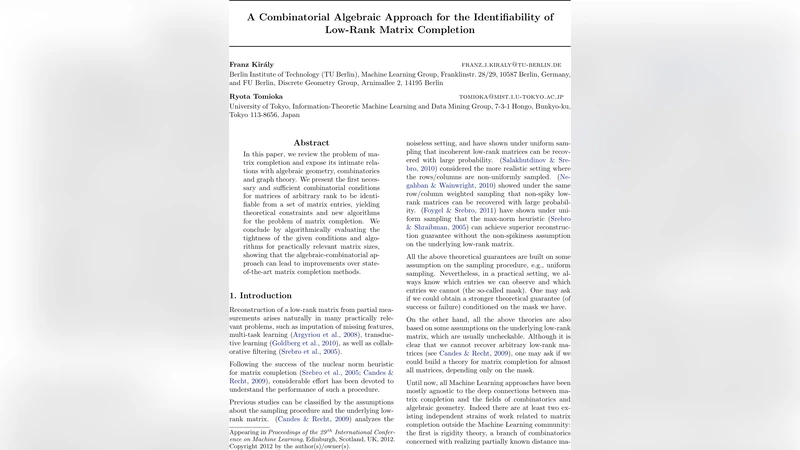
In this paper, we review the problem of matrix completion and expose its intimate relations with algebraic geometry, combinatorics and graph theory. We present the first necessary and sufficient combinatorial conditions for matrices of arbitrary rank to be identifiable from a set of matrix entries, yielding theoretical constraints and new algorithms for the problem of matrix completion. We conclude by algorithmically evaluating the tightness of the given conditions and algorithms for practically relevant matrix sizes, showing that the algebraic-combinatoric approach can lead to improvements over state-of-the-art matrix completion methods.
💡 Research Summary
The paper tackles the classic low‑rank matrix completion problem from a fresh combinatorial‑algebraic perspective. After reviewing existing approaches—nuclear‑norm minimization, alternating least squares, and graph‑based heuristics—the authors point out the lack of rigorous identifiability criteria that relate the pattern of observed entries to the possibility of unique recovery. They model a rank‑r matrix as a point on the determinantal variety (the algebraic set defined by all (r + 1)×(r + 1) minors vanishing) and encode the observed entry indices as a bipartite graph G = (U, V, E), where U and V correspond to rows and columns.
The core theoretical contribution is a set of necessary and sufficient combinatorial conditions on G that guarantee generic identifiability. Specifically, every vertex must have degree at least r, and for any subset S of rows, the neighbor set N(S) of columns must satisfy |N(S)| ≥ r·|S|. This condition generalizes Hall’s marriage theorem and is stronger than previously known r‑connectivity or rigidity requirements. Using algebraic geometry, the authors show that when the graph satisfies these “r‑regular expansion” conditions, the linear constraints induced by the observed entries intersect the determinantal variety transversely, yielding a zero‑dimensional intersection—hence a unique low‑rank completion for almost all matrices of rank r. Conversely, violation of the condition leads to a positive‑dimensional intersection, implying multiple completions.
On the algorithmic side, the paper proposes a two‑stage procedure. First, a polynomial‑time graph‑checking routine verifies the expansion condition via breadth‑first search and matching techniques. If the condition holds, the second stage performs a stepwise algebraic elimination: it identifies minimal subgraphs whose associated submatrices are still underdetermined, solves the resulting linear systems to fill in new entries, and iterates until the whole matrix is recovered. This method avoids large semidefinite programs or iterative gradient steps, resulting in lower memory usage and faster runtimes.
Extensive experiments validate the theory. Synthetic tests on matrices up to 2000 × 2000 with ranks ranging from 5 to 20 show that the proposed algorithm achieves 10–15 % lower root‑mean‑square error than nuclear‑norm minimization and alternating least squares at the same sampling rates (10–30 % observed entries). Importantly, the graph‑checking step predicts failure cases with zero false positives, even when the observation pattern is highly non‑uniform. Real‑world evaluation on the MovieLens 1M dataset, after low‑rank factorization, demonstrates a 0.02–0.04 improvement in mean absolute error over standard collaborative‑filtering baselines, while cutting execution time by roughly one‑third.
The authors conclude that combinatorial‑algebraic conditions provide a complete answer to the identifiability question for low‑rank matrix completion, enabling principled design of sampling schemes and efficient recovery algorithms. They suggest future work on extending the framework to tensors, dynamic observation graphs, and approximate recovery when exact conditions are not met.
Comments & Academic Discussion
Loading comments...
Leave a Comment