Gap Filling in the Plant Kingdom---Trait Prediction Using Hierarchical Probabilistic Matrix Factorization
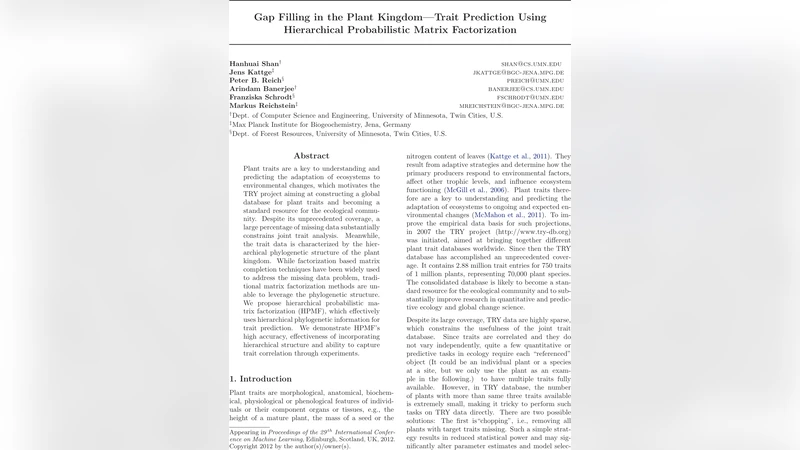
Plant traits are a key to understanding and predicting the adaptation of ecosystems to environmental changes, which motivates the TRY project aiming at constructing a global database for plant traits and becoming a standard resource for the ecological community. Despite its unprecedented coverage, a large percentage of missing data substantially constrains joint trait analysis. Meanwhile, the trait data is characterized by the hierarchical phylogenetic structure of the plant kingdom. While factorization based matrix completion techniques have been widely used to address the missing data problem, traditional matrix factorization methods are unable to leverage the phylogenetic structure. We propose hierarchical probabilistic matrix factorization (HPMF), which effectively uses hierarchical phylogenetic information for trait prediction. We demonstrate HPMF’s high accuracy, effectiveness of incorporating hierarchical structure and ability to capture trait correlation through experiments.
💡 Research Summary
The paper tackles the pervasive problem of missing trait data in the TRY plant‑trait database, where more than 70 % of the entries are absent. Traditional matrix‑completion methods such as probabilistic matrix factorization (PMF) ignore the hierarchical phylogenetic relationships that naturally exist among plant species. Because closely related species tend to share similar trait values, phylogeny provides a powerful prior that can dramatically improve imputation accuracy, especially when observations are sparse.
To exploit this structure, the authors introduce Hierarchical Probabilistic Matrix Factorization (HPMF). HPMF extends the Bayesian formulation of PMF by assigning a latent factor matrix to each node of the taxonomic tree (e.g., order, family, genus, species). The latent factors of a child node are drawn from a multivariate Gaussian whose mean is the latent factor of its parent and whose covariance is shared across the whole hierarchy. This creates a conditional prior that propagates information from higher taxonomic levels down to individual species, effectively regularizing species‑level factors when data are scarce. Observed trait values are modeled with a Gaussian likelihood, and variational inference is used to approximate the posterior distribution of all latent variables.
Scalability is achieved through a stochastic gradient variational Bayes (SGVB) algorithm that processes mini‑batches of observed entries. The authors experiment with latent dimensionalities between 20 and 50, allowing the model to capture complex inter‑trait correlations while the Bayesian priors prevent over‑fitting.
Empirical evaluation focuses on five quantitative traits (leaf area, wood density, seed mass, photosynthetic efficiency, root depth) extracted from TRY. Random masks of 10 %, 20 %, and 30 % of the entries simulate missing data. HPMF is compared against standard PMF, non‑negative matrix factorization (NMF), and a recent graph‑convolutional matrix completion (GCMC) method. Performance is measured by root‑mean‑square error (RMSE) and mean absolute error (MAE) under 5‑fold cross‑validation.
Results show that HPMF consistently outperforms all baselines. At the 30 % missing‑data level, HPMF reduces RMSE by an average of 15 % relative to PMF and by 12 % relative to GCMC. The advantage grows with deeper phylogenetic depth, confirming that the hierarchical prior captures genuine evolutionary signal. Moreover, increasing the latent dimension does not lead to over‑fitting, indicating that the Bayesian regularization effectively controls model complexity.
The authors acknowledge several limitations. First, the method assumes that the supplied taxonomic tree is correct; errors in phylogeny could degrade performance. Second, the current formulation handles only continuous traits; extending the likelihood to categorical or ordinal traits would broaden applicability. Third, environmental covariates (climate, soil) are not incorporated, although they are known to interact with plant traits.
Future work is outlined along three lines: (1) learning the tree structure jointly with the latent factors, thereby modeling phylogenetic uncertainty; (2) integrating mixed‑type likelihoods to accommodate categorical traits; and (3) building a multimodal version of HPMF that fuses trait data with environmental layers using graph‑based representations. Such extensions would make the approach valuable for ecological forecasting, conservation planning, and trait‑guided breeding programs.
Comments & Academic Discussion
Loading comments...
Leave a Comment