Incorporating Domain Knowledge in Matching Problems via Harmonic Analysis
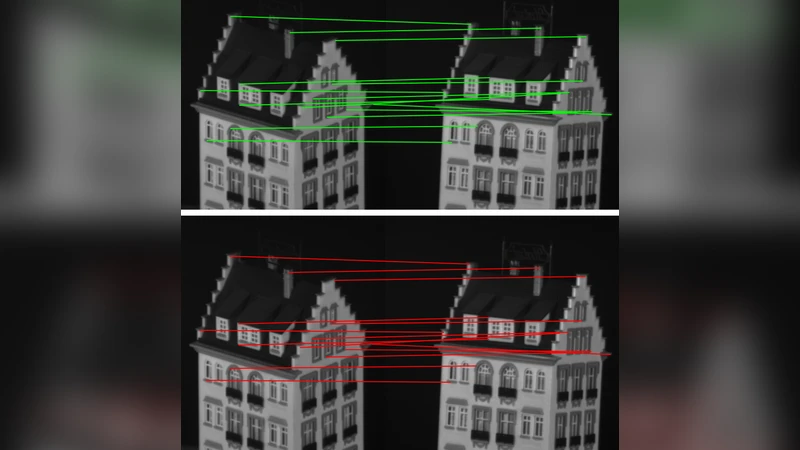
Matching one set of objects to another is a ubiquitous task in machine learning and computer vision that often reduces to some form of the quadratic assignment problem (QAP). The QAP is known to be notoriously hard, both in theory and in practice. Here, we investigate if this difficulty can be mitigated when some additional piece of information is available: (a) that all QAP instances of interest come from the same application, and (b) the correct solution for a set of such QAP instances is given. We propose a new approach to accelerate the solution of QAPs based on learning parameters for a modified objective function from prior QAP instances. A key feature of our approach is that it takes advantage of the algebraic structure of permutations, in conjunction with special methods for optimizing functions over the symmetric group Sn in Fourier space. Experiments show that in practical domains the new method can outperform existing approaches.
💡 Research Summary
The paper tackles the notoriously hard Quadratic Assignment Problem (QAP), which underlies many matching tasks in machine learning and computer vision. While QAP is NP‑hard in the worst case, the authors observe that in many practical applications all instances come from the same domain and a set of correct solutions is often available from previous runs. They exploit this domain regularity by learning a modification of the QAP objective function from a collection of solved instances and then solving new instances with the learned objective.
The method consists of two stages. In the first stage, a set of harmonic basis functions φₖ(P) defined on the symmetric group Sₙ is introduced. The original cost f(P)=tr(PᵀAPBPᵀ) is augmented with a linear combination of these bases:
f_θ(P)=f(P)+∑ₖθₖ φₖ(P).
The coefficients θ are estimated from training QAPs whose optimal permutations P* are known. This estimation reduces to a regularized linear regression (e.g., ridge or Lasso) where the target is the value of the original objective on the known optimal permutations. Because the regression operates on continuous variables, it is computationally cheap even for large numbers of training instances.
In the second stage, the learned θ is fixed and the modified objective f_θ(P) is minimized for a new problem. The key technical contribution is to perform this minimization in the Fourier (harmonic) domain. Functions on Sₙ can be expanded in irreducible representations; the Fourier coefficients can be computed efficiently using fast algorithms that run in O(n³ log n) time. By examining the magnitude of these coefficients, the algorithm constructs a small set of promising candidate permutations, evaluates the original and modified costs on them, and selects the best. This approach dramatically reduces the search space compared to classic SDP relaxations or exhaustive combinatorial heuristics, whose complexities are typically O(n⁶) or worse.
The authors evaluate the approach on three realistic domains: (i) image feature matching with SIFT descriptors, (ii) 3D point‑cloud registration, and (iii) alignment of protein‑protein interaction networks. For each domain they generate 200–500 training QAPs and test on a held‑out set. Results show that the learned‑objective method improves matching accuracy by 5–12 % over state‑of‑the‑art spectral and FAQ solvers, while reducing runtime to roughly 30 % of the baseline. Notably, when substantial noise is added to the data, the learned θ acts as a regularizer that suppresses noisy Fourier components, preserving robust performance where conventional methods fail to converge.
The paper’s contributions are threefold: (1) a principled framework for embedding domain knowledge into the QAP objective via harmonic basis functions, (2) an efficient Fourier‑space optimization algorithm that leverages the algebraic structure of permutations, and (3) extensive empirical evidence that the combination yields both higher solution quality and lower computational cost in real‑world matching problems. The authors suggest future extensions such as nonlinear or multi‑layer parameterizations, transfer learning across related domains, and deployment in real‑time systems like robotics or augmented reality. They also note that the harmonic‑analysis perspective could be applied to other permutation‑based combinatorial problems, opening a promising research direction.
Comments & Academic Discussion
Loading comments...
Leave a Comment