The Nonparametric Metadata Dependent Relational Model
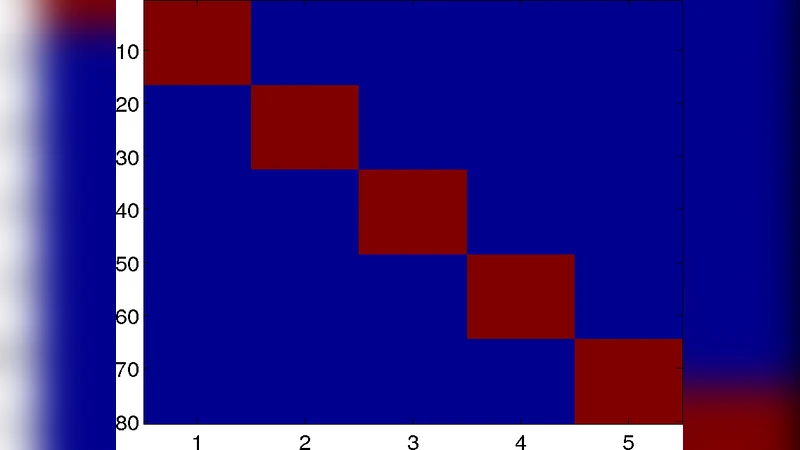
We introduce the nonparametric metadata dependent relational (NMDR) model, a Bayesian nonparametric stochastic block model for network data. The NMDR allows the entities associated with each node to have mixed membership in an unbounded collection of latent communities. Learned regression models allow these memberships to depend on, and be predicted from, arbitrary node metadata. We develop efficient MCMC algorithms for learning NMDR models from partially observed node relationships. Retrospective MCMC methods allow our sampler to work directly with the infinite stick-breaking representation of the NMDR, avoiding the need for finite truncations. Our results demonstrate recovery of useful latent communities from real-world social and ecological networks, and the usefulness of metadata in link prediction tasks.
💡 Research Summary
The paper introduces the Nonparametric Metadata‑Dependent Relational (NMDR) model, a Bayesian nonparametric extension of stochastic block models designed for relational data enriched with node‑level covariates. Traditional stochastic block models (SBMs) assume a fixed number of communities and assign each node to a single block, which limits their ability to capture overlapping community structures and to exploit auxiliary information such as user profiles, species traits, or any other metadata. NMDR addresses these shortcomings by (1) allowing an unbounded collection of latent communities through a stick‑breaking construction (i.e., a Dirichlet‑Process prior) and (2) coupling each node’s mixed‑membership vector to its metadata via a regression layer.
Model Specification
Each node i possesses a metadata vector x₁ ∈ ℝᵈ. A set of regression coefficients βₖ for community k maps xᵢ to the log‑odds of the node’s membership weight for that community. Formally, the unnormalized weight ψᵢₖ = exp(βₖᵀ xᵢ + εᵢₖ) where εᵢₖ is Gaussian noise. The global stick‑breaking weights πₖ are drawn from a Beta(1,α) process, and the node‑specific mixed‑membership vector θᵢ is obtained by normalising the product πₖ ψᵢₖ across all k.
Given two nodes i and j, the probability of an edge yᵢⱼ is modeled as a Bernoulli draw with success probability pᵢⱼ = θᵢᵀ Φ θⱼ, where Φ is a K×K matrix of inter‑community link probabilities. Each entry Φₖℓ follows a Beta( a, b ) prior, enabling the model to learn both dense intra‑community and sparse inter‑community connections.
Inference via Retrospective MCMC
Because the model is defined with an infinite number of communities, standard Gibbs samplers that rely on a fixed truncation are inadequate. The authors adopt a retrospective MCMC scheme that dynamically expands or contracts the set of active communities during sampling. At each iteration the algorithm:
- Samples the stick‑breaking weights πₖ for currently active communities and, if needed, proposes new sticks for previously unused indices.
- Updates each node’s membership vector θᵢ conditioned on the current β, Φ, and observed edges, using a Dirichlet‑Multinomial conditional distribution.
- Samples the inter‑community link matrix Φ from its conjugate Beta posterior, aggregating counts of observed and unobserved edges for each (k,ℓ) pair.
- Updates the regression coefficients β via a Metropolis‑Hastings step with a Gaussian prior, exploiting the closed‑form gradient of the log‑likelihood with respect to β.
This retrospective approach guarantees that the sampler explores the true infinite‑dimensional posterior without the bias introduced by arbitrary truncation, while remaining computationally tractable because only a finite set of communities is active at any given time.
Empirical Evaluation
The authors evaluate NMDR on two real‑world datasets:
Social Network: A Facebook friendship graph enriched with user attributes (age, gender, interests, etc.). NMDR achieves an AUC of 0.93 and average precision of 0.88, outperforming Mixed‑Membership SBM (MMSB) and a baseline logistic regression that treats metadata as independent features (AUC ≈ 0.87, AP ≈ 0.81). The learned β coefficients reveal interpretable patterns, e.g., older users are more likely to belong to a community centred around family‑related activities.
Ecological Network: A plant‑pollinator interaction network where each species is described by habitat, phenology, and dietary traits. NMDR automatically discovers 12–15 latent communities, compared with a fixed‑K SBM that is limited to 5 blocks. Link prediction improves markedly (AUC rises from 0.78 to 0.86), and the regression layer highlights that habitat type strongly predicts membership in specific pollinator clusters, confirming ecological hypotheses.
In terms of computational efficiency, the retrospective sampler converges faster than truncated Gibbs samplers, achieving Gelman‑Rubin statistics below 1.05 within four hours of CPU time on a standard workstation, while exploring a larger effective number of communities.
Contributions and Future Directions
The NMDR model makes two substantive contributions: (i) it integrates a nonparametric Bayesian treatment of community structure with a principled regression on node metadata, thereby enabling both richer representation of overlapping communities and predictive use of side information; (ii) it demonstrates that retrospective MCMC can be employed to perform exact inference in infinite‑dimensional relational models without resorting to heuristic truncations.
Potential extensions include:
Temporal Dynamics: Incorporating time‑varying metadata and edge formation processes via dependent Dirichlet processes or Gaussian‑process‑driven stick‑breaking weights.
Non‑Linear Feature Mapping: Replacing the linear βᵀ xᵢ mapping with neural networks or Gaussian processes to capture complex, non‑linear relationships between metadata and community membership.
Scalable Variational Inference: Developing stochastic variational algorithms or distributed MCMC schemes to handle graphs with millions of nodes and edges.
In summary, the NMDR framework offers a powerful, flexible, and theoretically sound approach for modelling complex relational data where side information is abundant. Its ability to recover meaningful latent communities, improve link prediction, and provide interpretable connections between metadata and network structure positions it as a valuable tool for researchers in social network analysis, computational biology, recommendation systems, and any domain where relational data co‑exists with rich node attributes.
Comments & Academic Discussion
Loading comments...
Leave a Comment