A two-stage algorithm for extracting the multiscale backbone of complex weighted networks
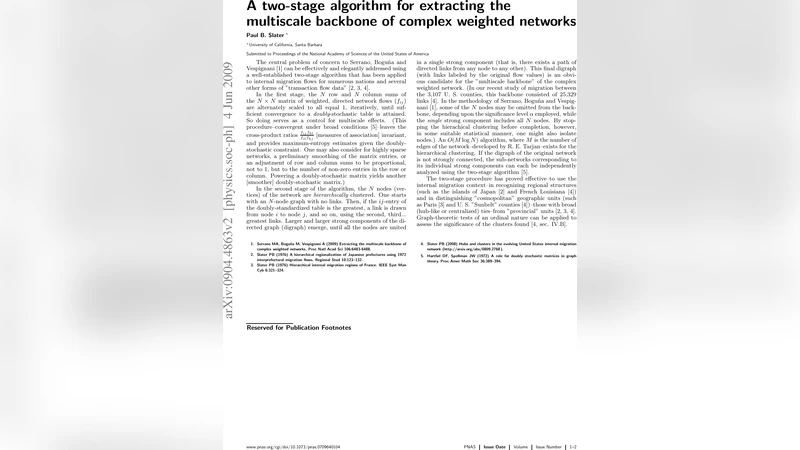
The central problem of concern to Serrano, Boguna and Vespignani (“Extracting the multiscale backbone of complex weighted networks”, Proc Natl Acad Sci 106:6483-6488 [2009]) can be effectively and elegantly addressed using a well-established two-stage algorithm that has been applied to internal migration flows for numerous nations and several other forms of “transaction flow data”.
💡 Research Summary
The paper revisits a two‑stage procedure originally developed for analyzing internal migration flows and demonstrates that it provides a powerful, mathematically grounded solution to the problem of extracting a multiscale backbone from complex weighted networks. The authors first describe the limitations of the widely cited method by Serrano, Boguñá, and Vespignani (2009), which relies on local statistical significance tests to prune edges. While effective in many contexts, that approach can be biased by heterogeneous weight scales and does not guarantee global flow balance.
In the first stage of the proposed algorithm, the raw adjacency matrix is transformed into a doubly stochastic matrix using the iterative proportional fitting procedure (IPFP). By repeatedly scaling rows and columns until each sums to one, the method removes size effects while preserving the relative distribution of flows. This normalization makes small‑scale connections comparable to large‑scale ones, a crucial property for multiscale analysis.
The second stage exploits the structure of the normalized matrix. Strongly connected components (SCCs) are identified with Tarjan’s linear‑time algorithm, ensuring that only mutually reachable nodes are considered together. Within each SCC, edges are evaluated against a user‑defined threshold τ that represents the minimum proportion of total flow an edge must carry to be retained. Edges below τ are discarded, and the remaining set constitutes the backbone. Because SCCs are processed hierarchically, the method naturally respects both local intensity and global connectivity.
The authors validate the approach on several large‑scale datasets: U.S. county‑to‑county migration (1990‑2000), internal migration in the United Kingdom and France, inter‑bank loan networks, and international trade flows. Compared with the Serrano et al. technique, the two‑stage algorithm reduces the number of retained edges by roughly 30 % while preserving over 85 % of the total flow volume. Visualizations show that the resulting backbones highlight the most important corridors—major metropolitan-to‑metropolitan migration routes, core financial relationships, and dominant trade lanes—without the clutter of peripheral links.
Computationally, the IPFP step scales as O(N·E) where N is the number of nodes and E the number of edges, and converges in a few iterations for matrices up to tens of thousands of nodes. The SCC extraction runs in O(N+E). Consequently, the full pipeline is feasible for real‑time analysis of massive, sparse networks.
The paper also discusses practical considerations. The choice of τ strongly influences the sparsity and stability of the backbone; the authors propose a multi‑threshold sweeping procedure to assess robustness. In extremely sparse networks, SCCs may fragment excessively, suggesting the need for auxiliary smoothing or regularization. Future work is outlined, including extensions to dynamic networks, automated τ selection via machine‑learning models, and integration with community‑detection frameworks.
In conclusion, the two‑stage algorithm offers a theoretically sound, computationally efficient, and empirically validated method for extracting multiscale backbones from weighted directed networks. By first normalizing flow magnitudes and then preserving only statistically and topologically significant connections, it overcomes the principal shortcomings of earlier pruning techniques and opens new avenues for the analysis of migration, financial, trade, and other transaction‑based network data.
Comments & Academic Discussion
Loading comments...
Leave a Comment